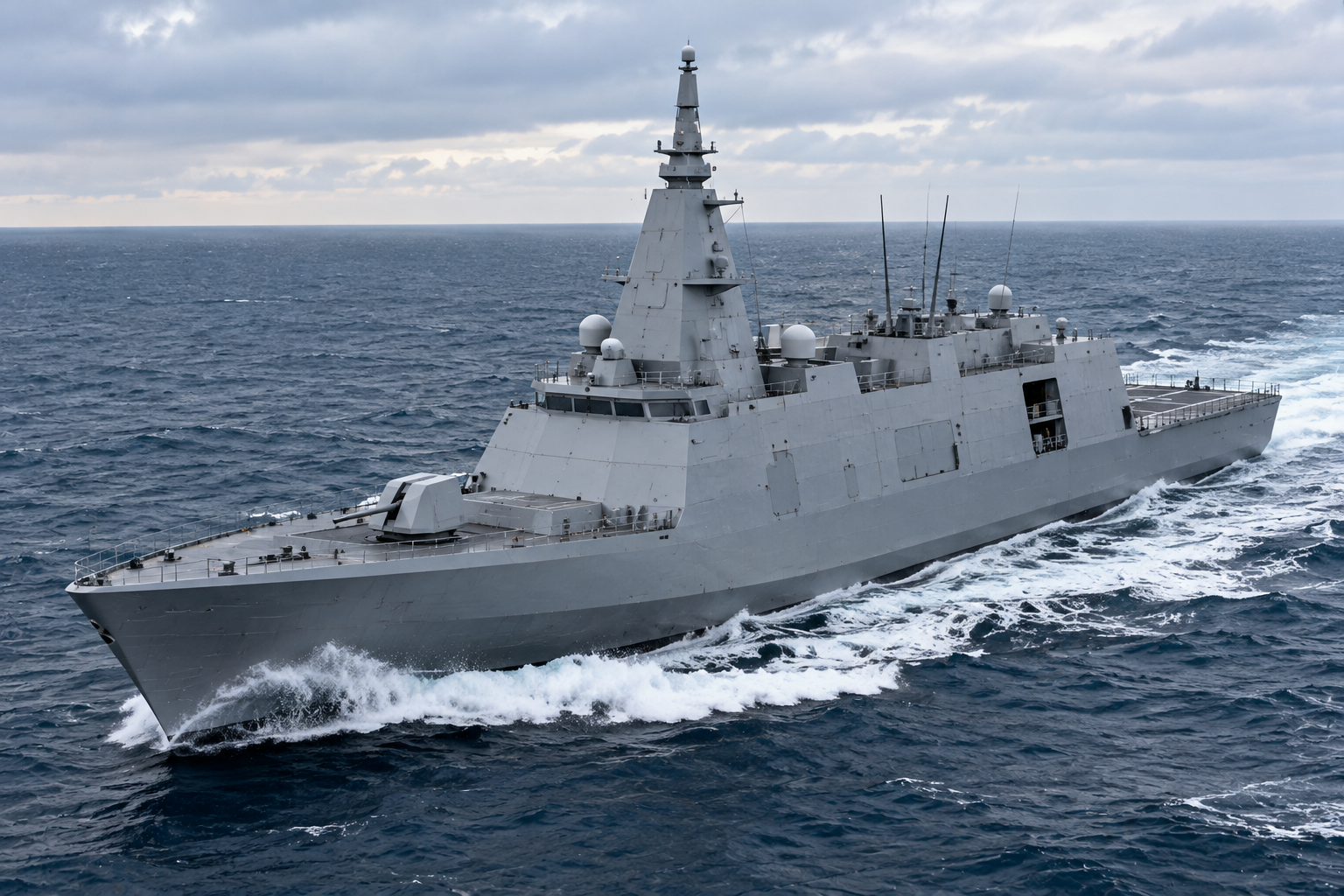
The U.S. Navy is exploring an unusual option to expand its surface fleet: consider modern foreign-designed frigates instead of relying exclusively on ships developed and built in the United States. Among the designs reported under consideration is Japan’s upgraded Mogami-class frigate, a 142-meter warship developed by Mitsubishi Heavy Industries (MHI).
The proposal reflects a growing challenge in American naval procurement. The Navy needs additional ships, but constructing them quickly requires more than selecting a design. Shipyard capacity, skilled workers, supply chains, technology integration, and production schedules all matter.
1. What Is the Upgraded Mogami?
The upgraded Mogami, sometimes called the New FFM or 06FFM, is an enlarged, more heavily equipped development of Japan’s existing Mogami-class multirole frigate.
The original Japanese Mogami measures 133 meters and has a standard displacement of approximately 3,900 tonnes. The upgraded design is larger, with a published standard displacement of 4,800 tonnes and a length of 142 meters.
According to the Royal Australian Navy’s published specifications, the upgraded design has a beam of 17 meters, a maximum speed of more than 30 knots, and a crew of approximately 92. Australian contract documents identify the upgraded Mogami as the foundation for that country’s future general-purpose frigate fleet.
These figures describe the upgraded design selected for Australia. They should not automatically be treated as final specifications for a possible U.S. Navy version, which could require additional changes.
2. Propulsion and Engineering
The upgraded Mogami uses a combined diesel and gas (CODAG) propulsion arrangement, pairing diesel engines with a gas turbine to provide propulsion across different operating conditions.
This configuration supports a balance between economical cruising and higher-speed operation. The ship’s published speed of more than 30 knots gives it the ability to keep pace with other naval formations, although actual performance depends on operating conditions and the final configuration.
The design also emphasizes automation. A crew of approximately 92 is relatively small for a modern warship of this size, potentially reducing long-term personnel requirements and operating costs.
However, fewer crew members do not eliminate the need for maintenance specialists, technical training, and support infrastructure. Automation can reduce routine workload, but it also increases the importance of dependable onboard systems and an effective maintenance network.
3. Weapons and Sensors
The upgraded Mogami is intended to perform several missions rather than specialize in a single type of naval warfare.
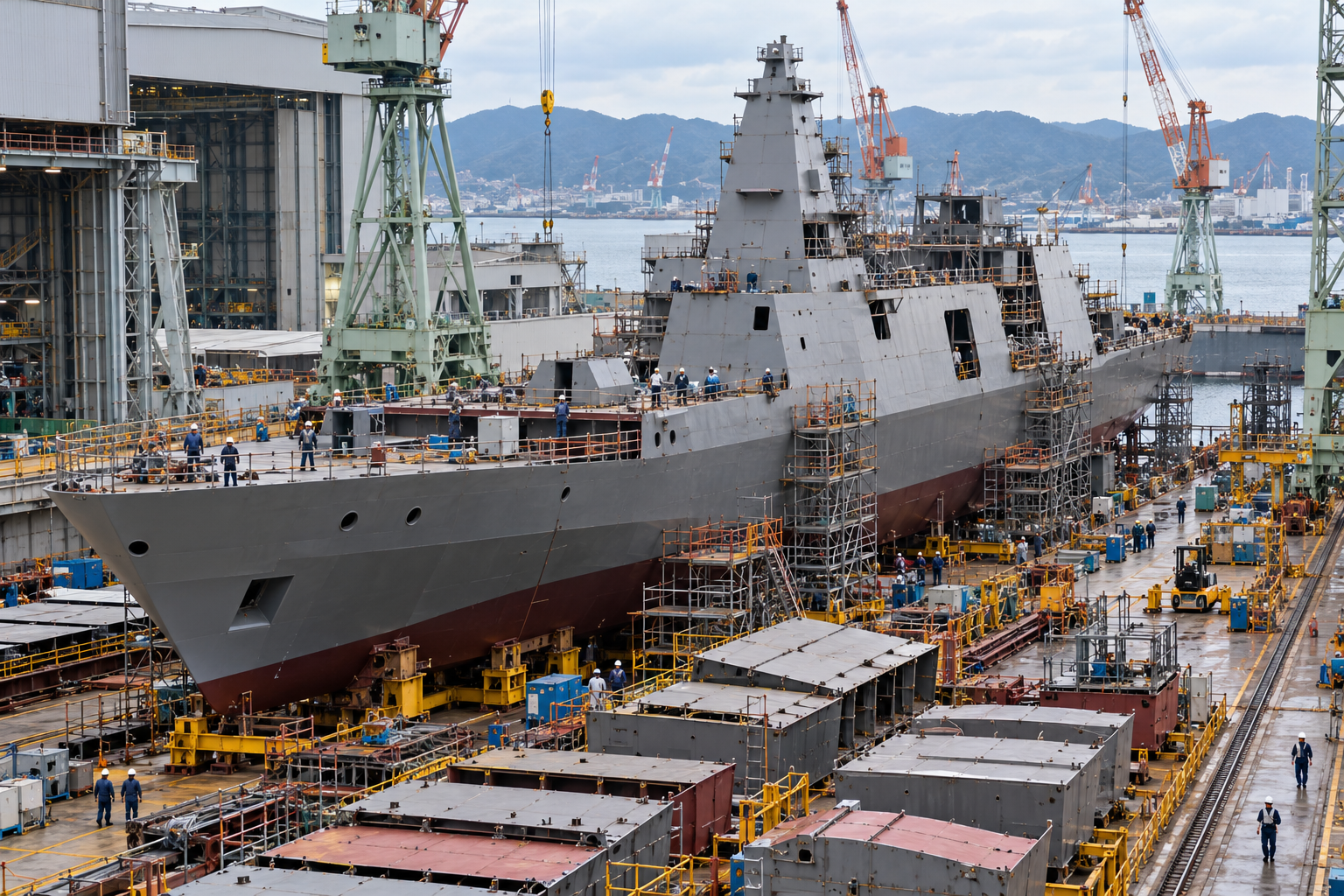
Its published Australian configuration includes a 32-cell vertical launch system (VLS), surface-to-air missiles, anti-ship missiles, a 5-inch main gun, and a SeaRAM short-range defensive system.
A VLS allows compatible missiles to be carried in cells integrated into the ship, rather than relying exclusively on exposed deck-mounted launchers. The particular missiles available depend on the final combat-system configuration and the customer’s requirements.
For submarine detection, the design includes a towed-array sonar system. The ship also incorporates an active electronically scanned array (AESA) radar, electronic countermeasures, and tactical data-link capabilities.
These systems work together to build a picture of activity around the ship, support engagement decisions, and exchange information with other platforms. The exact radar models, missile types, software integration, and weapons-control arrangements available to a future U.S. variant have not been publicly confirmed.
The aircraft facilities are designed to support a maritime helicopter, with Australia identifying the MH-60R Seahawk for its general-purpose frigate program.
4. Why the U.S. Navy Is Interested
On September 1, 2026, USNI News reported that the upgraded Mogami, South Korea’s Chungnam class, and Türkiye’s Istanbul class were among the foreign designs being considered in a U.S. Navy study.
The goal is to expand shipbuilding capacity and potentially deliver frigates sooner. Smaller combatants could take on escort duties and other missions in less-contested waters, allowing larger Arleigh Burke-class destroyers to focus on higher-end operations.
The foreign-design review is running alongside work on the Navy’s proposed FF(X) patrol frigate. As reported on September 27, the Navy had not yet publicly settled on whether it would pursue a domestic design, a foreign design, or more than one path.
5. Why Japan Might Hesitate
For Mitsubishi Heavy Industries, a U.S. deal could create a major export opportunity—but also a substantial industrial burden.
Under the reported “Finland model,” the first two ships might be constructed overseas before production shifts to American shipyards. This could mean that Japan receives relatively limited direct shipbuilding work while being expected to invest in U.S. facilities, workforce development, and industrial infrastructure.
Japan also has commitments at home and in Australia. In April 2026, MHI signed a contract for three upgraded Mogami frigates for Australia, with the first scheduled for delivery by December 2029. By September, Australia’s defense industry minister said production of long-lead items for the first Australian ship had begun.
Japanese industry analysts have therefore highlighted competing demands for labor, capital, engineering resources, and shipyard capacity. The uncertainty over U.S. production requirements adds another risk.
6. What Happens Next?
The U.S. Navy’s reported study is due to reach the White House by November 12, 2026. The final outcome also depends on U.S. law and congressional debate over whether American warships can be built overseas under the proposed approach.
Japan’s Defense Ministry did not confirm the Mogami’s selection on September 4; it declined to comment on individual reports. There is no publicly confirmed U.S. order for the frigate.
The upgraded Mogami offers an attractive combination of range, sensors, multirole weapons, and automation. But winning the competition would require much more than proving the ship can perform at sea. Japan and the United States would have to agree on industrial investment, technology integration, production responsibility, and a realistic delivery schedule.
The central question is not just whether the U.S. Navy wants the Mogami design. It is whether both countries can build the industrial partnership needed to deliver it.