By World News Desk | October 6, 2026 | Politics & World News
WASHINGTON — A disputed gunfire incident along the U.S.-Mexico border has triggered a rapid military buildup on both sides of the Rio Grande, with Washington saying U.S. Coast Guard personnel came under fire from Mexico and Mexico demanding evidence that shots actually originated from its territory.
The confrontation happened on September 26 near Garceno, Texas, in Starr County, while Coast Guard personnel were conducting joint interdiction operations with other federal agencies. According to the Coast Guard, gunfire came from the Mexican side of the river, and its personnel returned fire. No Coast Guard personnel or partner agencies were injured, and no Coast Guard equipment was damaged. The incident remains under investigation. Stars and Stripes
The dispute has now become a diplomatic and security issue involving hundreds of troops, military aircraft, drones and other equipment.
Mexico Wants to See the Evidence
Mexican President Claudia Sheinbaum said Monday that her government has asked Washington for all available evidence supporting the claim that shots were fired from Mexican territory toward U.S. personnel.
“We asked for all the evidence because we have no evidence,” Sheinbaum said at her daily news conference, according to Reuters.
She said Mexico’s National Guard, Army and Navy had not detected an incident in which gunfire crossed the border from Mexico into the United States.
That does not disprove the U.S. account, but it underscores how much remains unresolved about the confrontation, including who fired the shots and exactly where the gunfire originated. Reuters
The identity of the people who allegedly opened fire has also not been publicly established.
Hundreds of U.S. Troops Move Into the Region
The shooting occurred against the backdrop of an already significant American military presence along the southern border.
U.S. Northern Command said it had repositioned hundreds of troops and equipment to the Rio Grande Valley. Military officials described the September 26 incident as an example of what they consider increased illegal activity in the region. Stars and Stripes
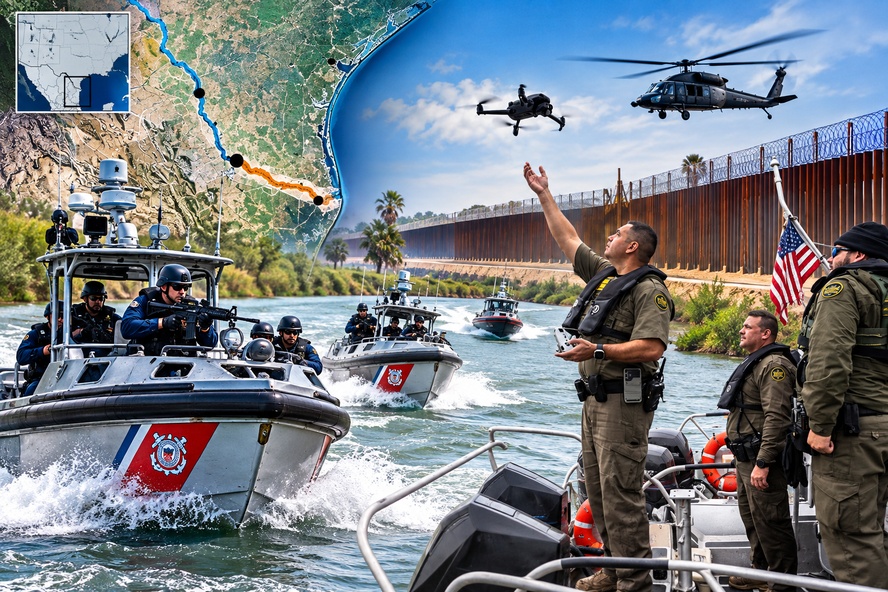
The Coast Guard has been conducting river operations under Operation River Wall, a mission launched in 2025 to expand patrols along the Rio Grande and support other federal agencies working on border security. Stars and Stripes
The newest deployment adds another layer to an operation that already involves the Coast Guard, Border Patrol, the Defense Department and Texas authorities.
For Americans living in the Rio Grande Valley, the result could mean more military patrols, aircraft and surveillance activity along an increasingly busy stretch of the border.
Mexico Deploys 500 Troops
Mexico has responded with its own reinforcement.
The Mexican government announced the deployment of 500 Army and National Guard personnel to Tamaulipas, along with helicopters, drones and anti-drone equipment. The operation is part of a coordinated effort intended to strengthen security on the Mexican side and reduce the chances of another cross-border incident. The Washington Post
U.S. Ambassador to Mexico Ronald Johnson said the U.S. Embassy was helping coordinate with Mexican forces in the area where the alleged shooting occurred.
Johnson said Mexican military commanders would communicate directly with U.S. forces and that both countries intended to patrol their respective sides of the border.
That coordination could be crucial.
When heavily armed forces operate in close proximity along a river that serves as an international boundary, even a misunderstanding can quickly become a much larger problem.
Why the Rio Grande Is So Sensitive
The area around Starr County sits along one of the busiest and most closely monitored sections of the U.S.-Mexico border.
The Rio Grande is not simply a geographic dividing line. It is also a major route for migration, drug trafficking and other illicit activity, making it a focus of intensive law-enforcement operations.
Coast Guard personnel have increasingly taken part in river patrols, working alongside Border Patrol and other agencies. U.S. military units are also supporting border operations under narrowly defined authorities. Army
Mexico, meanwhile, has its own extensive security presence along the opposite bank.
That means both countries are operating military and law-enforcement assets in an environment where criminal groups are also active.
A Diplomatic Test for Washington and Mexico City
The immediate challenge is to establish what actually happened on September 26.
The U.S. says its Coast Guard personnel came under fire and returned fire. Mexico says its forces found no evidence that shots were fired from Mexican territory and wants Washington to provide proof.
Until investigators determine the origin of the gunfire, the incident remains disputed.
The two governments have nevertheless begun increasing coordination rather than allowing the disagreement to escalate unchecked. Mexico’s “mirror operations” approach is intended to place forces on both sides of the frontier while maintaining communication between commanders. Reuters
That could reduce the chances of another confrontation—but it also demonstrates how quickly a single border incident can produce a major security response.
What Happens Next?
The investigation will be closely watched in both countries.
U.S. authorities will need to establish where the incoming rounds originated and who was responsible. Mexican authorities will likely continue pressing Washington for evidence while trying to prevent criminal activity from spilling across the boundary.
For President Donald Trump and the Mexican government, the episode is another test of how far border-security cooperation can go without creating new tensions.
The Bottom Line
A September 26 exchange of gunfire near Garceno, Texas, has sparked a significant security response on both sides of the U.S.-Mexico border.
Washington says Coast Guard personnel were fired upon from Mexico and returned fire. Mexico says it has found no evidence of gunfire coming from its territory and is demanding the evidence.
Meanwhile, hundreds of U.S. troops have been repositioned to the Rio Grande Valley, while Mexico has sent about 500 Army and National Guard personnel to Tamaulipas.
The biggest question now is not simply what happened—but whether the two governments can establish the facts and prevent the next border incident from becoming something far more dangerous.