By World News Desk | October 7, 2026 | Politics & World News
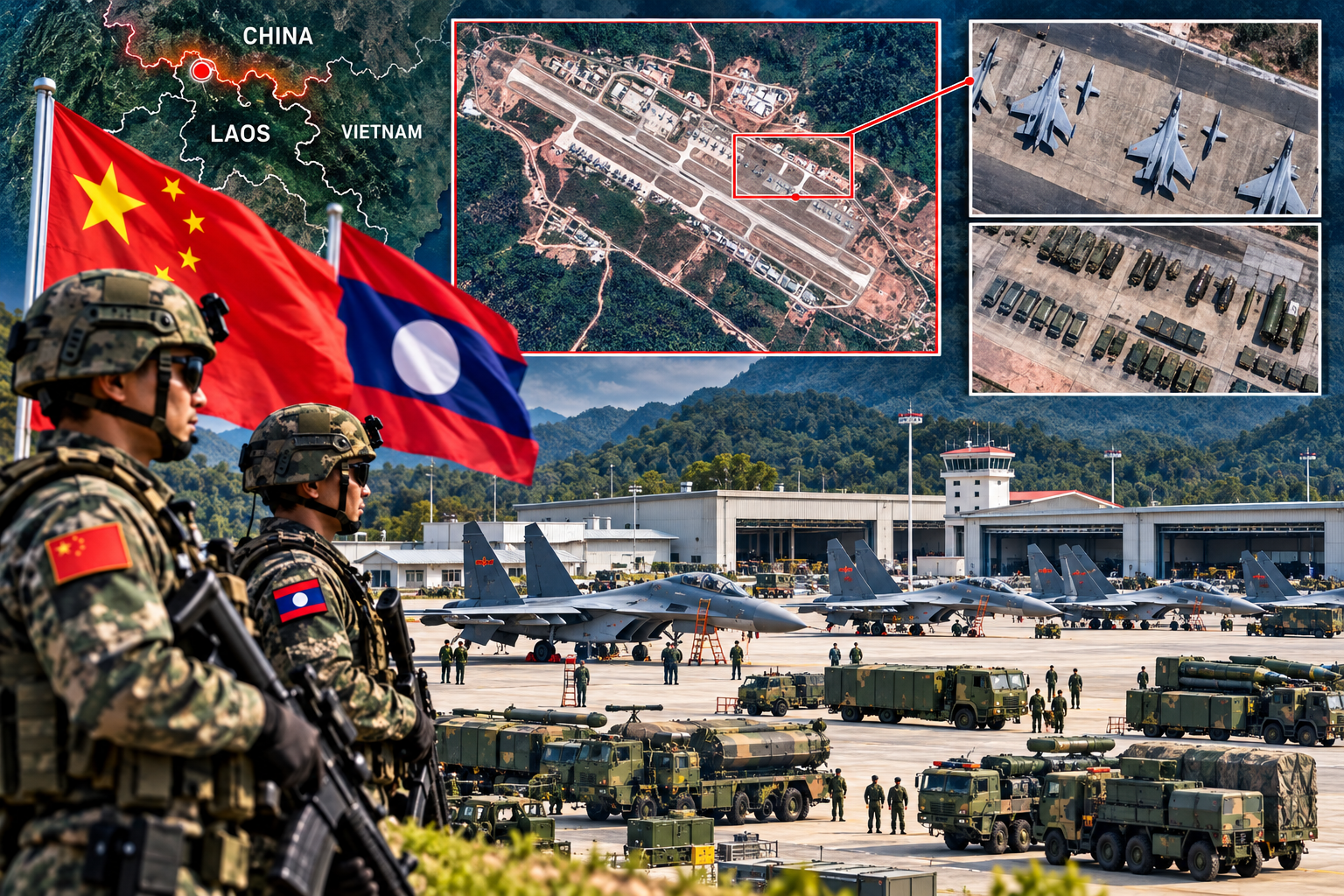
VIENTIANE, Laos — China’s expanding military footprint in Southeast Asia is drawing new attention after commercial satellite images showed light attack aircraft and military vehicles at a newly opened joint training facility in Laos.
Images reviewed by Reuters and captured on September 30 show what security analysts believe are eight K-8 light attack jets and more than two dozen support vehicles at the facility in Ban Keun, about 50 kilometers north of the Lao capital, Vientiane. The runway remains under construction, suggesting the site is still being expanded even as aircraft and vehicles have already arrived. Reuters
The development is significant because Beijing officially announced the opening of the China-Laos Joint Support and Training Center and the China-Laos Friendship Aviation Academy only one day earlier, on September 29. China says the facilities are designed to help Laos train air-force pilots and are jointly operated by the two countries. China National Defense Ministry
But military analysts say the site could eventually have a broader role.
China Calls It a Training Center
China’s Ministry of National Defense has been careful about how it describes the new facility.
According to Beijing, the center was established through consultation with Laos and is intended to strengthen bilateral military cooperation. Chinese officials have also emphasized that it is not directed against any third country and is intended to contribute to regional peace and stability. China National Defense Ministry
That description differs from the way some outside analysts view the strategic significance of the site.
The facility combines an aviation academy with a support and training center, potentially giving the Chinese military persistent access to an airfield in mainland Southeast Asia. Rachel Vandenbrink, a senior analyst at the Australian Strategic Policy Institute, told Reuters that the arrangement could provide a logistics hub supporting forces rotating through Laos, possibly including a small forward support element. Reuters
The Aircraft Raise New Questions
The satellite images appear to show Hongdu JL-8 aircraft, also known as K-8s.
The aircraft are used extensively for training but also have light-attack capabilities. Both China and Laos operate the type. According to the International Institute for Strategic Studies, Laos has four of the aircraft in its inventory, meaning the eight jets seen in the new imagery could potentially include aircraft associated with both countries. Reuters
Security analysts say the aircraft themselves do not prove the facility is functioning as a full Chinese combat base.
Instead, the more important clues may emerge as construction continues.
Analysts are watching for signs of air-defense systems, ammunition storage, fuel infrastructure and surveillance facilities. Those features would provide stronger evidence that the site is evolving beyond its stated training mission. Internazionale
Could the Airfield Grow Into Something Bigger?
One expert told Reuters that the runway appears relatively short and modest in its current form but may have been engineered to allow an extension.
Alexander Neill, an adjunct fellow at the Pacific Forum, said a future expansion could allow larger aircraft, including signals-intelligence and electronic-surveillance platforms, to operate from the location.
That possibility is attracting attention because larger surveillance aircraft could extend China’s ability to monitor activity across mainland Southeast Asia.
It is important to stress that no such deployment has been confirmed. The runway’s potential future capabilities are an assessment by analysts based on satellite imagery, not evidence that China has already decided to station larger aircraft there. Internazionale
Why Laos Matters to Beijing
At first glance, Laos may seem like an unlikely location for a major Chinese military facility.
But geographically, the country provides China with an accessible foothold in mainland Southeast Asia. Laos shares a border with China and is connected to its northern neighbor through major infrastructure projects, including the China-Laos railway.
Vandenbrink described the Ban Keun location as having geostrategic value despite the lack of an obvious immediate operational requirement. Reuters
For Beijing, a persistent military presence in Laos could therefore complement its broader efforts to develop access and influence across the region.
China already operates a logistics facility in Djibouti and has a joint support and training center at Cambodia’s Ream naval base. The Laos facility would add another overseas military foothold if its role develops beyond training. Internazionale
An Old American Airfield Gets a New Role
Perhaps the most striking historical detail is the location itself.
During the Vietnam War, Ban Keun was known as Lima Site 44, an airfield used by Air America, the airline secretly owned by the CIA.
Records cited by Reuters indicate that Air America used the site to support U.S.-backed Hmong forces and transport supplies during the conflict in Laos.
More than half a century later, the same location is becoming part of China’s expanding military relationship with Laos. Internazionale
What Washington Should Watch
For the United States, the development matters because Southeast Asia sits at the center of an increasingly competitive strategic environment involving China, the United States and regional powers.
A Chinese facility capable of supporting aircraft, logistics or surveillance operations could eventually strengthen Beijing’s ability to operate farther from its own territory.
But analysts caution against jumping from satellite images of aircraft and vehicles to the conclusion that China has established a fully operational overseas combat base.
Right now, the confirmed facts are more limited: the joint facility is operational, aircraft and military vehicles are present, and construction is continuing.
What the site ultimately becomes remains an open question.
The Bottom Line
Satellite imagery has provided the clearest look yet at the new China-Laos military facility near Vientiane, showing K-8 light attack aircraft and dozens of support vehicles only days after the center officially opened.
Beijing says the complex is for joint training and cooperation with Laos. Outside analysts say its location and continuing construction could eventually give China a more durable military foothold in mainland Southeast Asia.
For Washington and its regional partners, the key issue will be what appears at Ban Keun next—and whether today’s training center becomes tomorrow’s strategic military hub.