By World News Desk | October 7, 2026 | Politics & World News
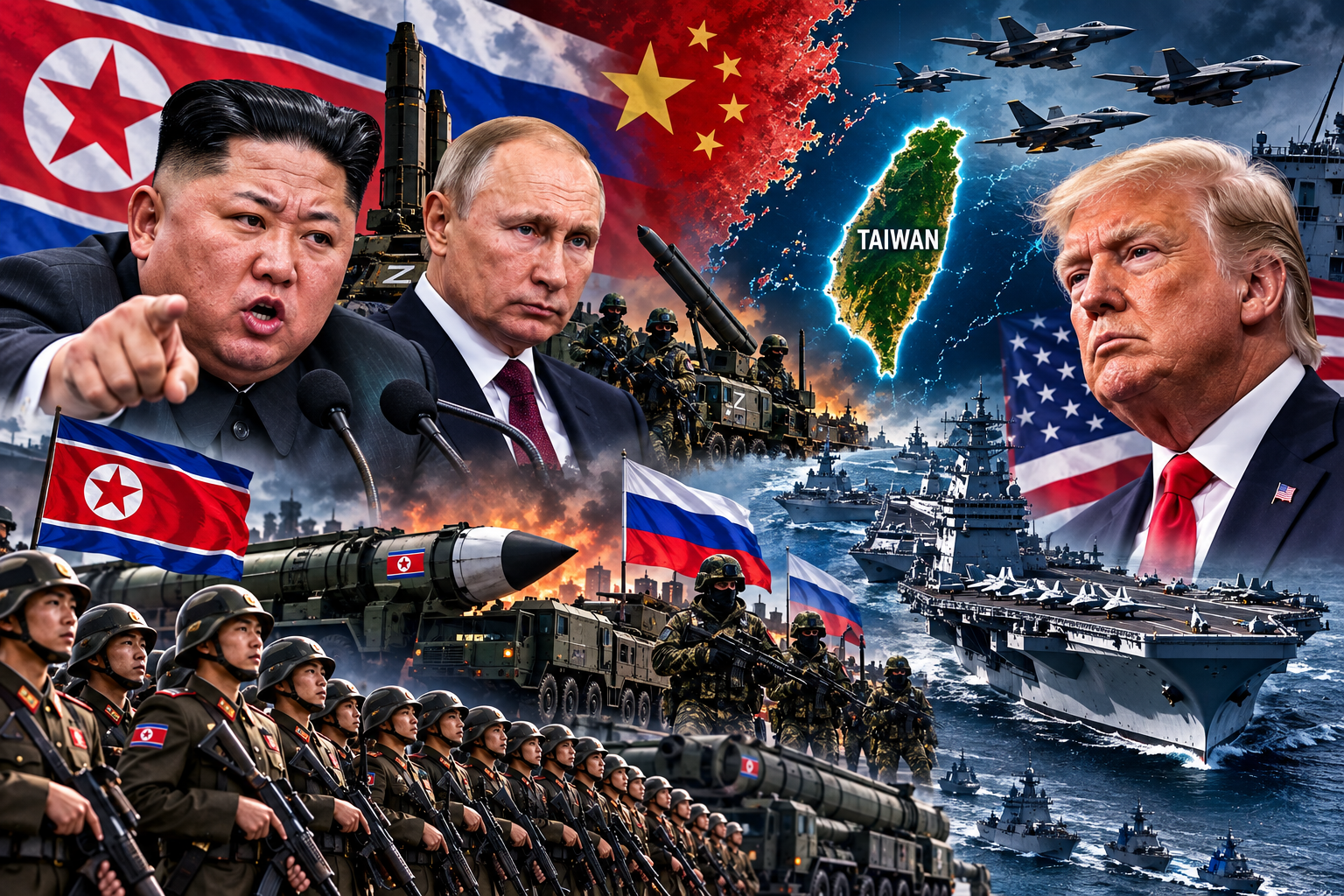
SEOUL — North Korea has issued a sharp warning to the United States over its military support for Taiwan while leader Kim Jong Un simultaneously reaffirmed Pyongyang’s support for Russia, putting two of Washington’s most sensitive geopolitical relationships at the center of a single message.
The warning came through North Korean state media on Wednesday, October 7, after Taiwan received the first two of 66 U.S.-made F-16V Block 70 fighter jets ordered in 2019. A commentary published by KCNA accused Washington of increasing tensions in the Taiwan Strait and warned the United States to think carefully about the consequences of confronting China over Taiwan. Reuters
At nearly the same time, Kim sent Russian President Vladimir Putin a birthday message pledging continued cooperation with Moscow and expressing confidence that Russia’s “sacred war” to defend its sovereignty, security interests and territorial integrity would end in victory.
The messages offer a striking picture of Pyongyang’s foreign policy: closer alignment with China on Taiwan and continued strategic support for Russia as its war with Ukraine enters another phase.
North Korea Issues a Direct Warning Over Taiwan
North Korea’s latest criticism focused on America’s military relationship with Taiwan.
A KCNA commentary attributed to North Korean international affairs analyst Kim Myong Chol said U.S. policy was undermining peace and stability in the Taiwan Strait. It specifically criticized the arrival of the F-16V fighter jets and warned Washington against entering a direct confrontation with China over the island. Reuters
The warning comes as tensions between China and Taiwan remain high.
Beijing claims Taiwan as Chinese territory and has repeatedly opposed U.S. arms sales to the island. Taiwan, meanwhile, has sought to strengthen its military defenses as Chinese military pressure continues.
The arrival of the new F-16Vs is therefore more than a routine weapons delivery. For Taipei, the aircraft represent an upgrade to its air-defense capabilities. For Beijing, U.S. military support for Taiwan remains one of its most sensitive political and security issues. Reuters
North Korea’s intervention adds another voice to Beijing’s opposition.
The F-16 Delivery Comes at a Sensitive Moment
Taiwan received the first two F-16V Block 70 aircraft on October 2. The jets are part of a 66-aircraft order approved in 2019 at a cost of roughly $8 billion.
The delivery had been delayed, including by software-related issues, making the arrival politically significant in Taiwan as officials have questioned the speed and reliability of U.S. weapons deliveries. Taiwan’s President Lai Ching-te welcomed the aircraft as an important development for the island’s air defenses. Reuters
Washington does not maintain formal diplomatic relations with Taipei, but U.S. law requires the United States to provide Taiwan with defensive means.
That longstanding policy has become increasingly important as Chinese military activity around Taiwan grows.
North Korea’s warning does not necessarily signal that Pyongyang would intervene in a Taiwan conflict. It does, however, demonstrate that North Korea is openly framing the Taiwan issue in language closely aligned with Beijing’s position.
Kim Sends Putin a Message of Support
Kim’s message to Putin adds another layer to the geopolitical picture.
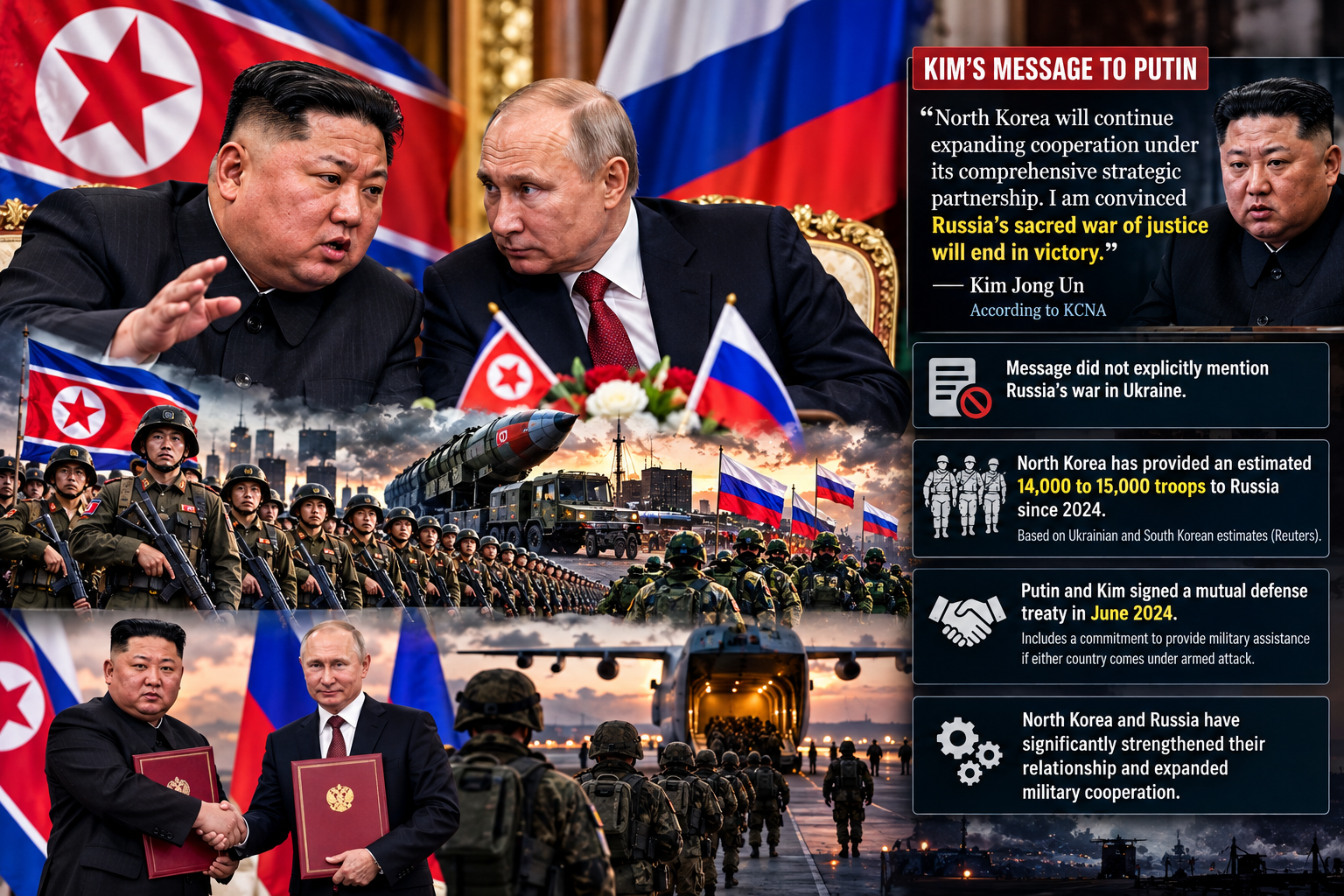
According to KCNA, Kim said North Korea would continue expanding cooperation under its “comprehensive strategic partnership” with Russia. He also said he was convinced Russia’s “sacred war of justice” would end in victory.
The message did not explicitly mention Russia’s war in Ukraine, an important distinction. However, Reuters reported that North Korea has already provided substantial military assistance to Russia, including an estimated 14,000 to 15,000 troops since 2024, based on Ukrainian and South Korean estimates. The Economic Times
North Korea and Russia significantly strengthened their relationship after Putin and Kim signed a mutual defense treaty in June 2024. The pact includes a commitment to provide military assistance if either country comes under armed attack. Reuters
That relationship has developed alongside growing military cooperation between the two governments.
A Three-Way Strategic Problem for Washington
The simultaneous messages about Taiwan and Russia matter because the United States is already managing security challenges in several regions.
In East Asia, Washington is attempting to deter Chinese military action against Taiwan while maintaining its alliances with Japan and South Korea.
In Europe, the United States remains deeply involved in responding to Russia’s invasion of Ukraine.
North Korea has now positioned itself closer to both Moscow and Beijing on issues directly affecting U.S. national-security interests.
That does not create a formal three-country military alliance. China, Russia and North Korea have different interests and do not always agree on strategy.
But the trend is clear: Pyongyang is increasingly willing to publicly support positions that challenge U.S. influence.
North Korea’s Own Military Pressure Is Growing
The latest statements also come as North Korea has stepped up its military activity.
Just days earlier, Pyongyang confirmed a test of an intermediate-range ballistic missile that it said incorporated maneuverable and AI-enhanced capabilities designed to complicate missile defenses in South Korea and Japan. Kim personally supervised that launch, according to North Korean state media. AP News
North Korea has also recently issued warnings toward South Korea following a landmine explosion that injured South Korean soldiers. Pyongyang rejected Seoul’s accusations and threatened what it called “immediate and powerful counteraction” if its territory were violated. Reuters
The result is a regional environment in which several security disputes are unfolding simultaneously.
Why Washington Is Watching Closely
For U.S. policymakers, the biggest concern may not be any single North Korean statement.
It is the combination of North Korea’s increasingly close relationship with Russia, its alignment with China over Taiwan, and its continuing development of nuclear and missile capabilities.
A crisis in Taiwan would already present an enormous challenge for the United States. A simultaneous escalation on the Korean Peninsula would make that challenge substantially more complicated.
There is no evidence that such a scenario is imminent.
But the messages from Pyongyang demonstrate that North Korea is watching the same strategic battlefield as Washington—and is increasingly comfortable taking positions that directly challenge U.S. policy.
The Bottom Line
North Korea has sharply criticized American military support for Taiwan just as the island receives its first new F-16V fighter jets. At the same time, Kim Jong Un has reaffirmed continued strategic cooperation with Russia and expressed confidence in Moscow’s victory.
Neither development proves that North Korea is preparing to enter a new conflict.
But together, they highlight a growing geopolitical reality: Washington is confronting increasingly interconnected security challenges involving North Korea, China, Russia and Taiwan.
For U.S. officials, the question is how to prevent those separate flashpoints from becoming one larger crisis.