By World News Desk | October 7, 2026 | Politics & World News
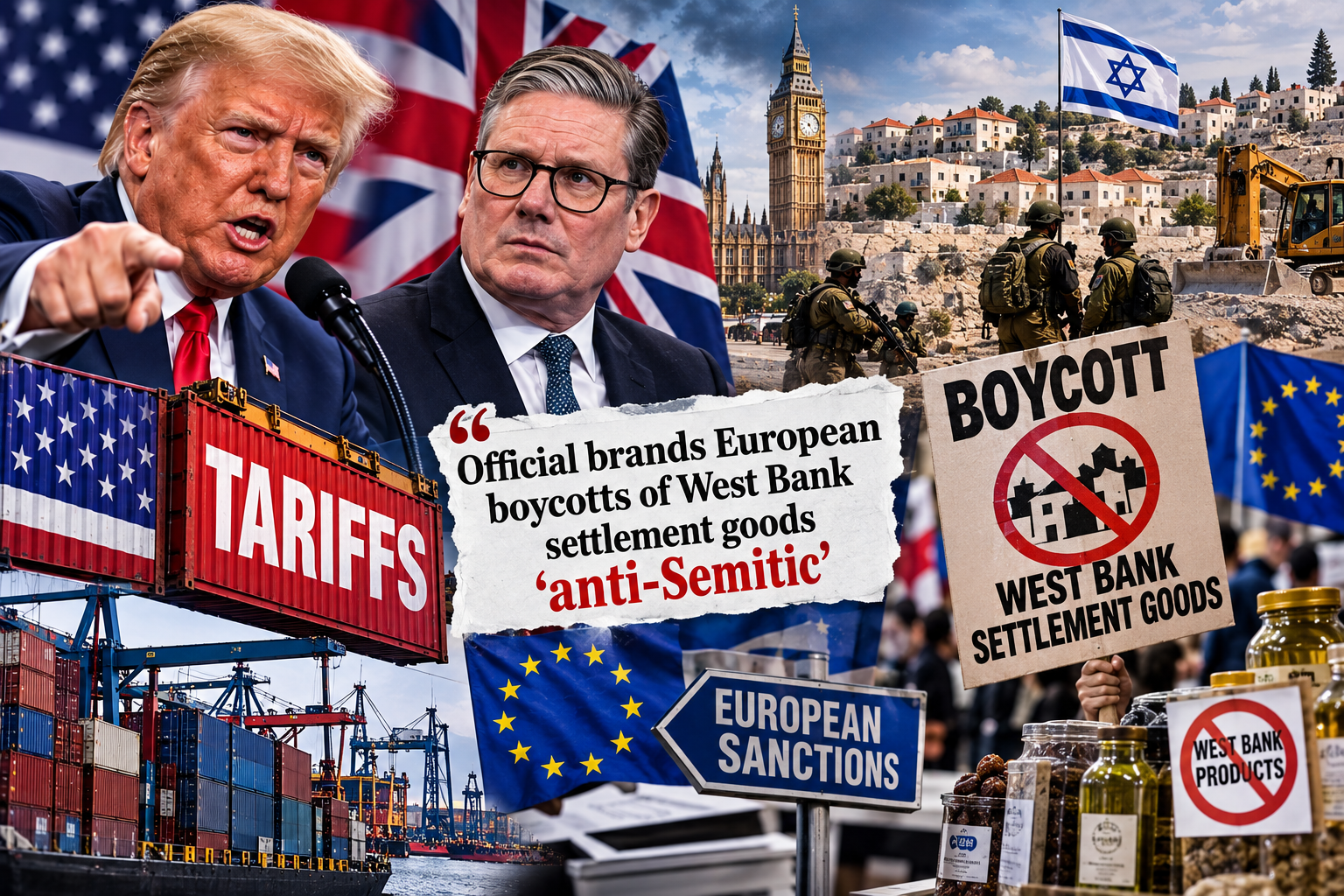
WASHINGTON — A new diplomatic dispute is emerging between Washington and some of its closest European allies after a senior Trump administration official warned that countries imposing boycotts or other restrictions on Israel could face retaliation from the United States.
Harmeet Dhillon, an assistant attorney general in the Justice Department’s Civil Rights Division, said Tuesday, October 6, that countries participating in what the United States calls the Boycott, Divestment and Sanctions movement could risk “retaliatory or corresponding sanctions” while President Donald Trump is in office. She specifically criticized European measures targeting products from Israeli settlements in the occupied West Bank. The Spectator Australia
Her comments represent a sharper U.S. warning than Washington had issued publicly when Britain, France and Canada announced their settlement-related trade measures in September.
But there is an important distinction: Dhillon referred to possible sanctions, not a specific new U.S. tariff already imposed on Britain. She did not provide details about what any retaliation might look like or whether tariffs were formally under consideration. The Spectator Australia
Britain Has Chosen a Different Approach to Israeli Settlements
Britain announced in September that it would introduce an import ban on goods produced in Israeli settlements in the occupied Palestinian territories, along with measures targeting companies and individuals that support or facilitate settlement expansion.
Foreign Secretary Ed Miliband told Parliament on September 8 that the planned sanctions regime would target settlements and settlement expansion rather than Israel as a whole. He explicitly said Britain would continue supporting trade with Israel within its internationally recognized borders and stated that he opposed the broader BDS campaign. GOV.UK
The policy was announced alongside France and Canada, while several other European governments said they intended to introduce or consider similar restrictions. A joint statement signed by 12 countries said their measures were aimed at goods from settlements that they consider illegal under international law. GOV.UK
That distinction is at the heart of the new argument in Washington.
British officials say they are not boycotting Israel as a country. They are targeting economic activity linked specifically to settlements in the West Bank.
Dhillon Calls the Measures Antisemitic
Dhillon used much broader language.
Speaking in Washington, she said the United States views BDS as antisemitic and warned governments participating in the movement that they could face U.S. retaliation.
“I do consider BDS,” she said, “and I think most people in my government consider it to be a form of anti-Semitism.” The Spectator Australia
Her remarks reflect a core priority of the Trump Justice Department, which has made combating antisemitism a major civil-rights and national-security issue. The department has launched investigations and lawsuits involving allegations of antisemitic discrimination at American universities and other institutions. Department of Justice
But critics of the U.S. position are likely to argue that opposing Israeli government policy or settlement activity is not automatically the same as hostility toward Jewish people.
That disagreement could become increasingly important as European governments distinguish between boycotting Israel and restricting trade connected to settlements.
The U.K. Policy Is Not Yet Fully in Force
Britain’s settlement measures are also more limited than the political rhetoric surrounding them might suggest.
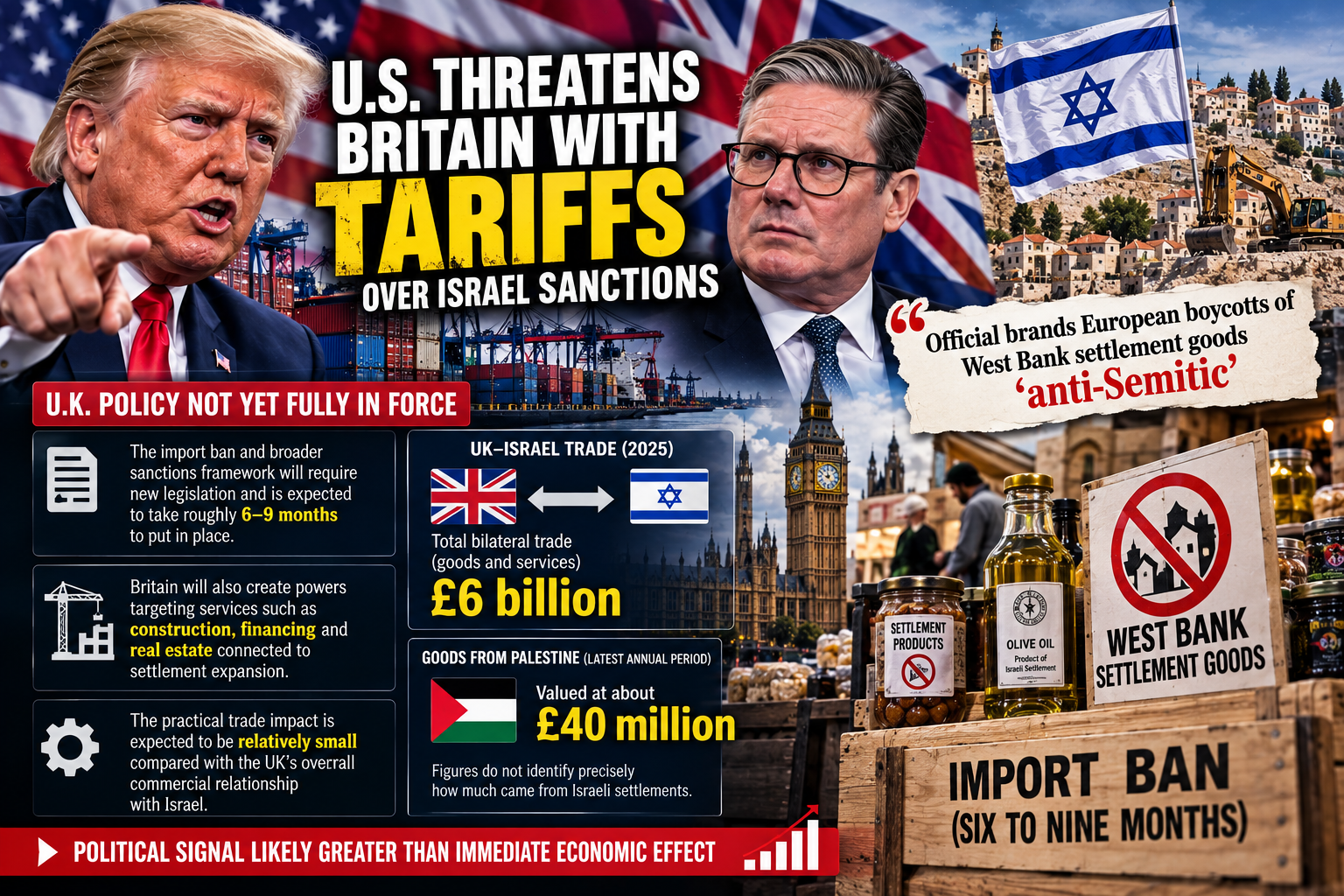
The government said the import ban and broader sanctions framework would require new legislation and would take roughly six to nine months to put in place. Britain said it would also create powers targeting services such as construction, financing and real estate connected to settlement expansion. GOV.UK
The practical trade impact is expected to be relatively small compared with Britain’s overall commercial relationship with Israel.
The UK has a free-trade agreement with Israel, and official figures put total bilateral trade in goods and services at roughly £6 billion in 2025. By contrast, goods recorded as coming from Palestine were valued at about £40 million in the latest annual period, although those figures do not identify precisely how much came from Israeli settlements. Al Jazeera
That means the political signal may be far greater than the immediate economic effect.
Israel Has Already Retaliated
Britain’s decision has already damaged relations with Israel.
Israel ordered Britain to close its consulate in East Jerusalem within 30 days after London announced the settlement trade measures. The dispute has also included restrictions affecting British officials, according to Reuters. Reuters
Britain is now weighing its response, with the possibility of expelling Israeli diplomats if the consulate closure proceeds.
The diplomatic confrontation has therefore expanded beyond trade.
What started as a dispute over settlement policy is now affecting consular services, diplomatic representation and the wider relationship between two long-standing U.S. allies.
Europe Is Moving in a Different Direction
Britain is not acting alone.
France, Canada and a group of European countries have supported or announced plans for restrictions on settlement-linked trade. The European Union has separately been considering options ranging from higher tariffs to partial or full import bans on settlement-produced goods. euronews
The measures reflect growing European concern about settlement expansion and settler violence in the West Bank.
The British government says its policy is intended to protect the possibility of a two-state solution and to increase pressure against settlement expansion. GOV.UK
Washington, however, appears increasingly determined to reject policies it views as part of an international campaign against Israel.
Could This Become a Bigger Trade Fight?
That remains uncertain.
Dhillon did not announce a specific tariff rate, sanctions package or deadline against Britain or any other European government. Her warning was framed as a potential consequence for countries that engage in BDS-style measures. The Spectator Australia
Still, the comments could create a new source of friction in transatlantic relations.
Britain and the United States remain close security partners, even as they increasingly disagree over aspects of Middle East policy.
For businesses, the uncertainty matters. Companies operating across the Atlantic may eventually have to navigate competing American and European rules concerning trade with settlement-linked entities.
For diplomats, the bigger concern may be whether disagreement over Israel and the West Bank starts spilling into other areas of the U.S.-Europe relationship.
The Bottom Line
The Trump administration has issued its strongest warning yet against European restrictions targeting Israeli settlement goods, with Assistant Attorney General Harmeet Dhillon saying countries engaged in BDS could face possible U.S. retaliation.
Britain insists its new policy is narrower: It targets goods and economic activity connected to Israeli settlements in the occupied West Bank, not trade with Israel generally, and London has explicitly rejected the broader BDS campaign. GOV.UK
No new U.S. tariff on Britain has been announced as a result of Dhillon’s remarks.
But the message from Washington is clear: the Trump administration is prepared to challenge European governments that use economic pressure against Israel—and the next move could determine whether this remains a diplomatic dispute or becomes a broader transatlantic trade confrontation.