By U.S. Politics & Economy Desk | October 7, 2026 | Politics & World News
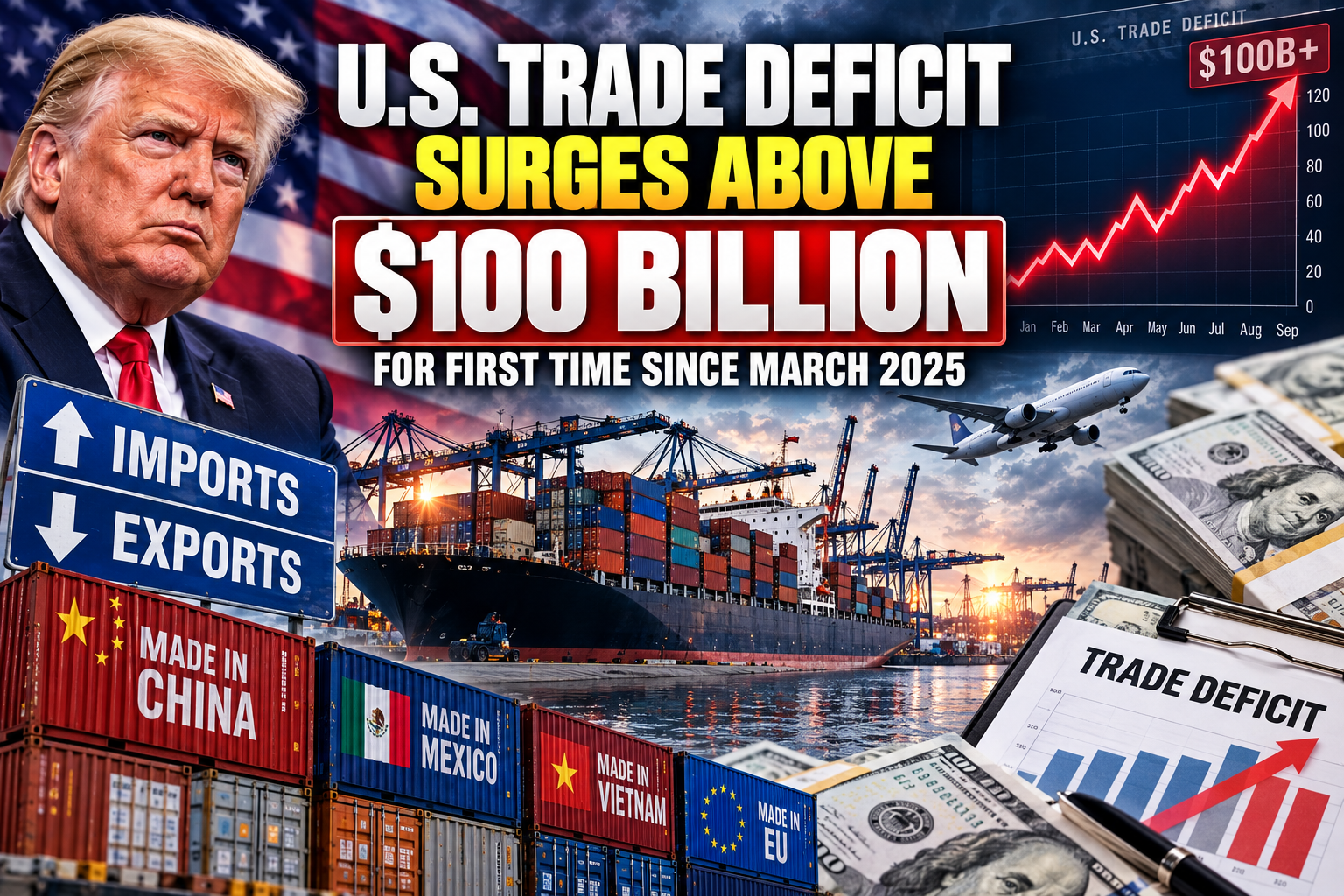
WASHINGTON — The U.S. trade deficit has surged back above the $100 billion mark, reaching its widest level in 17 months despite the Trump administration’s aggressive tariff campaign aimed at reducing America’s dependence on imports.
The Commerce Department reported Tuesday, October 6, that the U.S. goods-and-services trade deficit jumped 13.7% in August to $105.6 billion, up from a revised $92.8 billion in July. It was the largest monthly trade deficit since March 2025.
The number immediately became a political talking point because President Donald Trump’s trade strategy has centered on tariffs designed to discourage imports, encourage domestic production and narrow the country’s long-running trade gap.
Yet the latest data show that imports rose sharply instead.
Imports Hit a Record High
The biggest reason behind August’s widening deficit was a surge in imports.
U.S. imports climbed 4.3% to a record $420.8 billion, while exports rose a more modest 1.4% to $315.2 billion, according to the Census Bureau and Bureau of Economic Analysis.
The increase was broad, but several categories stood out.
Imports of capital goods reached a record $146.4 billion, reflecting strong demand for equipment, machinery, computers and other investment goods. The data come as American companies continue spending heavily on artificial-intelligence infrastructure and data centers.
Imports from Mexico also reached a record $60.6 billion, while imports from Vietnam hit a record $26.5 billion.
That pattern suggests American businesses and consumers continued purchasing large amounts of foreign-made goods even as tariffs raised the cost of bringing some products into the country.
Why the Deficit Matters for Trump
Trump has repeatedly argued that America’s trade deficit is evidence that the United States is being treated unfairly by trading partners.
His administration has imposed tariffs on a wide range of countries and products, arguing that higher import costs will encourage companies to move production into the United States.
The August numbers complicate that narrative.
The trade deficit increased even as many of those tariffs were already in place. Imports rose by $17.2 billion in August alone, compared with a $4.5 billion increase in exports.
That does not necessarily mean tariffs have failed.
Tariffs can affect trade with a delay, and companies often adjust purchasing decisions ahead of expected policy changes. Businesses may also import components and machinery because they need them to expand domestic production.
In other words, a wider monthly deficit does not by itself prove that the administration’s entire trade strategy is ineffective.
Businesses May Be Buying Before Prices Rise Further
One possible explanation is that companies are continuing to build inventories or accelerate purchases before additional trade costs take effect.
Reuters reported that August imports were boosted by replenished inventories and strong demand for industrial supplies and AI-related equipment. The continuing data-center investment boom has increased demand for semiconductors, computers and other specialized products.
That makes the current trade picture unusually complicated.
Some imports are consumer goods that compete with American producers. Others are machines, technology and industrial inputs that businesses use to expand operations inside the United States.
A trade deficit does not distinguish between those purposes.
The Year-to-Date Picture Looks Different
There is another important detail that could get lost in the headline.
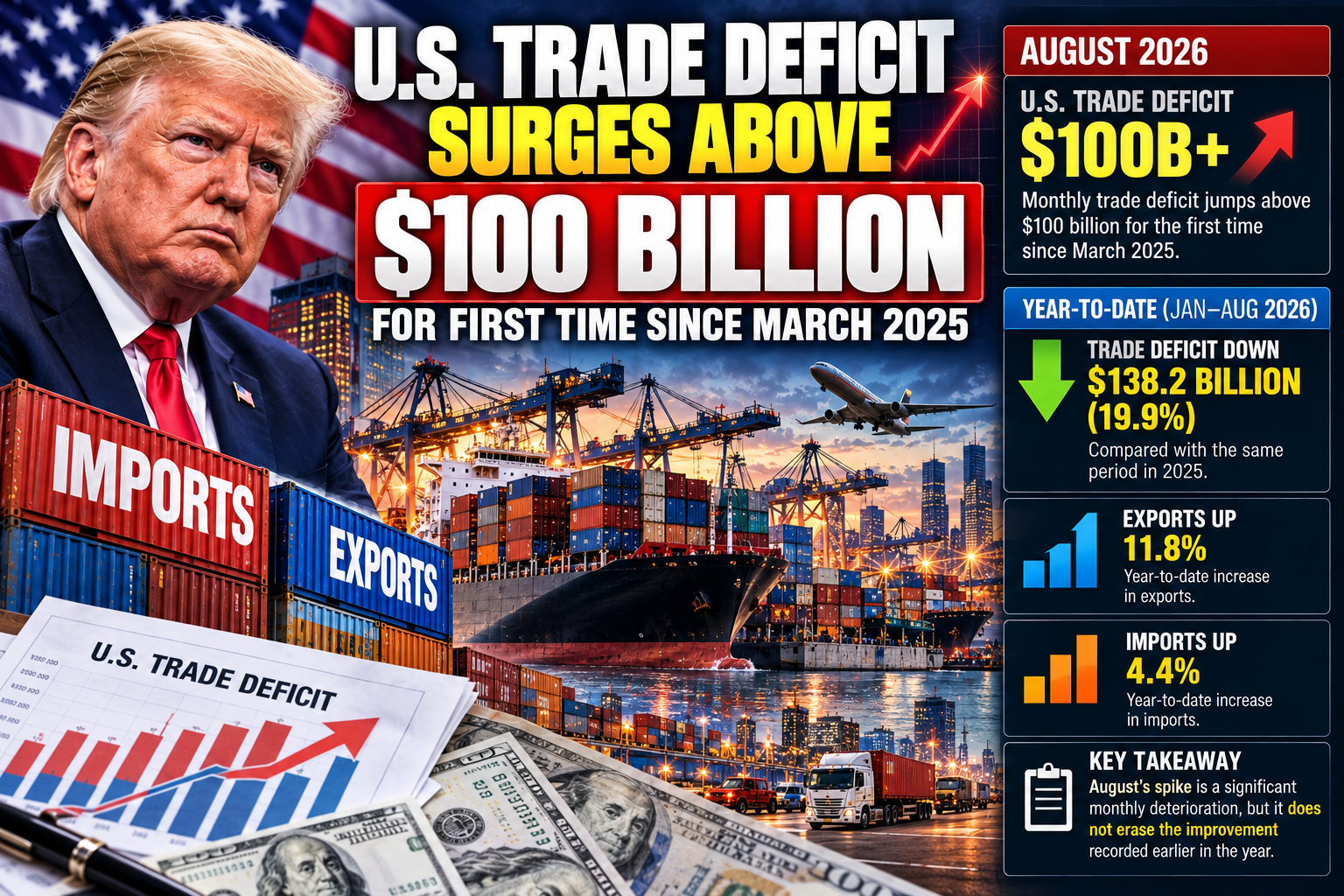
Although the August deficit jumped above $100 billion, the U.S. trade deficit for the first eight months of 2026 was still substantially smaller than during the same period in 2025.
According to the Census Bureau and BEA, the year-to-date goods-and-services deficit was down $138.2 billion, or 19.9%, from the comparable period in 2025. Exports were up 11.8%, while imports were up 4.4%.
That means August’s spike represents a significant monthly deterioration, but it does not erase the improvement recorded earlier in the year.
For the Trump administration, that distinction will be important when defending its trade policies.
A Potential Drag on Economic Growth
The widening deficit could also affect the broader U.S. economic outlook.
Trade is one of the components used to calculate gross domestic product. When imports rise faster than exports, net exports can subtract from GDP growth.
Reuters reported that economists estimated the August trade gap could reduce third-quarter GDP growth by as much as 2.5 percentage points, although the exact impact depends on how the trade data are incorporated into the final GDP calculation.
That could make the next round of economic reports particularly important.
If consumer spending and business investment remain strong, the economy may absorb the trade drag relatively easily. If other parts of the economy weaken, however, the import surge could become a bigger concern.
China Is Not the Only Story
The political discussion around U.S. trade often focuses heavily on China, but the August data show that America’s trade relationships are much broader.
Mexico and Vietnam both recorded record U.S. import totals in August, according to government data.
That matters because companies have increasingly diversified supply chains across multiple countries.
As tariffs change the relative costs of doing business, companies may shift production from one country to another rather than immediately relocating all manufacturing to the United States.
That can change the map of America’s trade deficit without necessarily eliminating it.
What Comes Next?
The next question is whether August represents a temporary surge or the beginning of a more persistent increase in imports.
The answer could influence everything from Trump’s tariff strategy to Federal Reserve policy and Wall Street expectations for economic growth.
Businesses will also be watching closely.
If tariffs continue to raise import costs while demand for foreign-made technology and equipment remains high, companies may have to decide whether to absorb higher expenses, raise prices or accelerate efforts to build more domestic capacity.
The Bottom Line
The U.S. trade deficit jumped to $105.6 billion in August, the first time it has exceeded $100 billion since March 2025 and the widest monthly gap in 17 months.
The surge was driven primarily by record imports, including record purchases of capital goods and higher imports from Mexico and Vietnam.
The headline number creates a fresh political challenge for the Trump administration, which has made reducing trade deficits a central argument for its tariff policies.
But the broader picture is more complicated: the year-to-date deficit is still nearly 20% below last year’s level.
The big question now is whether August was an exception—or a warning that America’s trade imbalance is beginning to widen again.