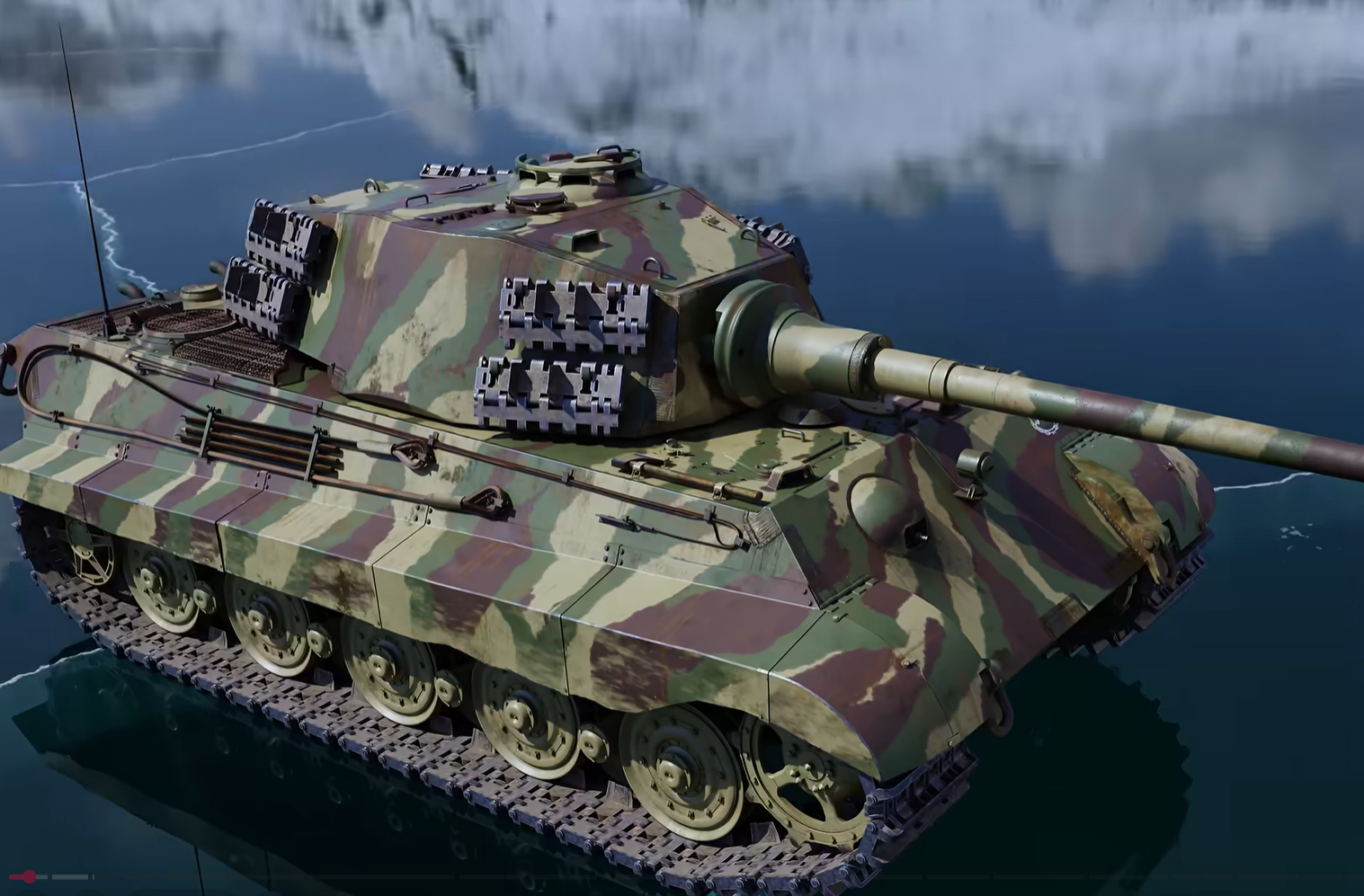
The Panzerkampfwagen VI Ausf. B, commonly known as the Tiger II or King Tiger, represented Germany’s attempt to combine exceptional armor protection with heavy-tank firepower. Entering combat in 1944, it could threaten Allied armored vehicles at long range while presenting a difficult target to many contemporary antitank weapons.
Yet the King Tiger also demonstrated a fundamental problem in military engineering: powerful weapons and thick armor are not enough when a vehicle is difficult to manufacture, transport, maintain, and keep running.
1. Design and Development
Development of the Tiger II began in 1942, as German designers pursued a successor to the original Tiger I. Both Porsche and Henschel worked on competing designs, while Krupp developed the turrets.
The Army ultimately selected Henschel’s hull design. Early production vehicles received curved-front turrets originally designed for the rejected Porsche proposal. Later tanks used a revised turret with a more angular profile.
The tank weighed approximately 69.8 metric tonnes and carried a crew of five: commander, gunner, loader, driver, and radio operator or hull machine-gunner. Its enormous size required wide tracks and a substantial suspension system to distribute its weight over the ground.
The result was a vehicle built around protection and firepower, rather than the simplicity and mobility needed for large-scale mechanized warfare.
2. Armor: Protection Through Thickness and Slope
The King Tiger’s armor was one of its defining features. Its upper frontal hull plate measured approximately 150 mm thick and was sharply sloped, while turret protection varied by design and location, with frontal sections reaching roughly 180–185 mm.
Sloping armor increases the thickness a projectile must pass through along its trajectory and can improve the likelihood of a projectile deflecting. This made the tank’s frontal profile particularly formidable in a head-on engagement.
However, protection was not uniform around the vehicle. Side and rear armor were thinner, leaving the tank more vulnerable from those directions. Tracks, suspension components, and other external systems could also be damaged without penetrating the main fighting compartment.
Armor therefore gave the King Tiger a major defensive advantage, but not immunity. Tactical position, range, ammunition, impact angle, and the condition of the armor all affected survivability.
3. The Long 88: The Tank’s Main Weapon
The Tiger II’s principal weapon was the 8.8 cm KwK 43 L/71 cannon, a long-barreled 88 mm gun developed for high-velocity antitank fire.
The L/71 designation refers to a barrel length of approximately 71 times the gun’s bore diameter. The weapon could fire different ammunition types, including armor-piercing rounds and high-explosive ammunition for other battlefield targets.
Its high muzzle velocity and effective fire-control arrangement made the gun dangerous to opposing tanks. The commander could locate potential targets, the gunner aimed through the sighting system, and the loader handled the heavy ammunition. These roles required coordination, observation, and training—not just raw gun performance.
Two 7.92 mm MG34 machine guns provided secondary armament, including defense against infantry. The combination gave the Tiger II the ability to engage armored vehicles and softer targets, although its large main-gun ammunition imposed important storage and resupply demands.
4. Engine, Transmission, and Mobility
The King Tiger used the Maybach HL230 P30 V12 gasoline engine, rated at approximately 700 metric horsepower. Divided by its nearly 70-tonne combat weight, that output equated to roughly 10 horsepower per tonne.
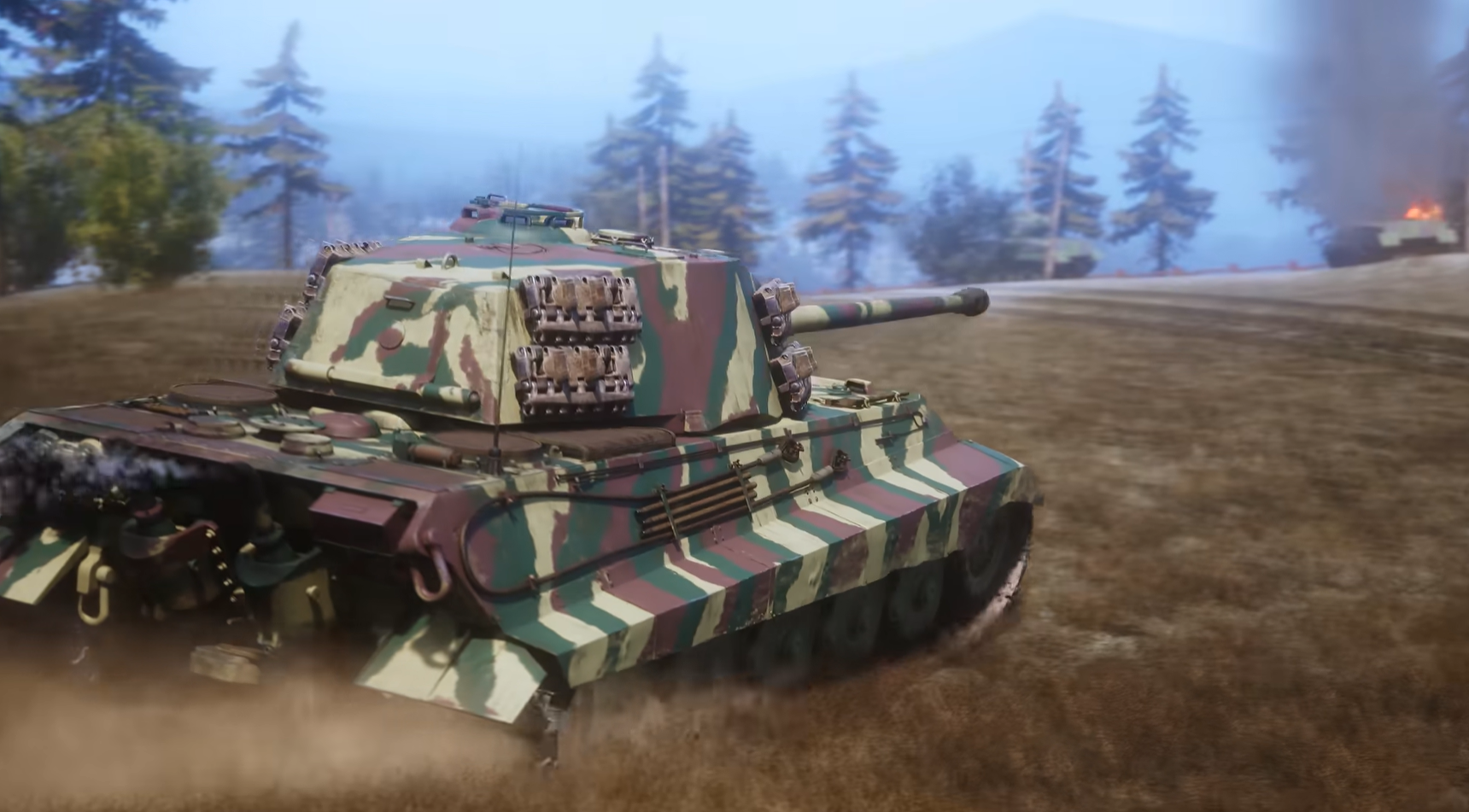
That was a difficult power-to-weight ratio for a vehicle of this size. Although published maximum-speed figures vary, practical movement depended heavily on terrain, mechanical condition, and operating circumstances.
The tank’s transmission, steering system, suspension, and final-drive components had to cope with enormous loads. Mechanical failures and difficult maintenance could reduce the number of tanks available for combat even when enemy fire had not destroyed them.
Its fuel consumption, heavy weight, and need for specialized repair and recovery equipment further complicated operations. Damaged tanks could be particularly difficult to retrieve, while bridges, rail transport, and narrow routes restricted where the vehicle could move.
5. Combat Record and Operational Limits
The Tiger II entered combat in Normandy in 1944 and later saw service on the Eastern Front and during the Ardennes offensive. When operational and positioned well, its combination of armor and long-range firepower could make it a formidable defensive weapon.
But the battlefield rarely offered ideal conditions. Allied aircraft, artillery, mines, antitank weapons, and attacks against supply routes all threatened its effectiveness. A tank could possess excellent frontal protection and still be immobilized, isolated, or abandoned.
Germany also produced the Tiger II in limited numbers. The Tank Museum’s narrative gives 489 tanks produced, while its technical panel lists 492, illustrating a discrepancy among published totals and counting conventions. Either way, production remained small compared with the scale required for a prolonged war of attrition.
6. Legacy: Power Versus Practicality
The King Tiger remains one of World War II’s best-known heavy tanks because it combined striking visual design with formidable armament and armor. However, its battlefield significance should not be judged only by technical specifications or isolated engagements.
Its story highlights the relationship between firepower, protection, mobility, production capacity, and logistics. A vehicle that performs impressively in a direct encounter may still contribute less than expected if fuel, spare parts, transport, and trained maintenance crews are unavailable.
The Tiger II was a powerful tank, but it was not a complete solution to Germany’s worsening military position. Its engineering achievements were real, and so were the operational costs of its immense weight and complexity.