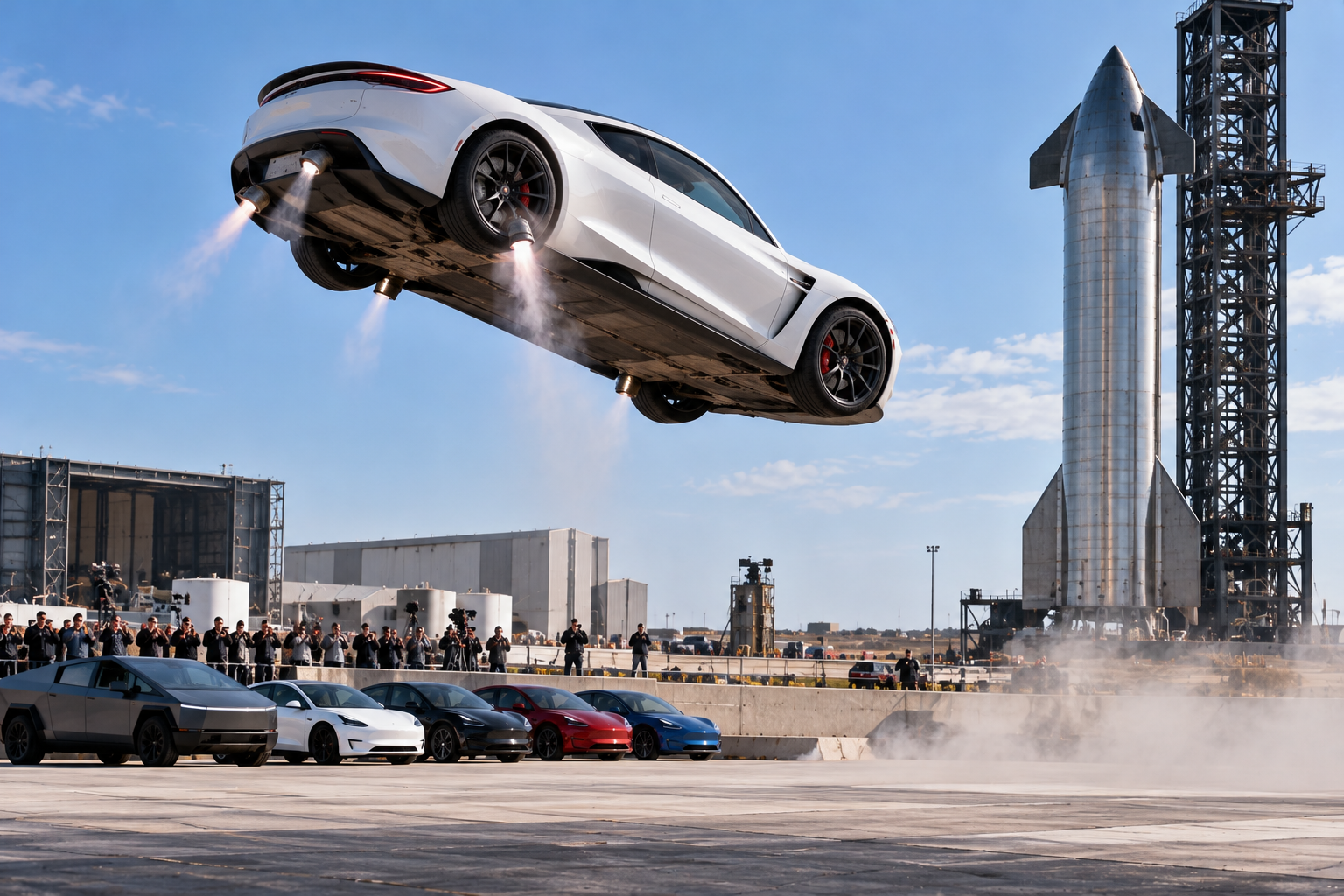
Subheadline: Elon Musk’s long-delayed electric supercar stunned audiences with an airborne flip, upside-down driving and rocket-inspired propulsion technology. But despite the spectacular demonstration, Tesla’s next-generation Roadster is not yet a production-ready flying car, and deliveries are not expected until 2028.
WACO, Texas — October 18, 2026 — Tesla has unveiled its redesigned Roadster, showcasing a dramatic midair flip that has reignited the debate over whether flying cars could become a reality.
The demonstration took place on October 15 at a SpaceX test facility in McGregor, Texas, where Tesla CEO Elon Musk presented the long-awaited electric sports car before an audience of enthusiasts and investors.
During the event, the white Roadster drove up a curved ramp, traveled upside down using a suction-based system, launched into the air, performed a midair rotation and landed back on its wheels using built-in thrusters. The vehicle later demonstrated additional airborne maneuvers over a lineup of other Tesla vehicles. (Reuters)
The spectacular display quickly attracted attention online, with Musk suggesting that the future of flying cars had arrived.
But the demonstration showed a vehicle performing short, controlled airborne maneuvers—not a car capable of sustained flight like an aircraft. Important questions also remain about production readiness, safety certification and whether the technology will be available to ordinary consumers.
A Roadster That Pushes Beyond Traditional Electric Cars
The new Roadster represents a major departure from conventional electric sports cars.
Developed through collaboration between Tesla and SpaceX, the vehicle incorporates rocket-inspired technology intended to produce bursts of thrust and enable unusual maneuvers. Tesla demonstrated a combination of cold-gas thrusters and a multi-mode suction system, allowing the prototype to perform stunts that would be impossible for an ordinary road car. (Associated Press)
The suction system allows the vehicle to maintain contact with a specially designed inverted ramp, while the thrusters provide force for short airborne movements.
That distinction matters because the demonstration does not establish that the Roadster can hover indefinitely, travel between destinations through the air or operate safely above public roads.
Nevertheless, the engineering concept represents an unconventional attempt to combine electric vehicle technology with aerospace-inspired propulsion.
Musk described the project as a collaboration between the world’s leading car and rocket companies, presenting the vehicle as a showcase of what Tesla and SpaceX engineers can develop together.
Tesla Claims Acceleration From 0 to 60 MPH in Under a Second
Performance figures were another major focus of the reveal.
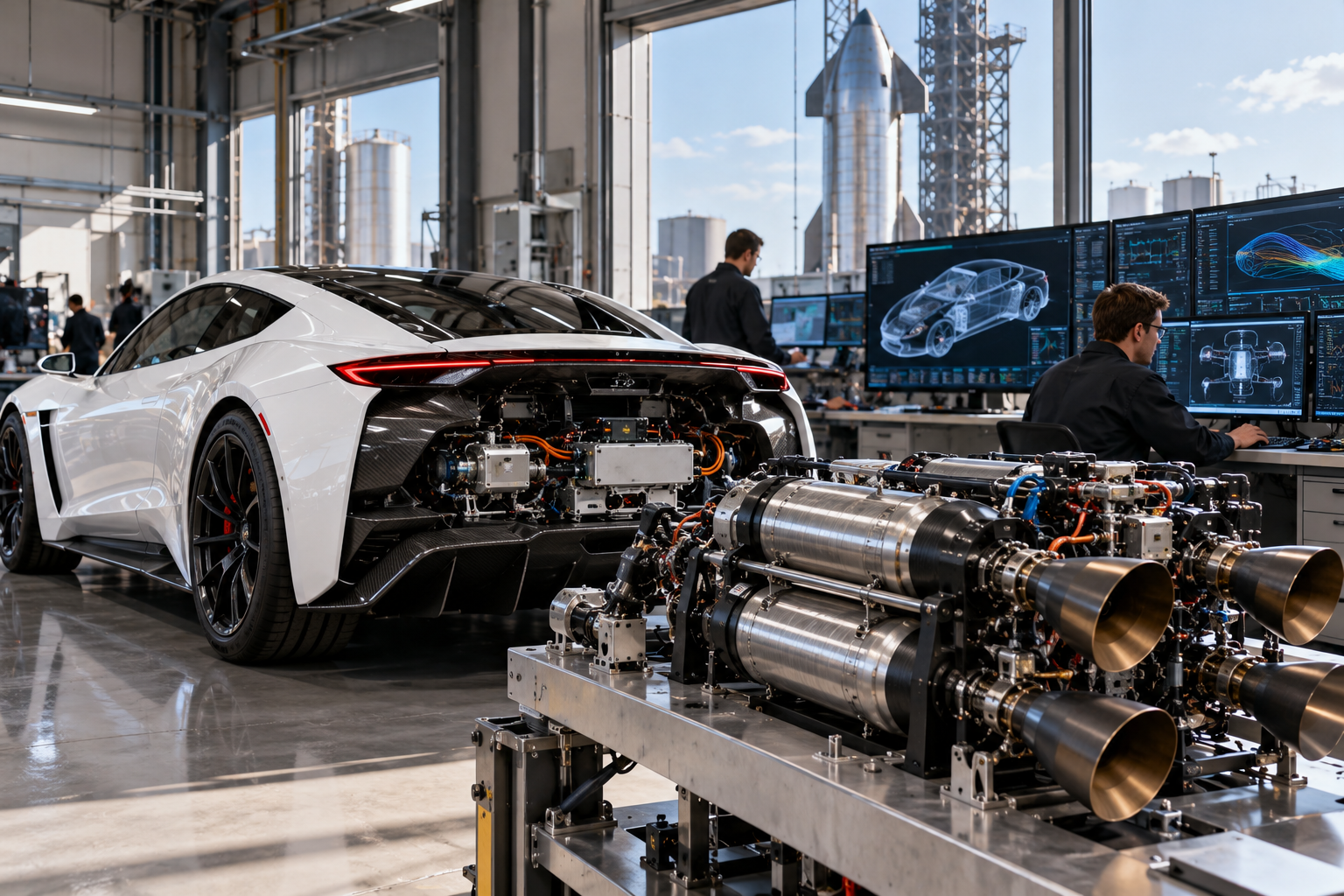
According to Tesla executives, the Roadster is designed to accelerate from 0 to 60 mph in less than one second, reach a top speed exceeding 230 mph and travel more than 300 miles on a single charge. These figures remain manufacturer claims rather than independently verified production-car results. (Reuters)
The sub-one-second acceleration claim is particularly ambitious, placing the Roadster among the most extreme performance targets announced for a passenger vehicle.
However, headline specifications alone do not establish how the finished car will perform under ordinary driving conditions. Independent testing will be needed to verify its acceleration, range, stability and reliability.
Tesla also has not announced a finalized retail price for the redesigned vehicle.
Following the unveiling, the company offered reservations for different configurations, including a Performance version requiring a $50,000 deposit and a Thrust version requiring a $250,000 deposit, according to Reuters. Those deposits should not be confused with the car’s total purchase price. (Reuters)
Nearly a Decade of Delays
The announcement also revisits one of Tesla’s longest-running vehicle projects.
Tesla first revealed its second-generation Roadster in 2017, promising extraordinary performance and initially targeting customer deliveries in 2020. That timeline passed without the redesigned vehicle entering production.
Now, Musk says consumer production is expected to begin in 2028, more than a decade after the original unveiling.
The latest demonstration may reassure some enthusiasts that the project is still moving forward. However, the proposed production timeline remains a target, not a guarantee that customers will receive their vehicles by that date.
Tesla’s reservation terms also state that a delivery date is not guaranteed, according to the Associated Press. (Associated Press)
The delay raises questions about whether the advanced propulsion features displayed during the event can be incorporated into a commercially viable vehicle without compromising reliability, safety or practicality.
Can the Flying Roadster Be Driven on Public Roads?
One of the largest obstacles is regulatory approval.
A vehicle that temporarily leaves the ground creates challenges involving road safety, airspace regulation, liability and the potential risks to other drivers and pedestrians.
Tesla has not demonstrated that its airborne Roadster configuration is approved for routine use on public roads. The demonstration occurred at a controlled test facility, where engineers could manage the environment and reduce risks to spectators.
The most ambitious configuration, described as the Rocket version, is listed as invitation-only and features a single-seat design with a more extensive flight system, according to Reuters. (Reuters)
That configuration appears to prioritize performance and spectacular maneuvers over the practicality expected from an everyday passenger vehicle.
A successful demonstration, therefore, does not automatically establish that a similar system can be certified for normal traffic.
A Technology Showcase as Tesla Changes Direction
The Roadster unveiling arrives as Tesla increasingly focuses on artificial intelligence, autonomous driving, robotics and robotaxi services.
The company has been expanding its work on self-driving technologies while shifting some resources toward robotics and other emerging businesses.
Against that background, the Roadster serves as a high-profile showcase for Tesla’s engineering ambitions. Its financial contribution may be relatively small compared with mass-market vehicles, but it could strengthen the company’s reputation for ambitious automotive technology.
Still, the central questions remain unanswered: when will production begin, how much will the finished vehicle cost, and will its most dramatic capabilities survive the transition from demonstration prototype to customer product?
Tesla’s Roadster has made the idea of a rocket-powered car feel more real than ever—but a spectacular midair flip is not the same as a practical flying car. The next major test will be whether the company can turn the spectacle into a safe, reliable vehicle that customers can actually buy and use.