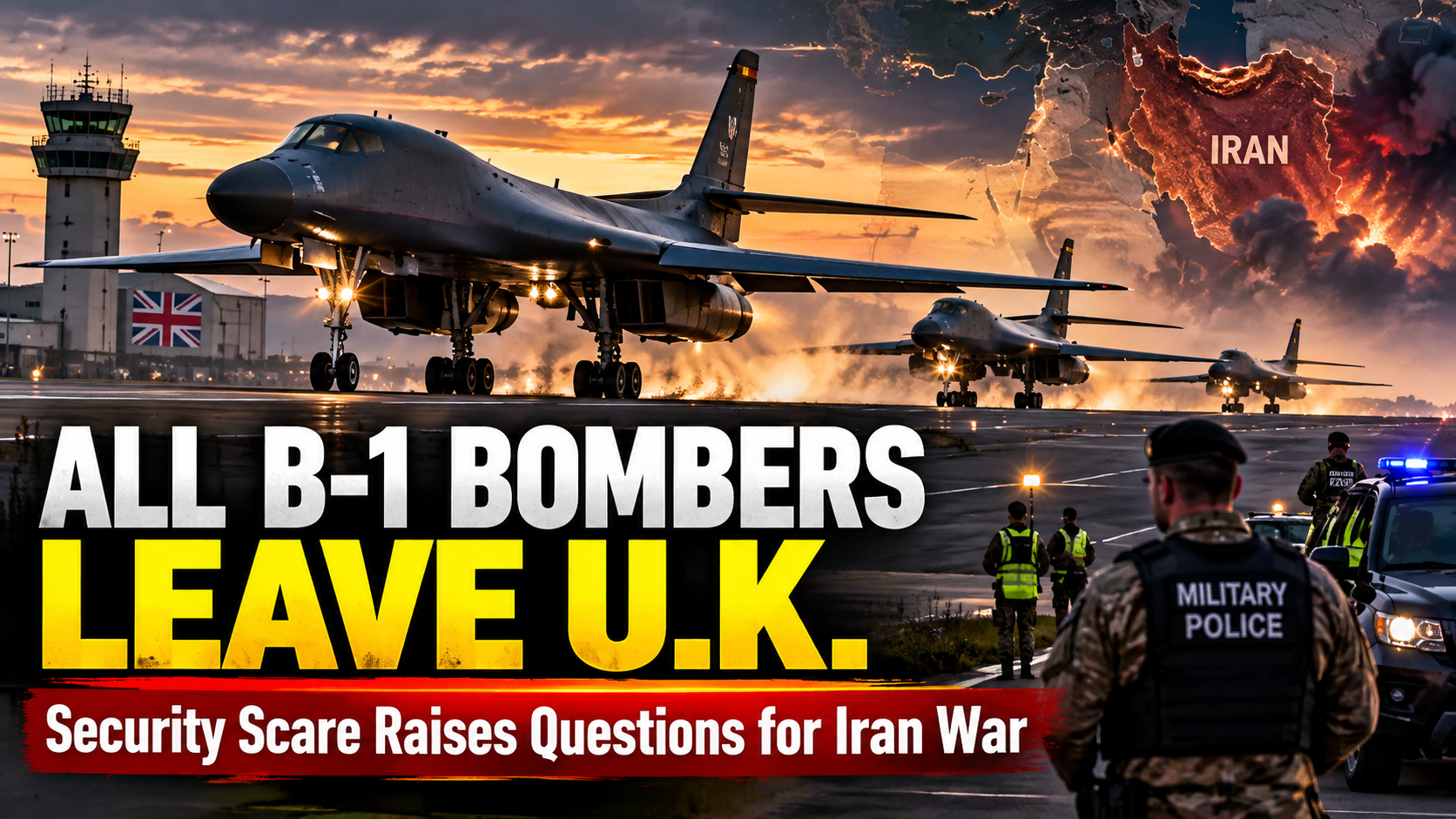
LONDON — The United States has pulled all of its B-1 bombers out of RAF Fairford in Britain and returned the aircraft to their home stations in the United States, a sudden move that has raised fresh questions about security at one of America’s most important overseas bomber bases.
The Pentagon confirmed Sunday that all U.S. bombers deployed to RAF Fairford had been redeployed to the United States. The announcement came after aircraft trackers observed B-1 bombers departing the Gloucestershire base.
The move follows a security investigation involving suspected plans to attack the base. British authorities recently arrested six people in connection with the investigation, although all had been released on bail as of the latest reports.
The Pentagon has not publicly said that the bomber withdrawal was directly caused by the suspected plot.
That distinction is important.
A Sudden Departure From RAF Fairford
RAF Fairford has played a major role in U.S. military operations involving Iran. The base, located northwest of London, has a long runway capable of supporting America’s largest long-range bombers.
In recent months, B-1B Lancer bombers have operated from the base as part of the U.S. military’s forward presence in Europe.
Air & Space Forces Magazine reported that 12 B-1 bombers rapidly departed Fairford on October 4. Aviation Week reported that 13 B-1Bs had been temporarily based at the facility.
The Pentagon’s public statement referred more broadly to all U.S. bombers deployed to Fairford, rather than providing a detailed aircraft count.
The military also emphasized that America’s bomber force remains capable of conducting long-range missions from the continental United States.
In other words, the aircraft have moved home—but the Pentagon says the bombers themselves remain ready for global operations.
The Security Investigation Behind the Alarm
The withdrawal comes roughly a week after British police arrested five men near RAF Fairford.
Authorities were investigating suspected preparations for a terrorist attack and possible violations of Britain’s explosives laws. Police found quantities of fuel in vehicles connected to the suspects, but reports said no explosives were discovered.
A sixth man, a dual British-Iranian citizen, was arrested in London on suspicion of preparing terrorist acts.
All six suspects were subsequently released on bail while the investigation continued.
British authorities have not publicly established that Iran ordered the alleged plot. However, Prime Minister Andy Burnham said there were “strong indications” of Iranian involvement.
Iran has denied involvement.
That leaves a critical distinction between what authorities suspect and what investigators have conclusively established.
Why Would the U.S. Move Valuable Bombers?
The B-1B Lancer is one of America’s most capable conventional long-range strike aircraft. Keeping a bomber force closer to a potential battlefield can reduce flight times and provide operational flexibility.
But placing high-value aircraft at a fixed overseas base also creates vulnerabilities.
Modern military conflicts have demonstrated that drones and relatively inexpensive weapons can threaten expensive aircraft and infrastructure. A successful attack does not necessarily require destroying an entire bomber fleet; even damaging one aircraft or disrupting operations could create significant military and political consequences.
That risk may help explain why the United States chose to move its bombers back to American bases.
However, the Pentagon has not publicly identified the precise threat that prompted the redeployment.
Britain Says the Base Remains Secure
The American decision has created an unusual contrast between Washington and London.
On Monday, Downing Street said RAF Fairford remained secure, pointing to Britain’s established measures for protecting military installations.
British officials continue to investigate the suspected plot, with counterterrorism authorities describing the case as complex and saying they are examining multiple possible lines of inquiry, including possible foreign-state involvement.
The fact that the United States moved its bombers does not necessarily mean British officials believe an attack is imminent.
Instead, it demonstrates that Washington may be applying a much lower tolerance for risk when extremely valuable strategic aircraft are involved.
What Happens to U.S. Operations Against Iran?
The biggest question is whether the withdrawal will significantly affect America’s military campaign.
The Pentagon says it will not prevent the B-1 force from conducting missions. The aircraft can launch from bases in the United States, although missions from the continental U.S. generally require longer flights and extensive aerial refueling.
That means the redeployment could reduce America’s operational convenience without eliminating its long-range strike capability.
The United States also maintains other military forces in Britain and elsewhere in Europe, meaning the bomber withdrawal does not represent a complete American military departure from the region.
A Warning Beyond One Air Base
The Fairford episode highlights a larger problem confronting Western militaries: how to protect sophisticated and extremely expensive weapons systems from relatively inexpensive attacks.
Traditional military bases were designed primarily to defend against conventional threats. Today’s militaries increasingly have to consider drones, sabotage, cyberattacks, insider threats, and covert operations.
For NATO countries, that creates a difficult security equation.
The more valuable the equipment stationed at a base, the greater the potential payoff for anyone attempting to disrupt it.
The Bottom Line
The United States has brought its B-1 bombers at RAF Fairford back to American bases following a period of heightened security concerns. The Pentagon has confirmed the redeployment but has not publicly stated that the suspected terrorist plot directly caused the decision.
The move does not mean America’s long-range bomber capability has disappeared. Instead, it signals that the United States is willing to accept the operational cost of flying from home bases rather than keeping valuable aircraft at a facility facing heightened security concerns.
For Britain and the United States, the bigger question may now be how military bases can remain secure in an era when a relatively inexpensive attack can threaten billions of dollars in military hardware.