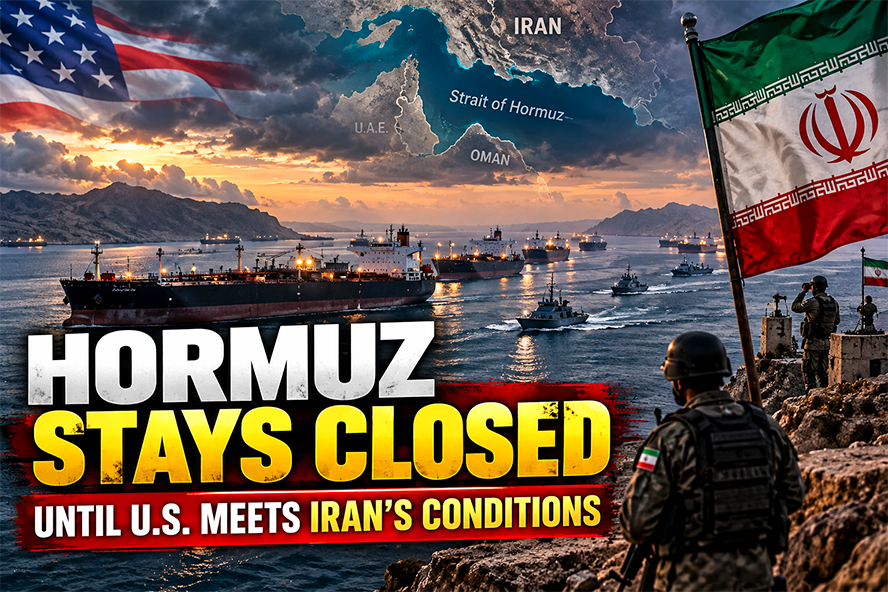
TEHRAN — Iran is refusing to reopen the Strait of Hormuz until the United States meets a list of conditions tied to an earlier interim agreement, raising fresh concerns about the future of global energy supplies and the possibility of a prolonged economic confrontation between Washington and Tehran.
Iranian Parliament Speaker and top negotiator Mohammad Baqer Qalibaf said Sunday that the strategic waterway would remain closed until seven conditions outlined in a June agreement are fulfilled.
The statement comes as indirect diplomatic efforts between Iran and the United States continue, with Qatar and other mediators attempting to bridge major differences between the two sides.
For Americans watching gasoline prices, inflation and the broader Iran conflict, the dispute over Hormuz could have consequences far beyond the Middle East.
Iran Puts Hormuz at the Center of the Negotiations
Iran has made reopening the Strait of Hormuz one of its central demands in negotiations with Washington.
According to Reuters, Iranian officials say Tehran has received proposals from the United States through a mediator but remains dissatisfied with Washington’s approach.
Qalibaf said Iran would not accept what he described as unilateral demands from the United States.
Iranian Foreign Minister Abbas Araghchi separately said Tehran remains prepared for diplomacy but warned that Iran is also prepared to respond militarily if Washington chooses further military action.
The competing statements show just how fragile the diplomatic process remains.
Both sides say they are willing to negotiate, but they disagree sharply over which issues must be resolved first.
What Does Iran Want?
Iran’s proposal would allow the Strait of Hormuz to reopen within seven days if Washington accepts Tehran’s conditions.
Those demands include an end to the broader conflict, changes involving the U.S. naval blockade of Iranian ports, sanctions relief, and the release of frozen Iranian assets.
Iran has also demanded recognition of its right to enrich uranium and a role in determining how the strategic waterway is governed.
Tehran says these demands are part of a broader framework linked to the June interim agreement.
The United States, however, has not publicly accepted the conditions.
Reuters reported that Washington previously rejected an Iranian proposal to reopen the strait in exchange for several major concessions.
That leaves the two governments facing a fundamental disagreement over sequencing: Iran wants guarantees and concessions before reopening the waterway, while Washington has focused heavily on broader security and nuclear issues.
Why the Strait of Hormuz Matters to Americans
The Strait of Hormuz is one of the world’s most important energy chokepoints.
Before the current conflict, roughly one-fifth of the world’s traded oil and natural gas passed through the waterway during peacetime, according to reporting from Al Jazeera and other international sources.
That makes the strait strategically important not only to Iran and its neighbors but also to the global economy.
Any prolonged disruption can affect crude oil prices, shipping costs and inflation expectations.
For American consumers, the most visible consequence could come at the gas pump. Higher global oil prices can eventually translate into higher gasoline and transportation costs, although the exact impact depends on global supply, demand, inventories and other factors.
The uncertainty itself can also affect financial markets.
Diplomacy Has Not Completely Failed
Despite the increasingly tough language from Tehran, diplomatic channels remain open.
Iran has said it is serious about finding a diplomatic solution, while mediators from Qatar and other countries continue working to bring the two sides closer together.
The United States and Iran have already exchanged proposals, although neither side has publicly released the complete details of the negotiations.
The Associated Press reported that mediators were still working toward an agreement to end the fighting and reopen the Strait of Hormuz, even after President Donald Trump rejected an earlier Iranian proposal.
That suggests the diplomatic process has not completely collapsed.
But the remaining disagreements are substantial.
The Nuclear Issue Could Complicate Everything
Another major obstacle is Iran’s nuclear program.
Iranian officials have emphasized that reopening the strait is currently Tehran’s main priority and have denied reports that they offered major nuclear concessions in exchange for sanctions relief.
Washington, meanwhile, continues to treat Iran’s nuclear activities as a central issue in the broader dispute.
That difference could make a comprehensive agreement extremely difficult.
Iran wants the immediate economic and security consequences of the conflict addressed. The United States wants guarantees that Iran’s nuclear program and military capabilities will not create another threat.
What Happens Next?
The next stage of negotiations could determine whether the Strait of Hormuz remains closed or begins returning to normal traffic.
If Washington accepts Tehran’s conditions, Iran says it could reopen the waterway within seven days.
If the two sides fail to reach an agreement, the standoff could continue, keeping pressure on global energy markets and increasing the risk of further military escalation.
For President Trump, the timing is also politically sensitive. The U.S. midterm elections are approaching in November, while Americans continue to watch fuel prices and the economic consequences of the conflict.
The Bottom Line
Iran says the Strait of Hormuz will remain closed until the United States meets seven conditions tied to an earlier interim agreement. Tehran says it is ready to reopen the crucial waterway within seven days if Washington accepts its proposal.
The United States has not agreed to those terms, and negotiations remain uncertain.
The outcome could have consequences well beyond Iran and the Persian Gulf. If the standoff continues, energy markets and consumers around the world could feel the pressure. If diplomacy succeeds, reopening Hormuz could become one of the most important steps toward stabilizing the global economy after months of conflict.