WASHINGTON — President Donald Trump has put one of the country’s most senior intelligence officials in charge of a rapidly expanding battlefield: artificial intelligence.
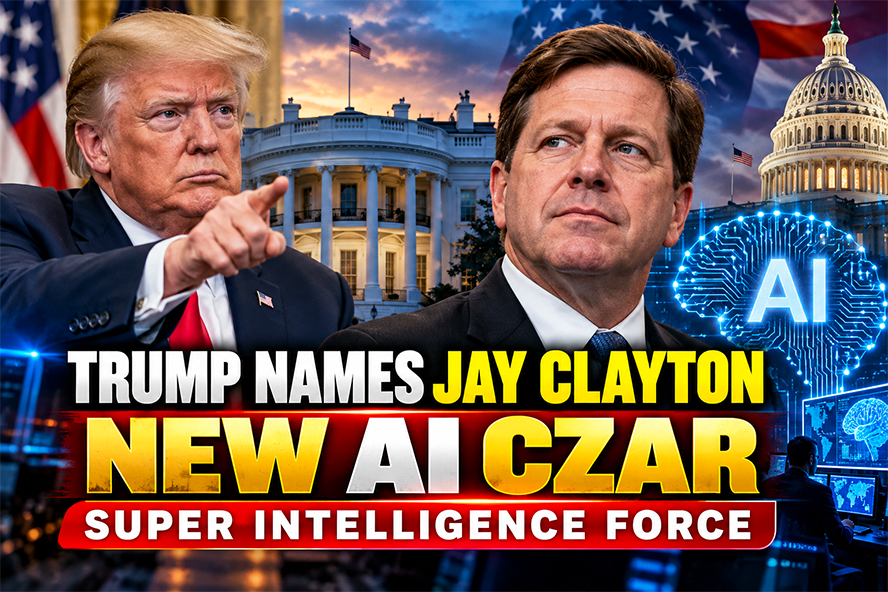
On Sunday, October 4, Trump named Director of National Intelligence Jay Clayton to lead a new federal task force focused on artificial intelligence, giving the national intelligence chief an additional role as the White House’s new AI czar.
Trump has called the initiative the “Super Intelligence Force,” reflecting his preference for describing advanced artificial intelligence as “super intelligence.”
The move places AI policy directly alongside national security at a moment when Washington is facing growing concerns about the technology’s potential to transform the economy, strengthen America’s military capabilities and create new security threats.
Why Trump Chose Jay Clayton
Clayton is not a traditional technology executive or Silicon Valley entrepreneur.
Before becoming director of national intelligence, he served as chairman of the Securities and Exchange Commission during Trump’s first term and previously worked as the U.S. attorney for the Southern District of New York.
The Senate confirmed Clayton as director of national intelligence in July 2026.
That background could become important in his new assignment.
As the country’s top intelligence official, Clayton already oversees America’s intelligence community and deals with issues involving national security, cyber threats and foreign adversaries.
During his Senate confirmation hearing, Clayton described AI as both a major opportunity and a threat.
He later called “super intelligence” a national security issue, emphasizing that the United States cannot simply pause development while other countries continue moving forward.
What Will the Super Intelligence Force Do?
Trump said the new task force will coordinate the federal government’s engagement with consumers, public-interest organizations, religious groups, critical infrastructure providers and AI companies.
The group will also examine the risks and opportunities created by increasingly advanced AI systems.
According to Reuters, the task force is expected to produce a comprehensive report within 120 days.
The group will report directly to Trump and White House Chief of Staff Susie Wiles.
Other officials named to the task force include Federal Trade Commission Chairman Andrew Ferguson, Pentagon technology official Emil Michael and Office of Personnel Management Director Scott Kupor.
The broad membership suggests the administration views AI as more than a technology issue.
It is increasingly being treated as an economic, regulatory and national-security challenge.
America’s AI Race With China
One of Trump’s central arguments is that the United States cannot afford to fall behind China in advanced AI.
The administration has repeatedly emphasized maintaining American leadership in the technology, particularly as AI becomes increasingly important to military systems, cybersecurity, manufacturing and the broader economy.
Trump has also pushed back against calls for heavy regulation, arguing that excessive government restrictions could slow American innovation and give foreign competitors an advantage.
That creates a difficult balancing act for Clayton.
The new AI czar will have to help protect Americans from potentially dangerous technology while also avoiding policies that could slow the development of systems the administration believes are strategically important.
The Safety Debate Is Growing
The appointment comes as concerns about AI safety are becoming increasingly difficult for Washington to ignore.
Technology companies are racing to develop more capable models, while researchers and policymakers continue debating what happens if advanced AI systems behave unpredictably or are deliberately misused.
Cybersecurity is one major concern.
AI systems capable of identifying software vulnerabilities could potentially help defenders secure computer networks—but the same capabilities could also be exploited by hackers.
There are also concerns about autonomous systems, misinformation, biological threats and AI agents operating with increasingly little human intervention.
Trump’s administration has generally favored rapid development rather than a broad pause.
But the creation of a dedicated task force suggests the White House recognizes that some level of government coordination is becoming necessary.
A New Chapter After David Sacks
Clayton is not the first person associated with the Trump administration to serve as an AI czar.
Venture capitalist David Sacks previously held the AI and cryptocurrency czar role during Trump’s second administration. Sacks left his official government position in March 2026 after reaching the employment limit associated with his status as a special government employee.
He remains influential in technology policy and continues to co-chair the President’s Council of Advisors on Science and Technology.
Clayton’s appointment represents a shift toward a more national-security-focused approach.
Rather than placing the AI portfolio primarily in the hands of a technology investor, Trump has chosen an official who already sits at the center of America’s intelligence apparatus.
What This Means for Americans
The immediate impact on consumers may be limited.
The task force is not itself a new AI regulatory agency, and its 120-day mission is primarily to study the technology and recommend how the federal government should respond.
But its recommendations could eventually influence AI regulation, cybersecurity policy, government procurement and national-security decisions.
For the technology industry, the biggest question is whether Clayton will emphasize speed, oversight—or attempt to find a middle ground.
For Trump, the message is clear: Washington wants America to lead the next generation of AI rather than watch another country take the lead.
The Bottom Line
Trump’s decision to appoint Jay Clayton as AI czar puts artificial intelligence firmly inside the national-security conversation.
Clayton will continue serving as director of national intelligence while leading the new Super Intelligence Force, which has been tasked with examining the opportunities and dangers created by rapidly advancing AI.
The next 120 days could provide an early indication of how the Trump administration plans to balance America’s race for AI leadership with growing concerns about safety, cybersecurity and national security.