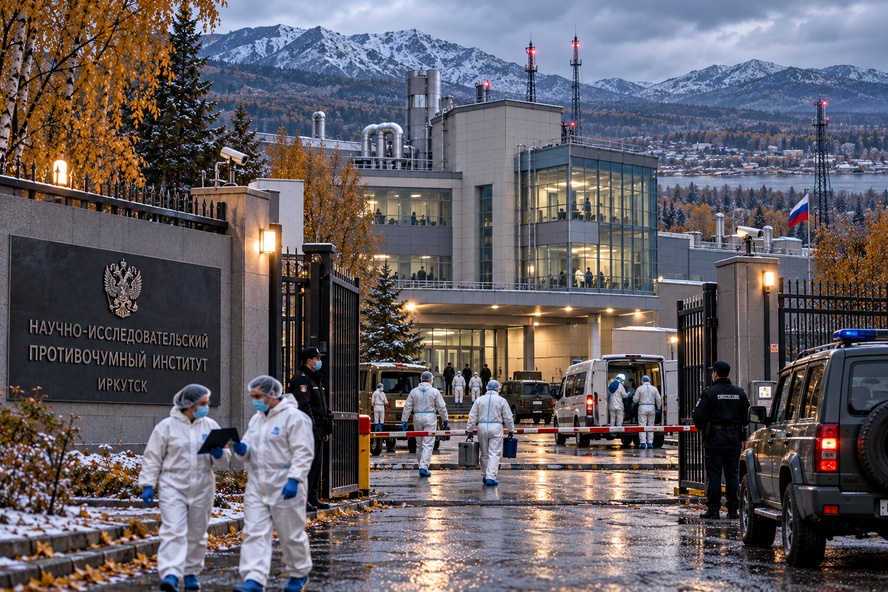
Subheadline: A laboratory worker in Siberia has died after developing severe pneumonia, prompting precautionary measures and international questions about whether plague played any role. Russia says there is no confirmed plague case.
A sudden plague scare in Siberia has drawn international attention after a laboratory worker at a Russian institute specializing in dangerous infectious diseases died following severe pneumonia, prompting the World Health Organization to request more information from Moscow.
The worker, identified in reports as 28-year-old Darya Shipilova, died on October 2, 2026, after being hospitalized with severe pneumonia. She worked at the Irkutsk Anti-Plague Research Institute, a facility that studies plague and other high-risk infectious diseases. Initial media reports raised fears that she may have been exposed to pneumonic plague in the laboratory, but no laboratory evidence has publicly confirmed that plague caused her death.
The case has quickly become an international health-security story because of the nature of the institute where Shipilova worked and the precautionary response that followed.
WHO Seeks More Information From Russia
The World Health Organization said on October 7 that it had asked Russia for additional information under the International Health Regulations.
WHO said it wants details about the laboratory tests performed on the deceased worker and her contacts, an explanation of what prompted Russia’s public-health measures, and updates on the health of those being monitored. The agency is also seeking verification of reports that a second employee may have developed pneumonia of undetermined cause.
WHO said Russia had reported placing about 200 contacts in quarantine after the incident. The organization also offered technical assistance related to plague, laboratory biosafety and biosecurity.
At this stage, however, WHO said it does not yet have the full picture of the event and therefore cannot complete a full risk assessment. That distinction is important: the investigation is ongoing, and the available information does not establish that a plague outbreak is underway.
Russia Rejects Plague Link
Russian authorities have repeatedly pushed back against reports suggesting a confirmed plague infection.
Russia’s public-health watchdog, Rospotrebnadzor, has said that extensive testing found no evidence that the worker’s illness was caused by the pathogens handled at the institute. Reuters also reported that Russian authorities said there had been no confirmed plague cases in the Irkutsk region connected to the incident.
The Kremlin has also criticized media coverage of the case, with spokesman Dmitry Peskov accusing some reports of spreading misinformation and insisting that Russia had properly informed the WHO through established channels.
Meanwhile, precautionary measures have included contact tracing, quarantine and medical monitoring. Reuters reported that nearly 5,000 tests involving roughly 200 quarantined contacts had not identified dangerous infections, leading authorities to ease some precautionary measures.
Why Pneumonic Plague Is Drawing Attention

The concern surrounding the incident is linked in part to the potentially serious nature of pneumonic plague, the form of plague that affects the lungs.
According to WHO, plague is caused by the bacterium Yersinia pestis. It can spread to humans through infected flea bites, contact with infected tissues or, in cases of pneumonic plague, through respiratory particles from an infected person. WHO says untreated pneumonic plague can be rapidly fatal, but early antibiotic treatment can be effective.
That makes a suspected case inside a facility dedicated to researching plague particularly sensitive. Laboratory safety officials must consider not only whether a worker was infected, but also whether anyone else could have been exposed.
So far, however, there is no confirmed evidence of person-to-person spread from the Siberian case. The people placed under observation have reportedly shown no symptoms of illness, according to information cited by WHO and Reuters.
A Question of Transparency as Much as Disease
The investigation is also highlighting the importance of transparency during a suspected infectious-disease event.
WHO Director-General Tedros Adhanom Ghebreyesus said timely and complete information sharing is essential for clarifying conflicting reports and accurately assessing possible public-health risks. The organization’s request comes after several contradictory accounts circulated publicly about the worker’s illness and a possible second case.
The episode is inevitably being viewed through the experience of the COVID-19 pandemic, when delays and disputes over early information intensified public concern. In the current case, WHO is emphasizing verification rather than drawing conclusions before the laboratory evidence is available.
For now, the key fact is straightforward: a researcher at a Russian anti-plague institute died after severe pneumonia, and the cause has not been publicly established as plague.
The WHO is continuing to seek answers from Russia, while Russian authorities maintain that there is no confirmed plague outbreak in the region. Until additional test results and epidemiological information become available, the incident remains an unusual and closely watched health-security event—not proof that a new plague epidemic has begun.
