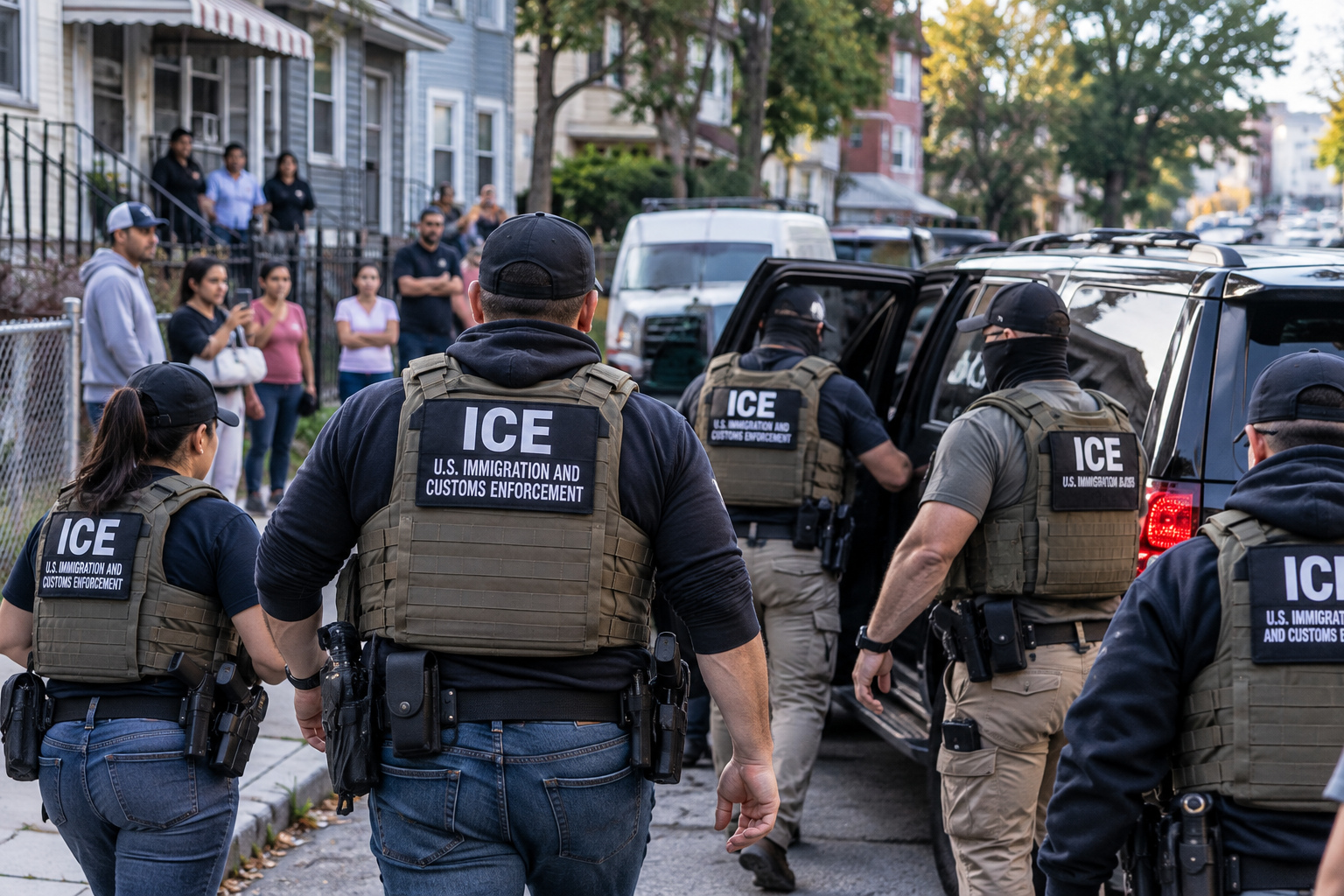
U.S. Immigration and Customs Enforcement (ICE) is carrying out enforcement operations in an expanding range of settings, from residential neighborhoods and workplaces to airports and Puerto Rico. The developments come as the Trump administration continues its mass-deportation campaign, with federal authorities increasingly relying on local law enforcement partnerships, information sharing and targeted arrests.
Recent reports from several parts of the country point to a broader enforcement effort. However, the evidence does not establish that every location is part of one coordinated new operation. Instead, different initiatives are unfolding across the country, raising questions about how immigration enforcement is changing and who may be affected.
ICE Activity Draws Attention in Puerto Rico
One of the most recent developments occurred in Puerto Rico, where immigration arrests intensified around the San Juan metropolitan area in October.
According to The Washington Post, White House border adviser Tom Homan visited the island to meet with immigration officials amid reports of increased enforcement. The White House said the trip involved assessments of immigration and maritime border security.
Local reporting indicated that ICE had launched an operation in the San Juan area. The Department of Homeland Security later said the Transportation Security Administration was leading checks of workers’ credentials around the port, with ICE helping inspect identification and investigate potential violations.
Witnesses and immigration advocates reported arrests in neighborhoods and during vehicle stops. Advocates estimated that at least 15 people had been arrested in the San Juan area, although authorities did not release a full accounting of arrests or identify everyone affected.
The activity drew criticism from immigrant-rights organizations, which raised concerns about the impact on residents and families. Federal officials, meanwhile, described their work as part of immigration and security enforcement.
The episode attracted particular attention because immigration enforcement has traditionally been less aggressive in Puerto Rico than in many parts of the U.S. mainland.
Airports Become Another Focus of Immigration Arrests
ICE enforcement has also expanded into airport settings, according to a report published by The Washington Post on July 30, 2026.
Six immigration lawyers told the newspaper that officials had increased detentions at airports serving the Washington, D.C., region, including Reagan National, Dulles International and Baltimore-Washington International. Similar cases involving visa overstays had also been reported in San Francisco, Houston and Denver.
The report described a change in the people being targeted. While airport enforcement had previously included travelers with existing deportation orders, attorneys said officers were increasingly detaining people who had originally entered the country legally but subsequently overstayed their visas.
Some of the individuals described by attorneys had pending asylum applications or work permits. Their immigration situations differed, and not every case had the same legal circumstances or outcome.
The newspaper reported that increased information sharing between ICE and the Transportation Security Administration appeared to be contributing to the arrests. DHS defended the cooperation, saying information sharing helps authorities identify people suspected of violating immigration law.
Arrests Rise in Cities and Neighborhoods
The pattern is not limited to airports or Puerto Rico.
In the Portland metropolitan area, Oregon Public Broadcasting reported a sharp increase in immigration arrests during the first week of October. An immigrant-rights coalition confirmed that at least nine people were detained on October 6 across Gresham, Troutdale and parts of eastern Portland. Additional detentions were reported the following day in Washington County.
The arrests prompted concerns that federal authorities could be preparing another large-scale operation. However, ICE did not confirm that a new Portland-specific operation had begun. An agency spokesperson said immigration officers would continue making arrests routinely across the United States.
Elsewhere, ICE announced that it had arrested 426 people in Indiana during a five-day operation spanning late August and early September. Most of those arrests occurred in Indianapolis. The agency said some of the people detained had records involving serious offenses, but it did not specify how many had criminal histories.
Together, these developments show how immigration enforcement can take different forms, including targeted operations, street arrests, cooperation with local police and investigations involving people encountered while traveling.
National Arrest Numbers Reach New Highs
The wider statistics help explain why enforcement activity is receiving renewed attention.
According to figures obtained by the University of California, Berkeley’s Deportation Data Project and analyzed by the Associated Press, ICE arrested 49,571 people in July 2026. That was the highest monthly total of President Donald Trump’s second term at the time, representing a 15% increase from June.
Reuters reported in September that preliminary government data showed arrests rising to nearly 51,000 in August, setting a record for the third consecutive month.
Yet the increase in arrests did not produce a comparable rise in deportations. The preliminary figures reviewed by Reuters showed deportations remaining relatively steady at roughly 1,200 per day. Legal proceedings, detention capacity and other logistical limitations can affect how many arrests ultimately lead to removals.
The figures also reflect a shift toward less-publicized enforcement methods, rather than relying exclusively on highly visible federal deployments to major cities.
What Happens Next?
The Trump administration has pledged to strengthen immigration enforcement, while DHS says its efforts are intended to identify people who violate immigration law and address public-safety concerns.
Immigrant-rights groups and some local officials have raised concerns about arrests involving people with pending cases, the impact on families and the transparency of federal operations.
The latest reports do not mean every immigrant without permanent status faces the same circumstances, nor do they establish that all arrests result in deportation. Immigration cases can involve different legal histories, applications and court proceedings.
The central development is the widening range of settings in which immigration arrests are being reported. Airports, local neighborhoods, workplace-related settings and territorial operations are all part of the current picture.
As enforcement continues, the key questions will be how the administration applies its policies, how courts handle contested cases and whether rising arrest totals translate into substantially more deportations.