By World News Desk | October 6, 2026 | U.S. Politics & World News
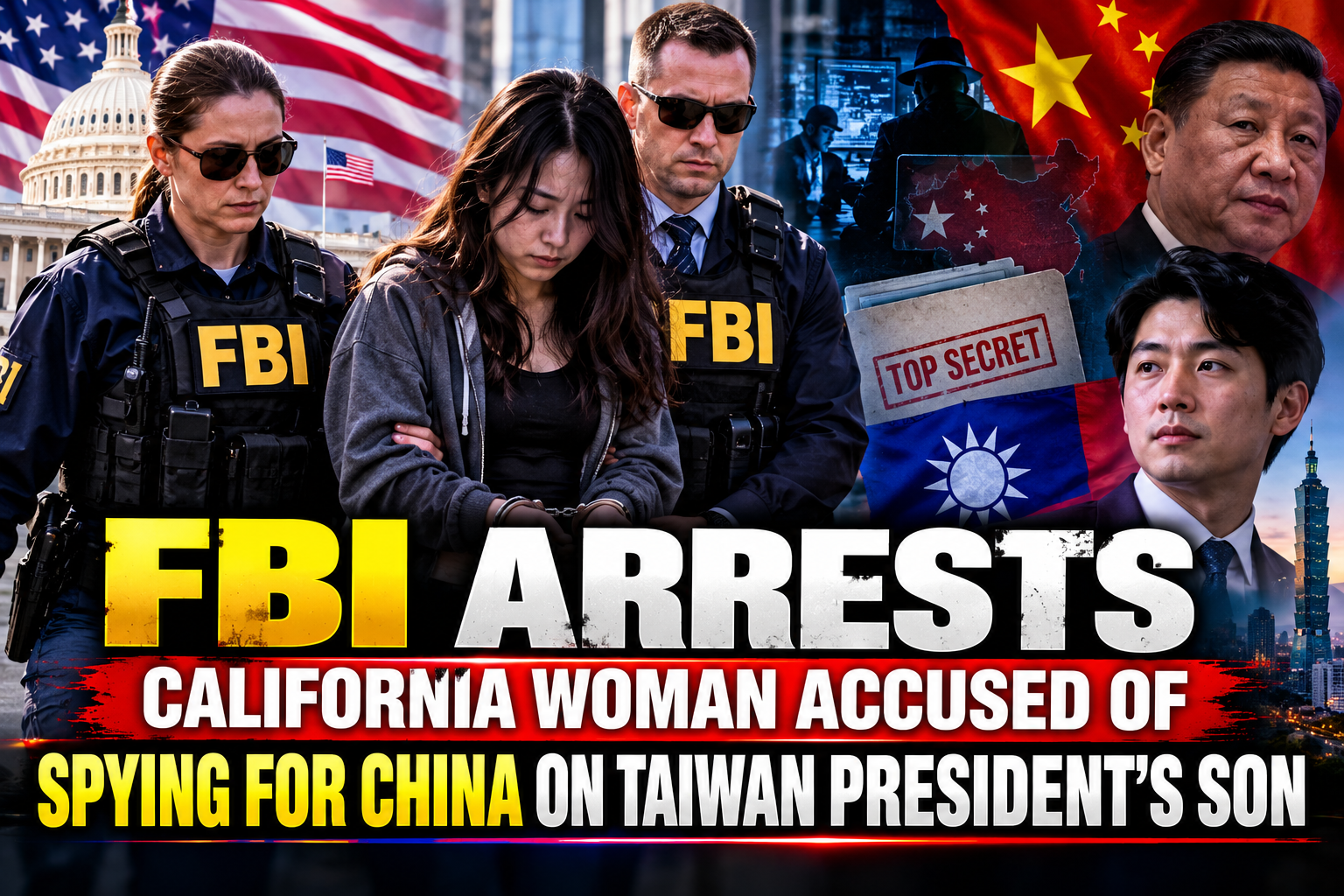
LOS ANGELES : A California real estate agent was arrested at Los Angeles International Airport after federal authorities accused her of acting as an unregistered agent for the Chinese government and conducting surveillance on the U.S.-based son and family of Taiwan’s President Lai Ching-te.
Wanying “Heather” Zhang, 34, of Irvine, was taken into custody Sunday, October 4, shortly before she was scheduled to board a flight to Shanghai, according to the U.S. Justice Department. She faces one count of acting in the United States as an unregistered agent of the government of the People’s Republic of China.
The arrest has quickly become a major national-security story, particularly because the alleged surveillance targeted a close relative of Taiwan’s president while he was living in the United States. Justice.gov
Prosecutors Describe a Covert Surveillance Operation
According to a federal criminal complaint, Zhang allegedly acted under the direction of Chinese officials between June and September 2025.
The Justice Department says Zhang traveled to China in June 2025, where she met with people prosecutors identified as officials connected to the Chinese government. Investigators allege she was then tasked with conducting surveillance in the United States.
In late August 2025, Zhang and another individual traveled from Southern California to Las Vegas. On September 1, they flew to the Pacific Northwest, rented a vehicle and traveled to the area where the target’s family lived.
Federal investigators say Zhang and the other person then watched the residence and allegedly recorded the Taiwanese official’s son and his family.
Prosecutors allege Zhang sent photographs, video and vehicle license plate information to a Chinese official through messages recovered by investigators. In one alleged message, Zhang told the contact, “Saw him, young male, it’s the young one.” She later indicated that she was recording video. Justice.gov
Who Was the Target?
The alleged target was identified by U.S. authorities and news organizations as Lai Ting-yu, the son of Taiwanese President Lai Ching-te.
Lai Ting-yu has lived and studied in the United States and is an engineer, according to reporting by CBS News. His family was living in the Seattle area when the alleged surveillance occurred. CBS News
The FBI’s complaint says information about a senior Taiwanese official’s relatives, including their homes and vehicles, could potentially provide leverage to Beijing during a future conflict.
That assessment is an allegation made by investigators, not proof that the information was ultimately used or that an attack was planned.
Zhang Was Stopped at LAX
Authorities arrested Zhang at Los Angeles International Airport as she prepared to leave the United States for China.
The timing of the arrest is one of the most striking parts of the case. Rather than discovering the alleged activity years later, investigators detained Zhang as she was about to leave the country, preventing her from completing the planned trip.
The Justice Department announced the arrest October 5 and said Zhang was expected to make her initial appearance in federal court in Los Angeles that afternoon. Justice.gov
At her court appearance Monday, Zhang confirmed her name and that she understood the charge. She did not enter a plea at that hearing, according to CBS News. CBS News
It was not immediately clear whether she had retained private counsel.
Why the Case Is Bigger Than One Arrest
The case arrives at a particularly sensitive moment in U.S.-China relations.
Beijing claims Taiwan as part of China, while Taiwan maintains its own democratic government and does not accept Beijing’s sovereignty claims. Washington does not have formal diplomatic relations with Taipei but maintains extensive unofficial ties and has long pursued a policy of helping Taiwan maintain its ability to defend itself.
That geopolitical tension makes allegations involving the family of Taiwan’s president especially sensitive.
Taiwan’s presidential office condemned the alleged surveillance and described it as an example of “transnational repression”—a term used for attempts by governments to intimidate or monitor people beyond their own borders. Reuters reported that Taiwan praised U.S. authorities for protecting Taiwanese citizens. Reuters
China, meanwhile, has denied knowledge of the case and criticized what it portrayed as attempts to use alleged espionage cases to attack China, according to reporting from The Wall Street Journal. The Wall Street Journal
A Growing U.S. Counterintelligence Challenge
American authorities have increasingly warned about foreign governments attempting to influence, surveil or intimidate people inside the United States.
The Justice Department has previously prosecuted cases involving alleged Chinese efforts to monitor dissidents, activists and Taiwanese interests on American soil.
The Zhang case is different in one important respect: prosecutors allege the surveillance was directed at a member of the immediate family of a sitting foreign president.
That could make the case a significant test of how aggressively the United States responds to foreign intelligence operations involving people connected to allied or partner governments.
What Happens Next?
Zhang’s case will now move through the federal court system. Prosecutors must prove their allegations beyond a reasonable doubt, and the criminal complaint is not a finding of guilt.
The Justice Department says the charge carries a statutory maximum sentence of 10 years in federal prison if Zhang is convicted. Justice.gov
For investigators, the next questions will include who directed the alleged operation, what information was ultimately collected, and whether other people in the United States were involved.
The Bottom Line
The FBI’s arrest of Wanying “Heather” Zhang has exposed an alleged Chinese surveillance operation targeting the family of Taiwan’s president inside the United States. Federal prosecutors say Zhang photographed and recorded the family and sent information to Chinese contacts before she was arrested at LAX while preparing to fly to Shanghai.
The allegations are serious, but the case remains in its early stages. Zhang is presumed innocent unless proven guilty in court. Still, the arrest underscores how tensions involving Taiwan and China can reach far beyond the island itself—and directly onto American soil.