By U.S. Politics & Technology Desk | October 6, 2026
NEW YORK — New York City Mayor Zohran Mamdani is taking a cautious position on one of the biggest technology debates in America: who should regulate artificial intelligence?
While City Council Speaker Julie Menin and other lawmakers are pushing for aggressive local rules on advanced AI, Mamdani has argued that the federal government needs to take the lead on the broader risks posed by the technology.
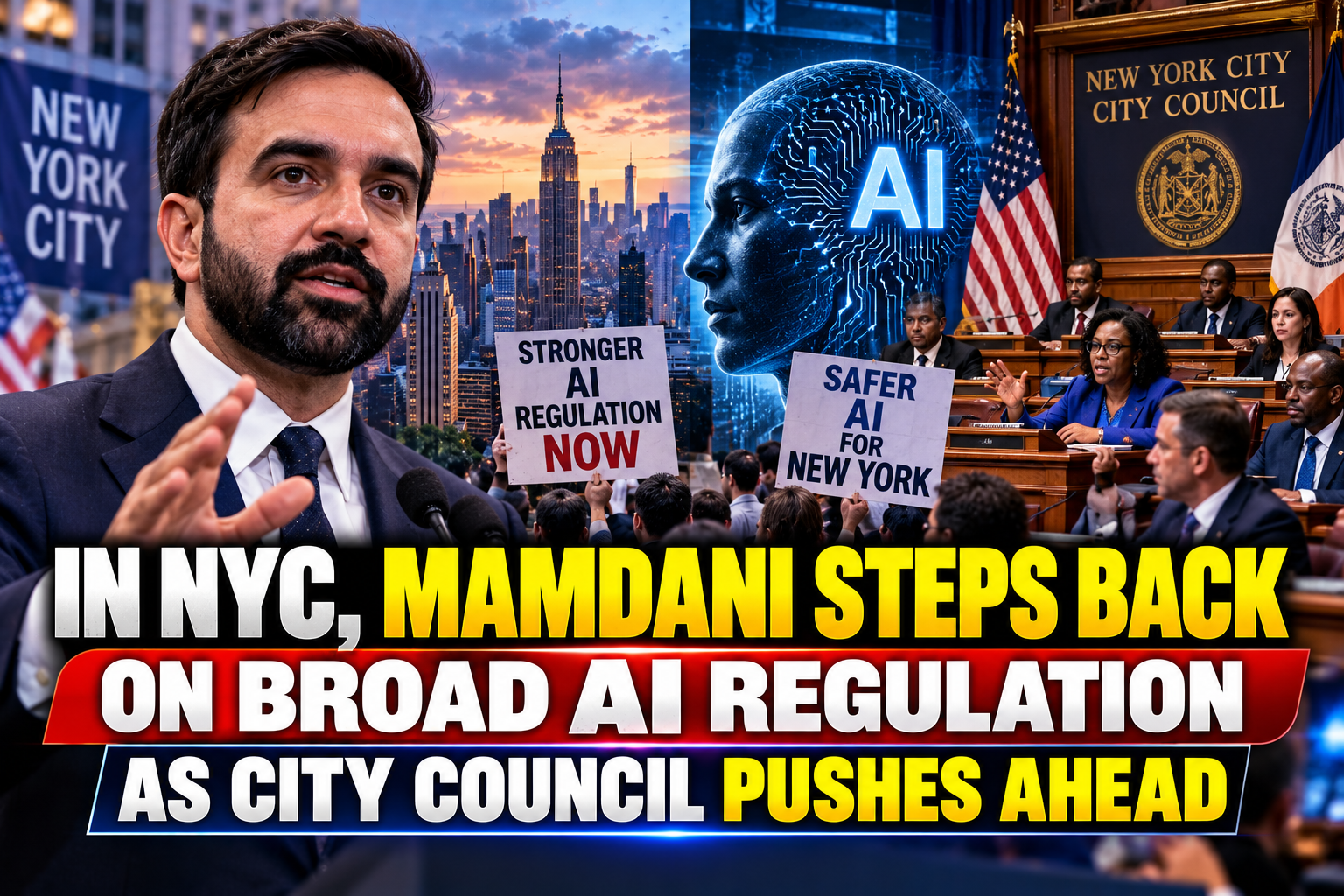
That split was on full display Monday, October 5, when the New York City Council held an unusual citywide hearing focused on AI safety. Representatives from major technology companies faced intense questioning, while former industry employees warned that rapidly advancing systems could create serious risks if governments fail to act. AP News
The result is an emerging political divide inside City Hall: Mamdani is demanding stronger federal action, while some of his colleagues want New York City to regulate what it can right now.
Mamdani Says Washington Needs to Act
Mamdani has not argued that government should ignore artificial intelligence.
In a September 15 news conference, the mayor said recent AI developments were “incredibly alarming” and argued that the federal government should respond with the urgency appropriate to the potential dangers.
He also said New York City would continue exploring every avenue available to local government. At the same time, he acknowledged that the most comprehensive response requires stronger federal leadership. New York City Government
That position puts Mamdani at something of a crossroads.
A city mayor can regulate certain local uses of technology, protect city agencies and schools, and enforce consumer rules. But many of the biggest AI questions—such as the development of frontier models, nationwide safety standards and rules governing major AI companies—extend far beyond city boundaries.
Mamdani appears reluctant to pretend New York can solve those national problems by itself.
Julie Menin Is Taking the Local Fight Directly to AI Companies
Menin, meanwhile, is moving in the opposite direction.
The City Council unveiled several proposals in September designed to establish new AI safeguards in New York City. One of the most striking would require AI models sold or deployed in the city to undergo third-party validation and possess a technical capability allowing a human operator to shut them down.
The proposal would also allow civil penalties of up to $25,000 for certain violations. New York City Council
Another proposal would create a system allowing members of the public to report AI violations to the city’s Department of Consumer and Worker Protection. Depending on how an enforcement case proceeds, people who provide information could potentially receive a share of recovered penalties. NYC Council Legistar
Those ideas go well beyond simply asking Washington to act.
They represent an attempt by local lawmakers to establish guardrails themselves—even as the federal government remains the center of the national AI policy debate.
Monday’s Hearing Put the Divide on Display
The October 5 hearing brought executives from OpenAI, Google, Anthropic and Meta before the Council, alongside former AI researchers and whistleblowers.
Former Anthropic researcher Jacob Coxon warned lawmakers that the technology industry is moving too quickly and that developers may not fully understand how to control increasingly powerful systems.
AP reported that former employees from Anthropic, OpenAI and Google DeepMind urged greater transparency and oversight, while company representatives acknowledged that AI carries risks and expressed openness to some forms of regulation. AP News
Menin pressed companies on issues including safety testing, independent oversight and the possibility of catastrophic failures.
The hearing also highlighted a larger frustration among lawmakers: Washington has not yet created a comprehensive federal AI framework.
That vacuum is encouraging states and cities to experiment with their own rules.
But Can a City Really Regulate AI?
This is where the debate becomes complicated.
AI systems are developed, trained and deployed across state and national borders. A company can be headquartered in California, operate data centers in several states and offer an AI service to users around the world.
New York City can regulate conduct inside its jurisdiction, but it cannot easily establish a complete national safety regime on its own.
That is one reason Mamdani’s federal-first position has a practical argument behind it.
Still, waiting for Congress also carries political risks.
The City Council argues that local governments cannot simply stand still while AI capabilities advance. Its proposed rules are designed to address areas where municipal authority may be more direct, including consumer protection, city technology systems and requirements attached to AI models operating in New York.
Mamdani Has Already Used City Power on AI
The mayor’s approach is not purely hands-off.
His administration recently backed a one-year moratorium on generative AI use for students from pre-K through eighth grade in New York City’s public schools for the 2026–27 academic year. High school students will receive AI literacy training instead.
That suggests Mamdani is willing to regulate specific local uses of AI while arguing that the biggest safety questions belong at the federal level.
The distinction could become increasingly important as the technology spreads into schools, workplaces, government services and critical infrastructure.
A New Political Battle Is Taking Shape
The disagreement is unlikely to end with Monday’s hearing.
New York is becoming a testing ground for a much larger national question: Should cities and states wait for Congress to establish uniform AI rules, or should they impose protections independently and force Washington to catch up?
Mamdani appears to favor a coordinated national approach for the biggest AI risks.
Menin and other council members are signaling that local government cannot afford to wait.
The Bottom Line
New York City’s AI debate is no longer simply about whether artificial intelligence should be regulated. It is increasingly about who should do the regulating.
Mamdani is calling for stronger federal leadership while using city authority in targeted areas such as public schools. Meanwhile, the City Council is advancing proposals that could impose some of the country’s most aggressive local AI requirements.
For New Yorkers—and eventually Americans nationwide—the struggle may offer an early preview of the next major technology-policy fight: national standards versus local control.