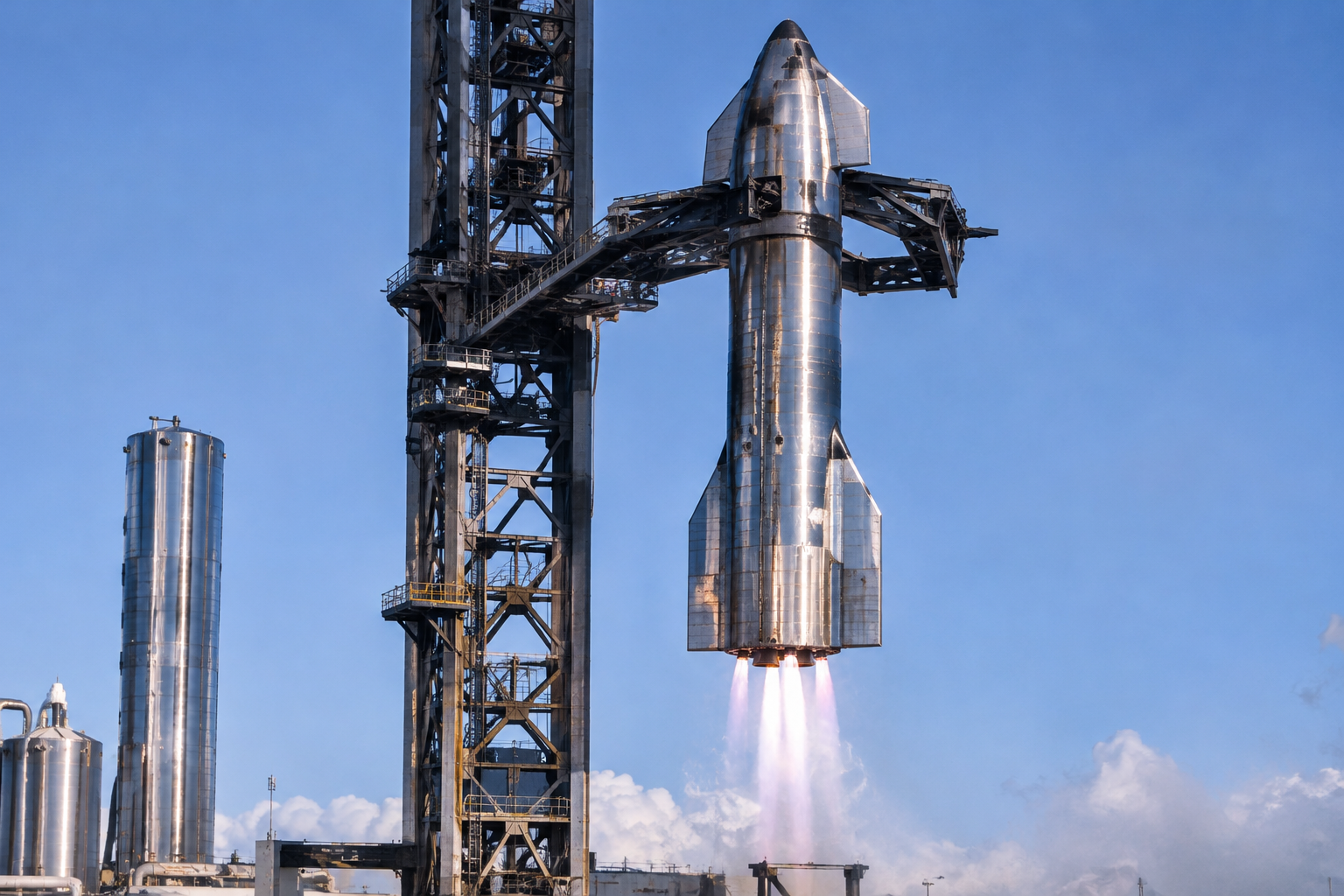
SpaceX has achieved a historic milestone in reusable spaceflight after its Starship spacecraft returned from a 22.5-hour orbital mission and was successfully caught by the giant mechanical arms of its launch tower in Texas. The breakthrough marks the first successful return and tower catch of a Starship upper stage after an orbital flight.
STARBASE, TEXAS — November 17, 2026
SpaceX has accomplished something previously unseen in orbital spaceflight.
On Saturday, November 14, the company’s massive Starship spacecraft returned from orbit and was caught in midair by the enormous mechanical arms of its launch tower at Starbase, Texas.
The historic achievement came approximately 22.5 hours after Starship’s November 13 launch, during the company’s 15th integrated flight test.
SpaceX celebrated the moment with a simple announcement on social media:
“Mechazilla catches Starship!”
The successful recovery of Ship 42 represents a major step toward Elon Musk’s long-term ambition of developing a fully reusable launch system capable of routinely traveling between Earth and space.
22 Hours in Space and 14 Orbits Around Earth
Starship Flight 15 began with a successful launch from SpaceX’s Starbase facility in South Texas.
The spacecraft reached orbit at approximately 161 miles above Earth and completed 14 revolutions around the planet during its extended mission.
One of its main objectives was deploying 26 Starlink V3 satellites, which successfully entered orbit.
These next-generation satellites are designed to significantly increase the capacity of SpaceX’s global internet network.
After completing its payload deployment and remaining in orbit for more than 22 hours, Ship 42 began its journey back toward Earth.
The spacecraft performed its deorbit maneuver, entered the atmosphere at approximately 17,000 miles per hour, and faced extreme temperatures during reentry.
Its improved heat shield and flight-control systems were critical to completing the journey.
The Historic Moment: Mechazilla Catches Starship
As Ship 42 approached Starbase, its engines reignited and the enormous spacecraft maneuvered into a vertical landing position.
The tower’s massive mechanical arms, nicknamed “chopsticks,” closed around the descending vehicle.
The spacecraft was successfully secured by the launch tower at approximately 4:20 p.m. Eastern Time on November 14.
The crowd and SpaceX employees watching the event erupted in celebration.
Previously, SpaceX had demonstrated that its launch tower could catch returning Super Heavy boosters. However, catching the much larger Starship upper stage after an orbital mission presented a new engineering challenge.
This flight demonstrated that the spacecraft itself could also return to its launch site and be caught.
One Part of the Mission Did Not Go as Planned
Although Starship’s recovery was successful, the mission was not a complete two-stage recovery.
SpaceX had also planned to catch the Super Heavy booster, but the attempt was automatically aborted after the boostback sequence ended early.
The booster diverted toward an offshore landing in the Gulf of Mexico instead.
Early flight information pointed to a low-fuel-mass alarm, but SpaceX said its guidance and navigation system correctly triggered the automatic abort when the booster was not in the required position.
The company continued investigating the underlying cause.
What This Means for America’s Future in Space
The successful catch could transform the economics of launching massive spacecraft.
Instead of discarding expensive rocket stages after every mission, SpaceX aims to recover, inspect, refurbish, and fly both parts of Starship repeatedly.
The technology is central to the company’s plans for expanding Starlink, supporting future orbital operations, and eventually transporting astronauts and equipment to the Moon and Mars.
NASA has also committed billions of dollars toward using Starship as part of its Artemis lunar exploration program.
However, important challenges remain, including improving heat-shield durability and demonstrating orbital propellant transfers needed for long-distance missions.
Starship Flight 15 did not achieve complete recovery of both rocket stages, but it demonstrated something extraordinary: an orbital spacecraft can return to Earth and be caught by the same tower that launched it.
For the American space industry, November 14 could become an important milestone in the history of reusable spaceflight.



