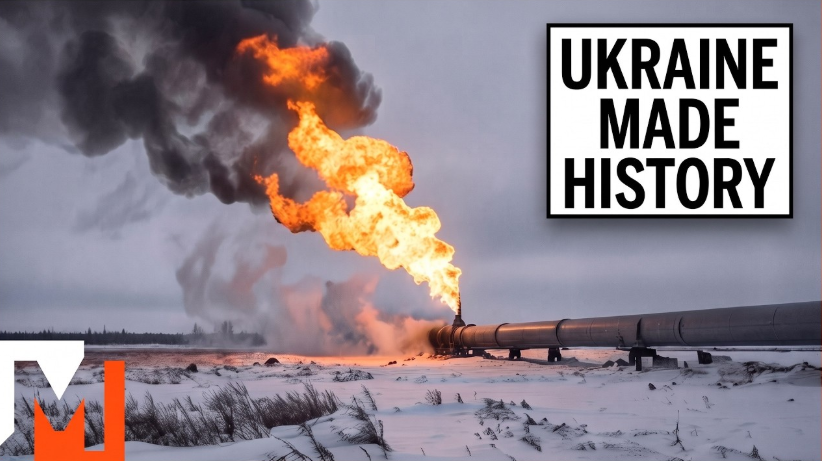
Ukraine has demonstrated that even Russia’s remote Arctic energy infrastructure may no longer be beyond the reach of its long-range drones. On September 9, Ukrainian forces launched an operation targeting two major gas-condensate facilities in Russia’s Yamalo-Nenets Autonomous Region, including the Novy Urengoy processing plant, more than 2,800 kilometers from Ukraine’s border.
The operation marked one of the deepest reported Ukrainian strikes of the war, challenging Moscow’s assumption that its most distant industrial facilities could remain relatively safe from Ukrainian attacks.
A Record-Breaking Strike Deep Inside Russia
Ukraine’s Special Operations Forces announced that their long-range units had struck the Novy Urengoy Condensate Treatment Plant and the Purovsky Gas Condensate Processing Plant.
Both facilities are located in the Yamalo-Nenets region of northwestern Siberia, a major center of Russia’s natural gas and gas-condensate industry.
Ukrainian sources described the operation as the deepest strike against Russian industrial targets since the beginning of the full-scale invasion in February 2022.
The exact distance remains disputed. The Insider placed the Novy Urengoy facility approximately 2,800 kilometers from Ukraine’s border, while Ukrainian manufacturer Fire Point and affiliated reporting described the FP-1 drones as traveling more than 3,200 kilometers. The precise launch location and flight route have not been independently established.
FP-1 Drones Reach Russia’s Arctic Energy Infrastructure
Ukrainian defense manufacturer Fire Point said its FP-1 long-range drones were used in the operation.
The reported range represents a substantial increase from the approximately 700-kilometer maximum range initially attributed to the FP-1 platform.
According to Ukrainian open-source intelligence analysts at CyberBoroshno, the Novy Urengoy facility’s de-ethanization gas-treatment unit was among the structures targeted.
The unit processes gases released during condensate treatment, including ethane, which is an important raw material for producing ethylene and polyethylene.
The nearby Novy Urengoy Gas Chemical Complex has a planned production capacity of approximately 400,000 metric tons of polyethylene annually. Damage to the treatment infrastructure could therefore affect a broader industrial production chain, although the full extent of operational disruption has not been independently established.
Russia Confirms Fire at an Industrial Facility
Russian regional governor Dmitry Artyukhov confirmed that a drone attack had occurred on September 9 and that an industrial facility caught fire.
However, his public statement did not identify the exact facility. He said Russian air defenses had repelled the attack, but falling debris caused the fire. He also reported that there were no fatalities or injuries.
The Russian energy company Gazprom did not respond to Reuters’ request for comment about the incident.
Meanwhile, Ukrainian officials described both gas-condensate facilities as important targets supporting Russia’s energy industry and government revenues.
Why This Region Matters to Putin
The importance of the operation goes beyond the damage to one processing unit.
The Yamalo-Nenets Autonomous Region contains some of Russia’s most important natural gas reserves and production infrastructure. Novy Urengoy is widely known as Russia’s unofficial gas capital.
The Novy Urengoy processing plant has a designed capacity of approximately 19.5 million metric tons of raw material annually. The neighboring Purovsky facility processed 13.4 million metric tons of gas condensate in 2025, according to Ukrainian reporting.
These figures describe processing capacity and production, not the percentage of Russia’s national natural gas extraction. The claim that this single plant produces 80% of Russia’s gas would therefore be misleading.
Another important detail is the proximity of Yamal LNG, one of Russia’s largest liquefied natural gas projects, located approximately 600 kilometers from the Novy Urengoy facility.
The LNG complex itself was not identified as a target in the September 9 operation. Nevertheless, the attack brought attention to security concerns surrounding Russia’s wider Arctic energy infrastructure.
A New Challenge for Russia’s Energy Security
Ukraine’s strategy increasingly focuses on infrastructure that supports Russia’s ability to finance and sustain its military campaign.
Oil refineries, fuel depots, transportation facilities and now remote gas-processing installations have all become potential targets.
The September operation demonstrated that geographic distance alone cannot guarantee protection.
The biggest strategic message is that Russia’s economic infrastructure deep inside Siberia may face risks once associated primarily with facilities closer to the Ukrainian border.
Whether the damage will create lasting economic consequences remains uncertain. But Ukraine has shown that its long-range drone campaign can reach some of the most important industrial regions supporting the Russian economy.



