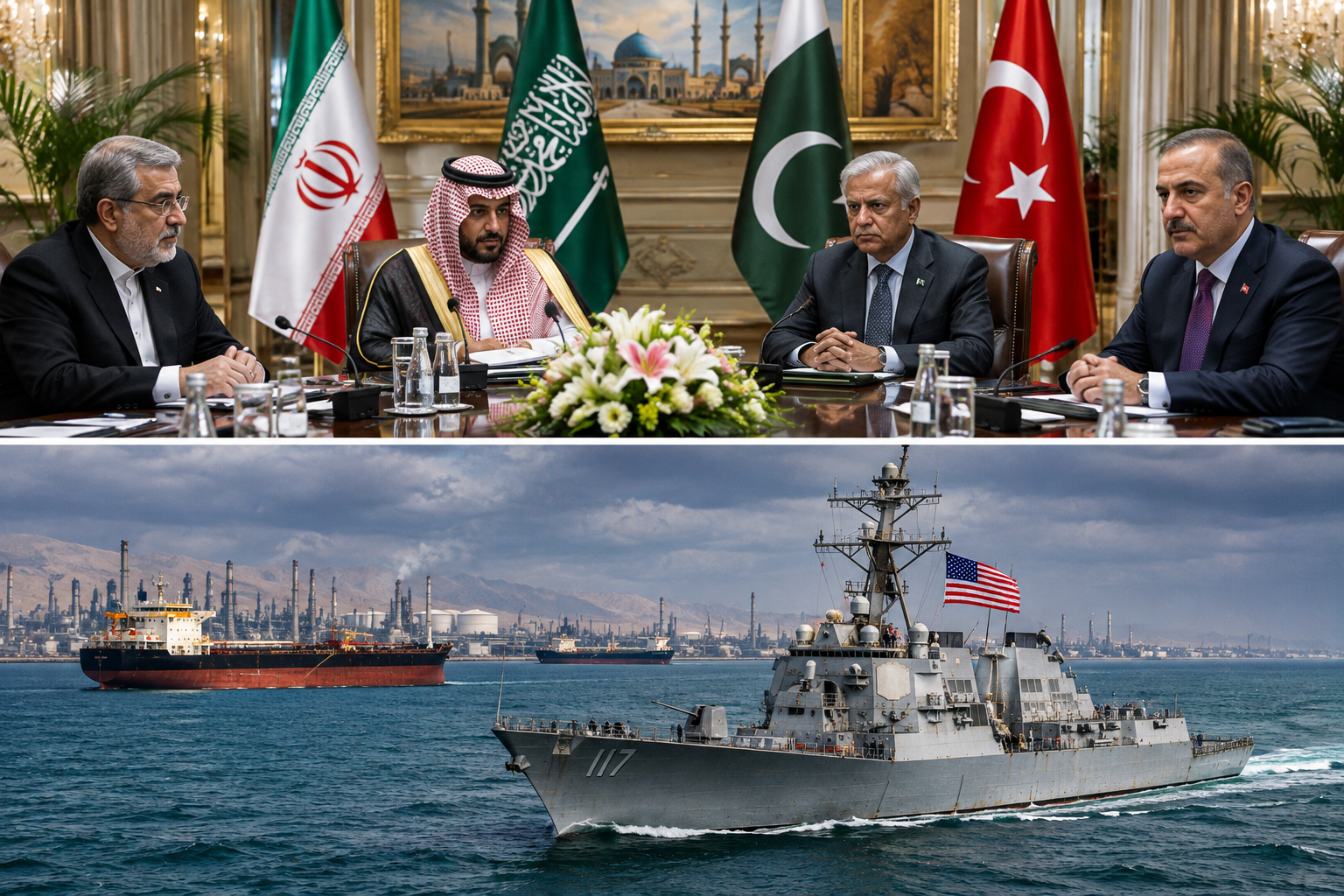
The Persian Gulf is facing another dangerous escalation as the United States carries out new strikes against Iranian targets, attacks on commercial shipping continue, and regional governments intensify diplomatic efforts to prevent a wider war.
A dramatic headline claiming that four countries have joined forces to launch a major military attack, however, does not accurately describe the latest developments. On October 26, Iran, Saudi Arabia, Pakistan and Türkiye held high-level security talks in Tehran, seeking to prevent another round of fighting—not coordinate an offensive against Iran.
Meanwhile, the United States conducted additional strikes on November 2, targeting Iranian positions on Qeshm Island near the strategically important Strait of Hormuz.
Four Countries Meet as Regional Security Deteriorates
The October 26 meeting brought together representatives from four countries with increasingly important roles in Middle Eastern security.
Saudi Arabia was represented by Defense Minister Prince Khalid bin Salman, Pakistan by Army Chief Field Marshal Asim Munir, Türkiye by intelligence chief Ibrahim Kalin, and Iran by senior national security officials.
The discussions focused on regional stability, diplomatic communication and preventing the conflict from escalating further.
The meeting was particularly significant because Saudi Arabia, Pakistan and Türkiye had signed a mutual-defense agreement in August. However, the four countries did not announce a joint military operation against Iran.
Instead, the diplomatic initiative demonstrated that regional governments are attempting to prevent the conflict from spreading beyond its existing battlefields.
United States Launches New Strikes Near the Strait of Hormuz
While diplomats were pursuing negotiations, American forces continued military operations.
On Monday, November 2, the United States carried out limited strikes against Iranian targets on Qeshm Island, located near the northern entrance to the Strait of Hormuz.
A U.S. official described the operation as defensive, saying American forces targeted Iranian personnel using surface-to-air missiles against U.S. assets. Another official said missile launchers were among the targets.
Iranian state television reported explosions on the island.
The operation did not represent an officially announced return to full-scale hostilities. However, it came despite President Donald Trump previously saying that the United States would not launch new attacks against Iran before the November 3 midterm elections.
The latest strikes raise questions about whether Washington is preparing for another phase of military confrontation or attempting to protect its forces while negotiations continue.
American Military Bases Across the Gulf Have Suffered Damage
The wider conflict has already exposed vulnerabilities in America’s regional military infrastructure.
An Associated Press investigation published on October 31 examined satellite imagery and interviewed regional officials familiar with the damage.
The investigation found that more than 115 missile and drone strikes attributed to Iran or Iran-aligned militias had damaged or destroyed structures at 26 U.S. military bases and other sites through August 2026.
The affected locations included Kuwait, Bahrain, Iraq, Jordan, Oman, Qatar, Saudi Arabia and the United Arab Emirates.
Kuwait experienced particularly extensive damage. At Ali Al Salem Air Base, at least 15 aircraft hangars and numerous other structures were damaged or destroyed.
The investigation also found that Iranian attacks initially focused on early-warning radars and air-defense infrastructure before expanding to aircraft, warehouses, fuel facilities and troop accommodations.
These findings illustrate why protecting American installations across the region remains a major challenge.
The Strait of Hormuz Becomes a Global Economic Flashpoint
The military confrontation is also threatening international commerce.
The Strait of Hormuz is one of the world’s most important energy shipping routes, carrying approximately one-fifth of global oil supplies under normal conditions.
On October 30, Iran’s Revolutionary Guards Navy claimed that four oil tankers had caught fire after attempting to use unauthorized shipping routes. Reuters could not independently verify those claims.
Separately, the United Kingdom Maritime Trade Operations agency confirmed receiving reports of a crude tanker being struck by an unidentified projectile. The vessel’s crew was reported safe, with no environmental impact reported.
Further disruption could affect oil prices, shipping insurance, transportation costs and energy supplies worldwide.
Diplomacy or Another Regional War?
The situation remains uncertain.
Qatari mediators have been working toward a framework under which Iran could stop attacks in the Strait of Hormuz in exchange for the United States lifting its naval blockade of Iranian ports.
At the same time, Israeli Prime Minister Benjamin Netanyahu has reportedly urged Trump to consider another major military campaign against Iran. Several Middle Eastern governments have warned that renewed large-scale fighting could draw additional armed groups into the conflict, including Yemen’s Houthis and Iran-aligned militias in Iraq.
The central question is whether diplomatic negotiations can prevent another major military escalation.
The four-country meeting was an attempt to find a regional solution, while the latest American strikes demonstrate that military confrontation remains a serious possibility.
For the United States, its Gulf partners and the global economy, the coming days could prove critical. The Persian Gulf remains under enormous pressure, and another major attack could have consequences far beyond the Middle East.



