By World News Desk | October 6, 2026 | Politics & World News
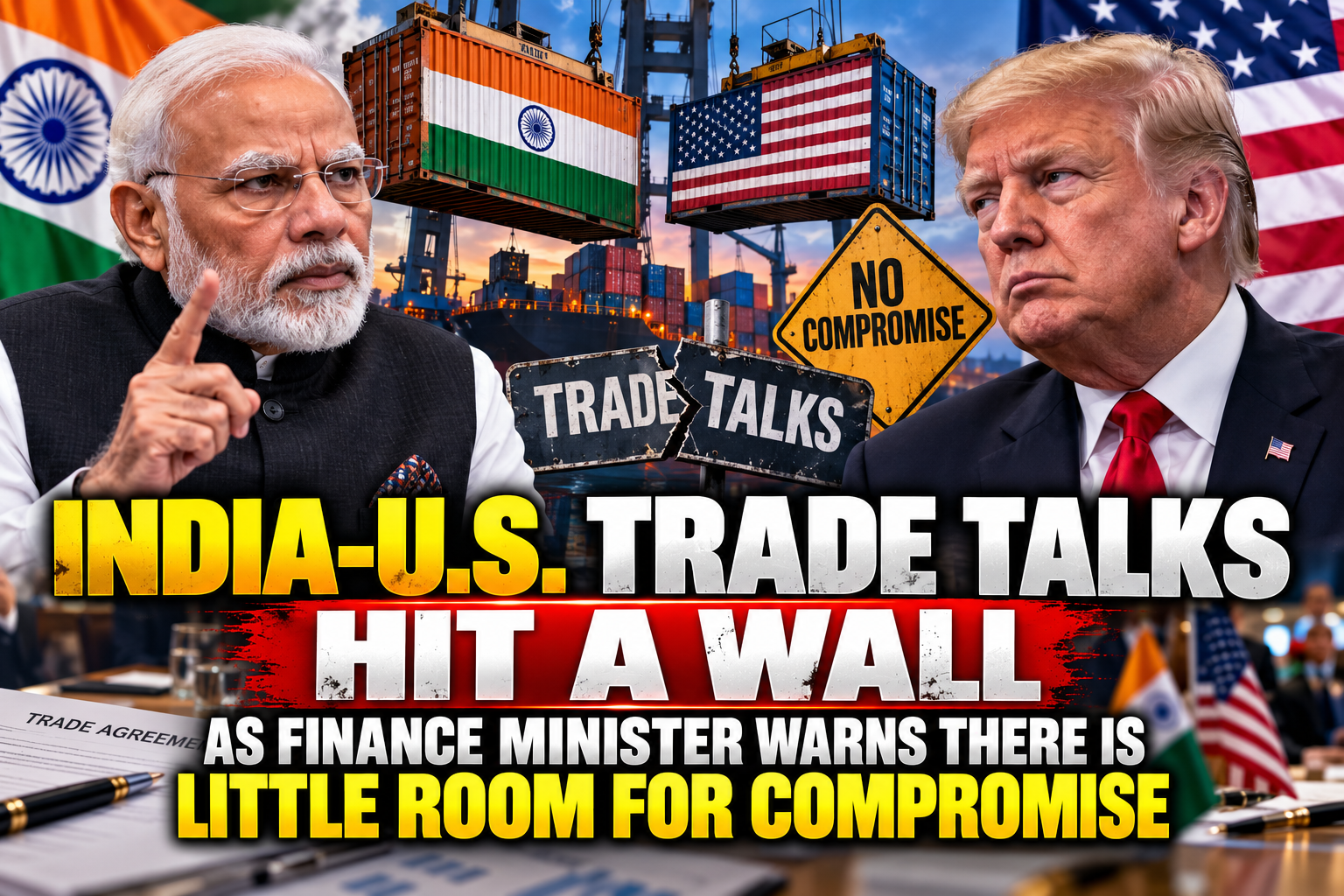
NEW DELHI : A major trade agreement between India and the United States is facing a new obstacle after India’s Finance Minister Nirmala Sitharaman said negotiations have reached a “plateau,” with both sides finding it increasingly difficult to make further concessions.
Sitharaman’s comments, reported Monday, October 5, are the clearest acknowledgment yet from New Delhi that the long-running talks remain stuck despite continued diplomatic engagement. Her remarks came just days after U.S. Trade Representative Jamieson Greer said a deal was still not imminent, even though negotiators were working through what he described as a set of remaining sticking points. Reuters
The stalled negotiations matter far beyond tariffs. India is one of Washington’s most important strategic partners in the Indo-Pacific, while the United States is India’s largest export destination. A prolonged trade dispute could put pressure on businesses in both countries and complicate a broader relationship that includes defense, energy and technology cooperation. United States Trade Representative
India’s Finance Minister Says the Easy Concessions May Be Gone
Speaking to reporters in New Delhi, Sitharaman said negotiations were continuing but suggested that the two countries had reached a point where “giving or taking” would be very difficult.
Her comments reflect a fundamental problem at the center of the talks: Washington wants to reduce its trade deficit with India, while New Delhi is seeking better access for its exports and is reluctant to make concessions that could put additional pressure on sensitive domestic industries.
The United States recorded a $58.4 billion goods trade deficit with India in 2025, according to U.S. Trade Representative data. U.S. Census Bureau figures put the 2025 deficit at approximately $58.42 billion. Through the first seven months of 2026, the U.S. goods deficit with India stood at about $28.44 billion. Census.gov
For the Trump administration, that imbalance has become a central part of its argument for changing trade terms.
For India, however, the size of the deficit alone is not something that can simply be negotiated away.
Washington Says a Deal Is Close But Not Close Enough
The latest comments from New Delhi came shortly after Greer gave a similarly cautious assessment.
Speaking after meeting Indian Commerce and Industry Minister Piyush Goyal on the sidelines of the G20 Trade Ministers’ Meeting in Milwaukee, Greer said the negotiations were in the final stretch but warned that an agreement was not imminent.
He said the two countries had identified the “universe” of issues still acting as obstacles and were working toward resolving them. Reuters
That creates an unusual picture: Both sides say negotiations are active, yet neither appears ready to make the final concessions needed to close the deal.
For businesses, that uncertainty can be almost as disruptive as a formal breakdown.
Companies planning investments, production and exports need to know what tariff rates and market-access rules will apply months or years into the future.
Why Tariffs Are Such a Difficult Issue
The negotiations have been complicated by the broader tariff policy of the Trump administration.
India has sought preferential treatment that would make its exports to the United States more competitive. Washington, meanwhile, has pushed for greater access to India’s market and has focused heavily on reducing the trade imbalance. KhanList
Sensitive agricultural and dairy markets have been among the difficult areas in the negotiations, while India has sought protection or improved access for sectors important to its exporters.
The disagreement illustrates why trade negotiations can become so difficult: A concession that looks relatively small from Washington may have major political consequences in New Delhi.
Russia’s Oil Adds Another Layer of Pressure
Trade is also increasingly intertwined with energy and geopolitics.
India remains a major buyer of Russian crude oil. A new U.S. sanctions law gives President Donald Trump authority to impose tariffs of up to 100% on countries purchasing significant amounts of Russian energy, creating another potential source of tension between Washington and New Delhi. Reuters
That issue makes the trade talks considerably more complicated.
India needs affordable energy to support its huge population and growing economy. Washington, meanwhile, is using economic pressure as part of its broader effort to constrain Russia’s ability to generate revenue from energy exports.
The two governments therefore have to negotiate trade while simultaneously managing conflicting economic and geopolitical priorities.
Trump and Modi Are Still Talking
Despite the impasse, the relationship has not entered a complete diplomatic freeze.
Trump and Indian Prime Minister Narendra Modi spoke by phone on September 30 and reviewed cooperation in trade, defense, energy and critical technologies. India’s Prime Minister’s Office said the two leaders reaffirmed their commitment to advancing the broader U.S.-India strategic partnership. Press Information Bureau
That high-level contact suggests both governments still see value in preserving the relationship.
The problem is that good diplomatic relations do not automatically produce a trade agreement.
What Happens Next?
The immediate question is whether negotiators can find a compromise without either side appearing to surrender too much.
India wants access to the American market on terms that support its exporters. The United States wants concessions that reduce barriers to American goods and address its trade deficit.
Neither side appears ready to give up its core demands.
That leaves negotiators facing a familiar but increasingly urgent choice: compromise now, or allow the dispute to drag into another round of tariff uncertainty.
The Bottom Line
India and the United States remain in negotiations, but New Delhi is now openly acknowledging that the talks have reached a difficult plateau. Washington says the remaining issues are clearly identified, yet U.S. officials also do not expect an immediate agreement. Reuters
For American companies and consumers, the outcome could affect prices, supply chains and access to one of the world’s fastest-growing major economies. For both governments, the bigger challenge is finding a trade compromise without allowing economic disagreements to damage a strategic partnership that extends far beyond commerce.