By U.S. Politics Desk | October 7, 2026 | Politics & World News
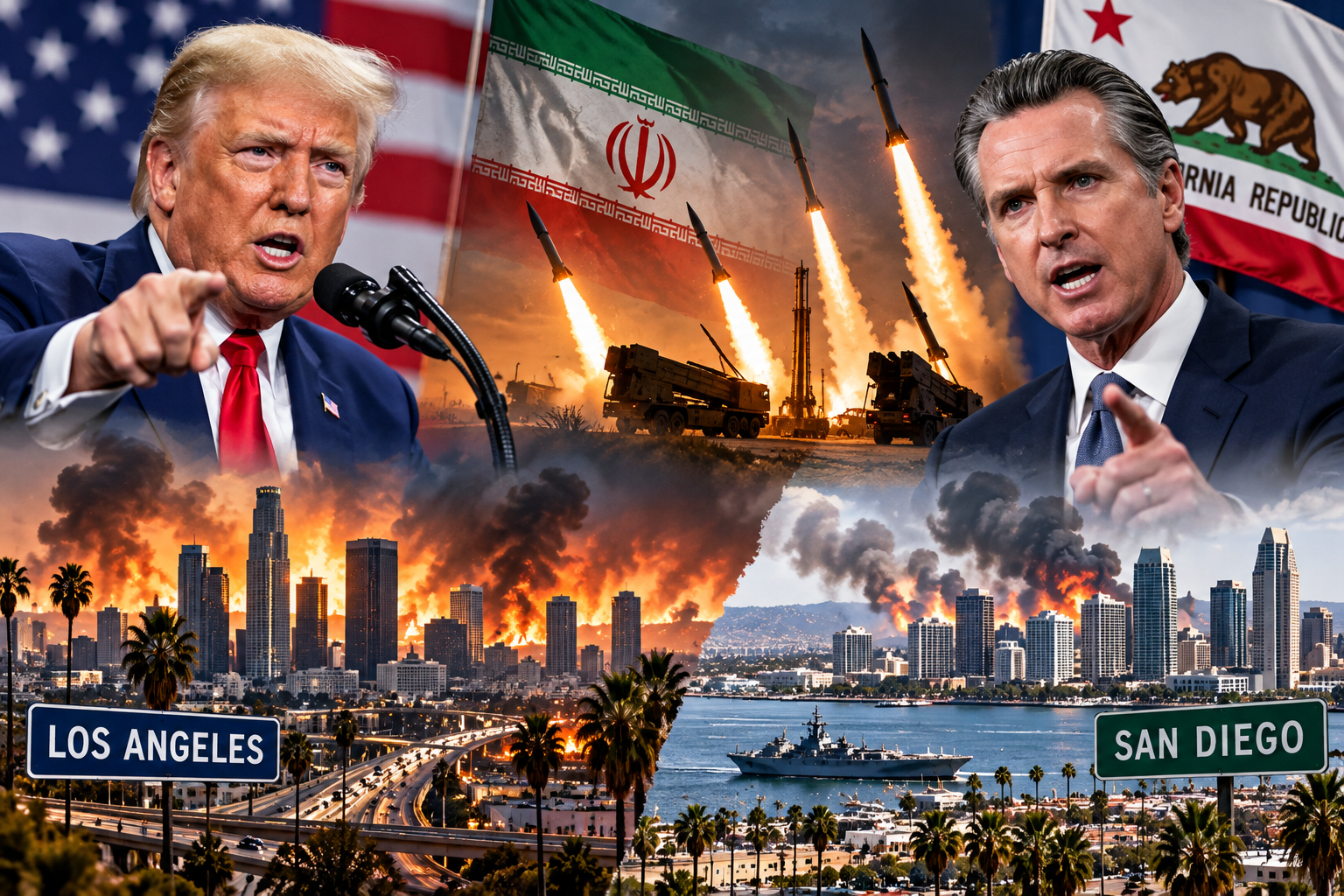
LOS ANGELES — President Donald Trump has triggered a political firestorm in California after appearing to suggest at a campaign rally that Iran could “take out” Los Angeles or San Diego, calling the potential loss of an American city a “small price to pay” for keeping the United States and the world safe.
Trump made the remarks Monday, October 5, during a Republican rally in Grand Island, Nebraska, where he defended the ongoing U.S. war with Iran and argued that the conflict was necessary to prevent Tehran from developing a nuclear weapon.
The comments were met with immediate outrage from California officials, including Gov. Gavin Newsom, Los Angeles Mayor Karen Bass and San Diego Mayor Todd Gloria.
The controversy has also exposed a deeper argument over Trump’s Iran policy, the risks of escalation and how a president should talk about potential attacks on American cities.
What Trump Said
During his speech, Trump was discussing the economic effects of the war, particularly higher prices at the gas pump.
He said the increased costs were a “small price to pay for keeping the world safe, keeping our country safe.”
He then added that Iran could “take out a city,” followed by references to Los Angeles and San Diego.
The crowd cheered.
Trump concluded by saying the war would be over “very soon” and that it was “essentially almost over.”
The wording immediately raised questions about whether Trump was describing a hypothetical danger that his administration had prevented or suggesting that an Iranian attack on American cities would be acceptable.
That distinction has become central to the political battle that followed.
California Officials Fire Back
Newsom responded on social media by calling Trump “deranged and dangerous.”
The governor argued that the president was effectively treating two major California cities as expendable while pursuing his broader confrontation with Iran.
Los Angeles Mayor Karen Bass also condemned the remarks, saying a president’s responsibility is to protect Americans rather than suggest that U.S. cities could be sacrificed.
San Diego Mayor Todd Gloria was equally blunt.
“San Diego is not collateral damage,” Gloria wrote. He said the city was not expendable and urged Trump to keep San Diego out of what he described as reckless war rhetoric.
The backlash was not limited to Democrats.
Republican congressional candidate Jim Desmond, a Navy veteran and former San Diego County supervisor, also rejected the idea that any American city should be considered an acceptable price of war.
The White House Says Trump Was Making a Different Point
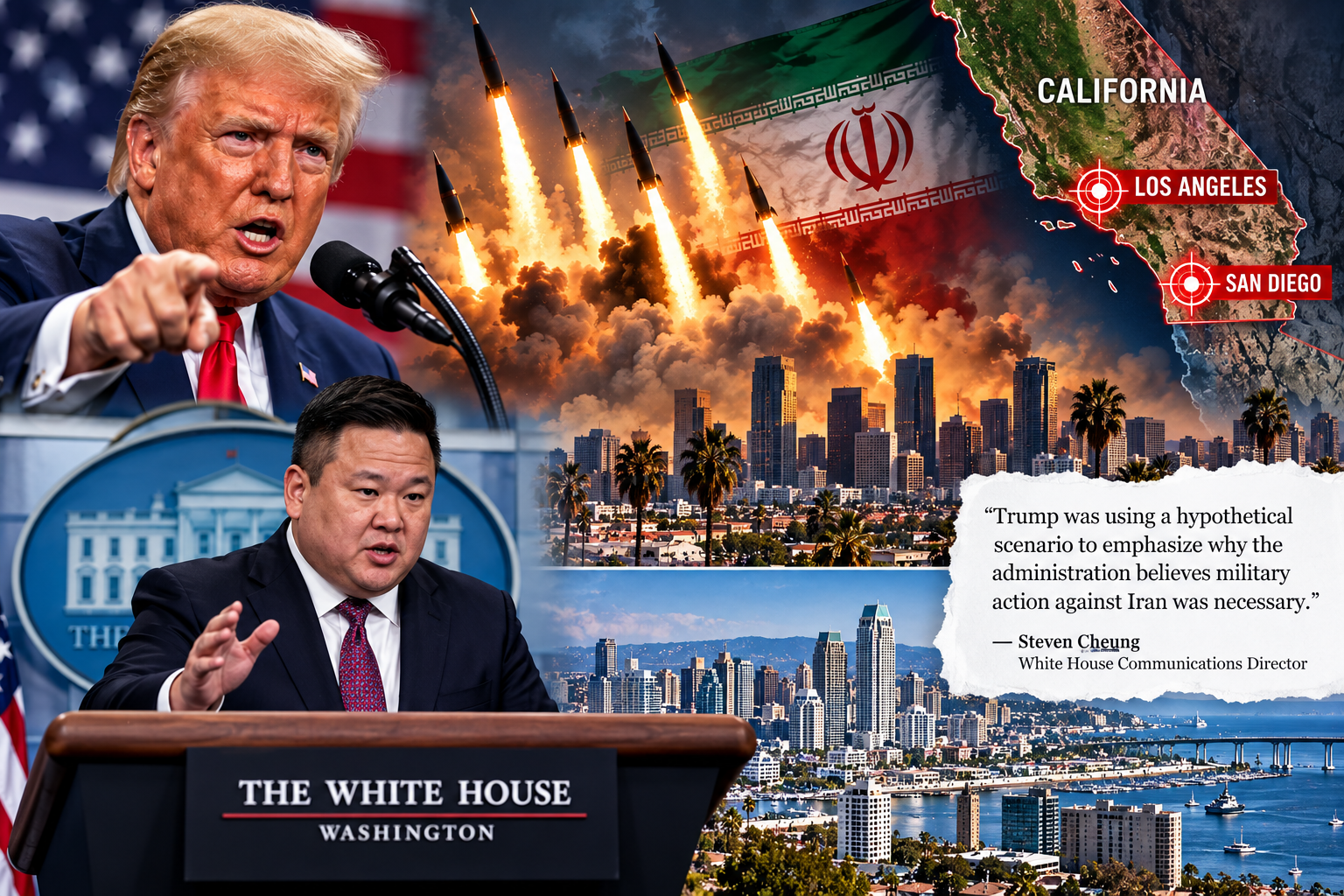
The White House has pushed back against the interpretation that Trump was calling for Iran to attack California.
Communications Director Steven Cheung said Trump was using a hypothetical scenario to emphasize why the administration believes military action against Iran was necessary.
According to the Associated Press, Cheung argued that Trump was explaining what could have happened if Iran had been allowed to develop a nuclear capability—not advocating that Tehran should attack U.S. cities.
That clarification, however, has not ended the controversy.
Critics say the president chose extraordinarily inflammatory language at a moment when the United States is already engaged in a dangerous conflict with Iran.
Could Iran Actually Hit California?
Another important question is whether Iran currently has the military capability to launch a missile attack on Los Angeles or San Diego from Iranian territory.
Publicly available reporting does not establish that Iran possesses a ballistic missile capable of reaching California today.
The Los Angeles Times reported that Iran’s stated or observed ballistic-missile range is far shorter than the distance between Iran and the U.S. West Coast. The paper noted that Iran has historically limited its ballistic missiles to roughly 1,240 miles, although U.S. officials have long expressed concern that its space program could eventually contribute to longer-range missile technology.
That makes Trump’s hypothetical scenario fundamentally different from an immediate, confirmed Iranian capability to strike California with a ballistic missile.
The possibility of unconventional threats, including drones or cyberattacks, is a separate matter. California authorities were previously warned about the possibility of Iranian retaliation, but those warnings did not establish a credible imminent threat against Los Angeles or San Diego.
Why the Remarks Hit California So Hard
The political fallout is especially intense because California has become one of Trump’s most frequent targets in domestic political fights.
The president has repeatedly criticized the state’s Democratic leadership, including Newsom and local officials, over immigration, elections, crime and other issues.
Trump’s latest comments therefore landed in an already hostile political environment.
For California leaders, the statement was not simply another campaign insult. They viewed the reference to Los Angeles and San Diego as crossing into a matter of public safety.
For Trump’s defenders, the comments were an argument for why the administration believes the Iran war was necessary.
The disagreement reflects one of the most difficult features of wartime politics: the same words can be interpreted as either a warning about a threat or an apparent normalization of catastrophic consequences.
Midterm Politics Add Another Layer
Trump made the comments while campaigning ahead of the November 3 midterm elections.
That timing is significant.
The president is attempting to rally Republican voters around his foreign-policy record while Americans continue to face higher fuel prices linked to the Iran conflict.
Trump told the Nebraska crowd that the economic pain was temporary and would be outweighed by greater national security.
But California is also a major political battleground in the broader fight over public opinion, even though many statewide races there remain heavily Democratic.
The controversy gives Newsom and other California Democrats another opportunity to portray Trump’s foreign policy as reckless and dangerous.
What Happens Next?
The political debate is likely to continue well beyond the Nebraska rally.
The Trump administration will have to explain what intelligence it believes supports the broader threat from Iran, while California officials will continue pressing the White House to avoid language that they believe could alarm residents or undermine public confidence.
The actual security threat to California may remain limited compared with the political shock caused by the president’s words.
But in a conflict involving missiles, nuclear technology and an increasingly tense U.S.-Iran relationship, rhetoric itself can become a strategic problem.
The Bottom Line
Trump’s remarks about Los Angeles and San Diego have ignited fury in California after he said an attack on an American city could be a “small price to pay” for keeping the country safe.
The White House says he was describing a hypothetical danger and defending the military campaign against Iran—not inviting an attack on California.
Still, the controversy underscores how much is at stake when the president talks about the possibility of catastrophic attacks on U.S. soil.
For California residents, the immediate question is not whether Iran is about to strike Los Angeles or San Diego. It is whether Washington’s increasingly aggressive language signals a conflict that could become even more dangerous.