
Subheadline: The Pentagon plans to broadcast the scheduled firing-squad execution of Nidal Malik Hasan, who was convicted of killing 13 people at Fort Hood in 2009. The announcement has raised new questions about military justice, public transparency and the limits of broadcasting an execution.
WASHINGTON — October 9, 2026 — The U.S. Department of Defense plans to livestream the scheduled execution of Nidal Malik Hasan, the former Army psychiatrist convicted of carrying out the deadly 2009 shooting at Fort Hood, Texas, Defense Department officials confirmed Thursday.
Defense Secretary Pete Hegseth said the execution would be made available for the public to watch, describing it as an opportunity to demonstrate the consequences of the crime. A Pentagon official subsequently confirmed that the execution would be livestreamed, although authorities have not yet released full details about how the broadcast would work or who would be allowed to access it. (Associated Press)
The execution is scheduled for December 3, 2026, at Fort Hood, where the shooting took place nearly 17 years ago. If carried out as planned, it would mark the first U.S. military execution in more than 65 years.
However, the date is not necessarily final. Hasan may still pursue legal challenges that could delay the execution, according to legal experts cited by the Associated Press.
What Hegseth Said About the Execution
Hegseth discussed the planned execution during an interview with the conservative media outlet Real America’s Voice earlier this week.
He said the military would use a firing squad, adding that the public should be able to witness the event because, in his view, people need to understand the consequences of committing such crimes. The Pentagon’s subsequent confirmation made clear that the administration intends to livestream the execution rather than simply permit a limited number of witnesses to attend in person. (CBS News)
The announcement is unusual because military execution procedures traditionally restrict attendance to authorized witnesses. Broadcasting an execution to a wider audience raises questions about how existing rules will be applied and what safeguards will govern the transmission.
The Pentagon has said further information will follow. It has not yet publicly specified the streaming platform, access restrictions or other technical arrangements.
The 2009 Fort Hood Shooting
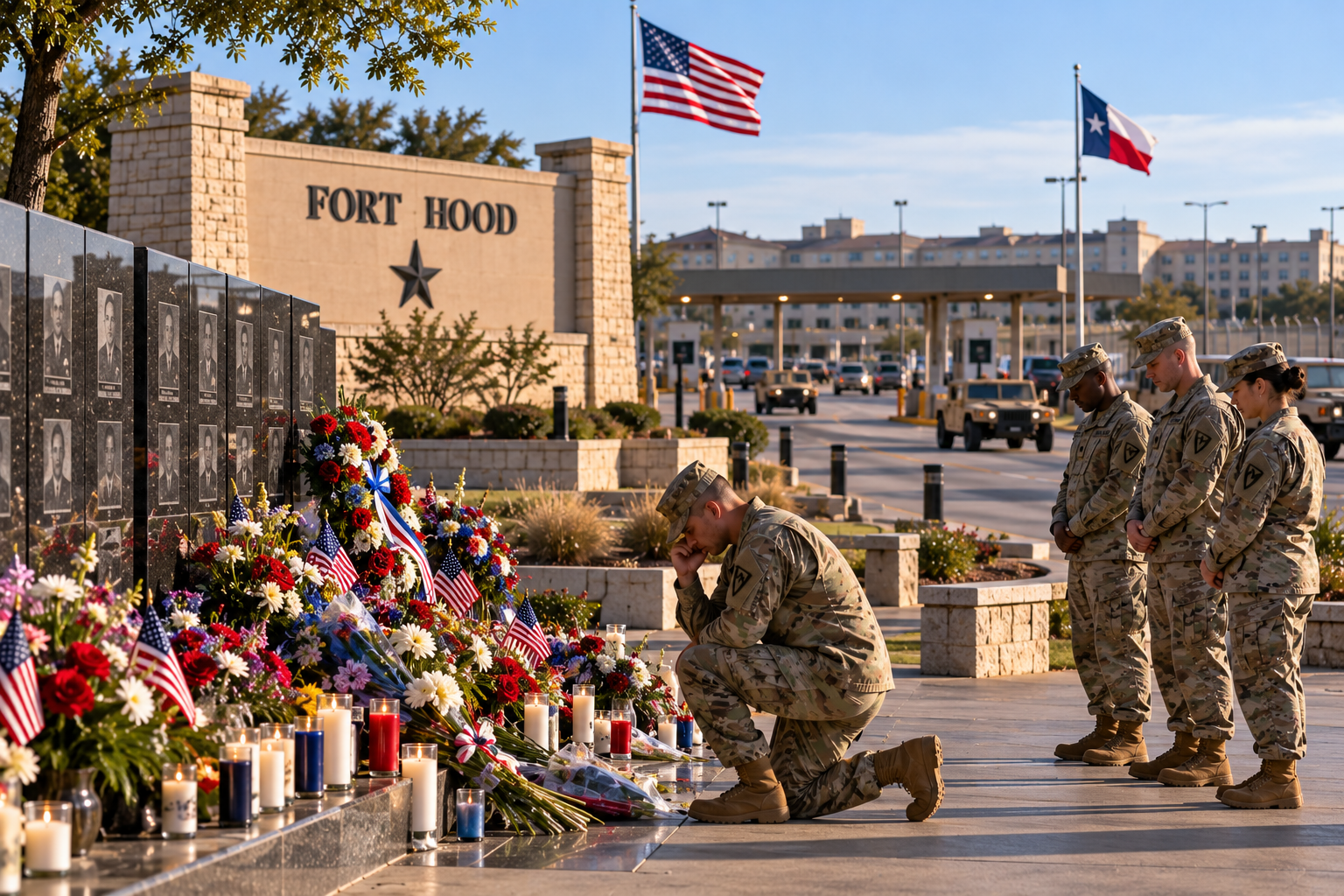
Hasan was convicted in 2013 of 13 counts of premeditated murder and 32 counts of attempted murder for the November 5, 2009, shooting at Fort Hood, then one of the largest U.S. Army installations.
Hasan, a former Army major and psychiatrist, opened fire inside a medical processing facility where soldiers were waiting for deployment-related medical procedures. The attack killed 13 people and wounded 32 others, leaving lasting consequences for survivors, military families and the wider Army community. (Associated Press)
During his trial, Hasan represented himself and acknowledged that he was responsible for the shooting. A military jury subsequently sentenced him to death.
The case became one of the most significant mass-casualty attacks on a U.S. military installation in recent history. Hasan’s conviction and death sentence have remained in place, although legal procedures associated with carrying out military executions are separate from the original trial.
Legal Questions Surround the Livestream
The decision to broadcast the execution has prompted debate among legal specialists and death-penalty experts.
Some argue that making an execution visible to the public could increase transparency by showing how capital punishment is administered. Others question whether turning the procedure into a broadcast risks transforming a legal sentence into a public spectacle.
The announcement also raises procedural questions. Military regulations generally limit who may witness executions, and it remains unclear how a livestream will be reconciled with those restrictions.
Hasan could file a habeas corpus petition in civilian court, seeking judicial review of the legality of his detention or execution. Such a petition could delay the scheduled date while courts consider the claims. Legal experts told the Associated Press that any challenge could potentially extend beyond the current administration’s term.
The Army has also faced questions about the notification process. A lawyer who has previously represented Hasan said he was concerned that Hasan had not had immediate access to legal counsel when informed that President Donald Trump had approved the execution. The Army disputed suggestions that Hasan had been prevented from contacting his lawyers, saying it had followed applicable procedures. (Associated Press)
Trump Approved the Execution
President Donald Trump approved Hasan’s execution on October 5, 2026, according to reporting by the Associated Press. The decision cleared a major administrative step toward carrying out the military death sentence.
Military executions are exceptionally rare in the United States. The last U.S. military execution occurred in 1961, when Army Private John Bennett was executed by hanging.
The use of a firing squad also distinguishes the planned execution from the lethal-injection method used in many civilian cases. Firing squads remain a legally available execution method in certain U.S. jurisdictions, but their use has attracted renewed debate as states and federal authorities confront practical and legal difficulties with other methods.
The planned livestream introduces another dimension to that debate: not simply whether an execution will take place, but whether the government should broadcast it to a potentially much wider audience.
What Happens Next?
The Pentagon is expected to provide additional information about the broadcast arrangements and execution procedures as the scheduled date approaches.
For now, December 3 remains the announced date, but legal challenges could alter the timetable. Authorities have not indicated that a livestream is already available or that the execution has taken place.
The decision has drawn attention to the intersection of military justice, capital punishment and public access to government actions. Supporters of transparency may see a broadcast as a way to make an otherwise restricted process more visible, while critics question whether such exposure is appropriate.
For the families of those killed and wounded in 2009, the case carries deeply personal consequences that extend far beyond the debate over broadcasting.
As the scheduled date approaches, the central questions remain whether Hasan will pursue further legal challenges, whether the military will proceed as planned and how the Pentagon intends to make the event public without violating applicable rules.
For now, the execution remains scheduled—not completed—and the proposed livestream has become a significant new controversy surrounding one of the deadliest attacks on a U.S. military base.