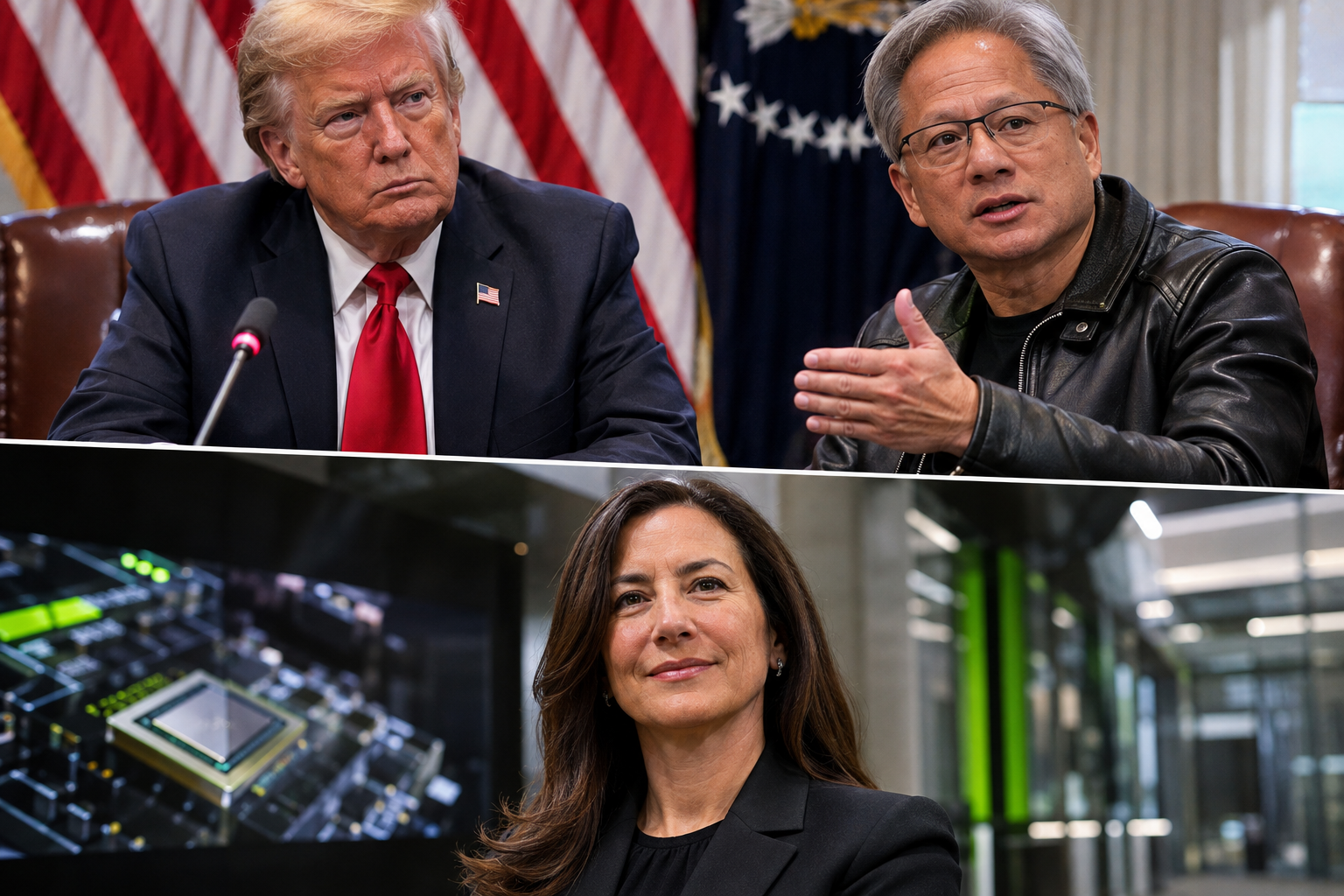
President Donald Trump reportedly made a personal appeal to NVIDIA CEO Jensen Huang, encouraging him to fight to keep his position as the technology giant faced an explosive controversy involving an alleged Chinese intelligence operation. Despite Trump’s support, Huang resigned on November 12, ending a 33-year leadership run at one of America’s most influential technology companies.
WASHINGTON, D.C. — November 14, 2026
President Donald Trump reportedly tried to persuade Jensen Huang to fight for his position at NVIDIA shortly before the technology executive resigned, adding a new dimension to one of Silicon Valley’s most extraordinary corporate controversies.
According to a New York Times report cited by Reuters on November 12, Trump called Huang on Tuesday, November 10, and encouraged him to defend his position as pressure mounted over revelations involving his personal relationships and an alleged Chinese intelligence connection.
The private conversation reportedly took place just two days before NVIDIA announced Huang’s departure.
Trump had already publicly defended the executive during a November 9 press conference, saying Huang told him he had no knowledge that the woman involved was allegedly connected to Chinese intelligence.
“I really believe him,” Trump told reporters.
The Controversy Behind Huang’s Departure
The crisis centers partly on Alice Huang, a Chinese businesswoman and former executive at Megaspeed International, a Singapore-based technology company that worked with NVIDIA.
American intelligence officials reportedly suspected she had connections to Chinese intelligence operations.
However, the allegations have not been independently verified by Reuters. Beijing has also denied that she was a Chinese spy.
The situation intensified after reports emerged that Jensen Huang had an intimate relationship with Alice Huang.
On November 8, Huang acknowledged being unfaithful to his wife and expressed regret for disappointing his family and NVIDIA.
Reuters subsequently reported that Huang had also had relationships with other NVIDIA employees, citing people familiar with the matter.
NVIDIA’s independent directors hired outside legal counsel to investigate whether Huang had been targeted by a foreign intelligence operation.
NVIDIA Announces a Sudden Leadership Change
On November 12, NVIDIA officially announced that Huang had resigned as president and CEO, effective immediately.
The decision marked the end of an extraordinary 33-year tenure.
Huang co-founded NVIDIA in 1993 and transformed it into a global leader in graphics processors and artificial intelligence computing.
The company appointed longtime Chief Financial Officer Colette Kress as interim CEO while its board begins searching for a permanent successor.
The resignation also raised questions about NVIDIA’s corporate governance, investor confidence, and the potential consequences for America’s artificial intelligence industry.
Trump Suggests Tim Cook as a Replacement
Following Huang’s departure, Trump publicly suggested that former Apple CEO Tim Cook should take over NVIDIA.
Writing on Truth Social, Trump described Cook as the person who could replace Huang, declaring, “A Legend replaces a Legend!”
However, NVIDIA has not announced that Cook is being considered for the position. The company’s board retains responsibility for selecting its next permanent chief executive.
Colette Kress remains the interim leader.
Questions Remain About National Security
Beyond the corporate controversy, the allegations have attracted significant attention in Washington because NVIDIA develops some of the world’s most important artificial intelligence chips.
The possibility that a foreign intelligence operation could have targeted a leading American technology executive has raised broader concerns about corporate security and the protection of sensitive commercial information.
U.S. authorities have reportedly examined the allegations, but the Justice Department has not established publicly that Alice Huang acted as a Chinese intelligence operative.
For now, NVIDIA faces the challenge of maintaining investor confidence while conducting its internal investigation and searching for new leadership.
Trump reportedly tried to persuade Huang not to surrender his position. But the longtime technology chief ultimately stepped away.
The departure marks the end of an era for NVIDIA and leaves Washington, Silicon Valley, and the international AI industry facing important questions about corporate leadership, national security, and America’s technological future.



