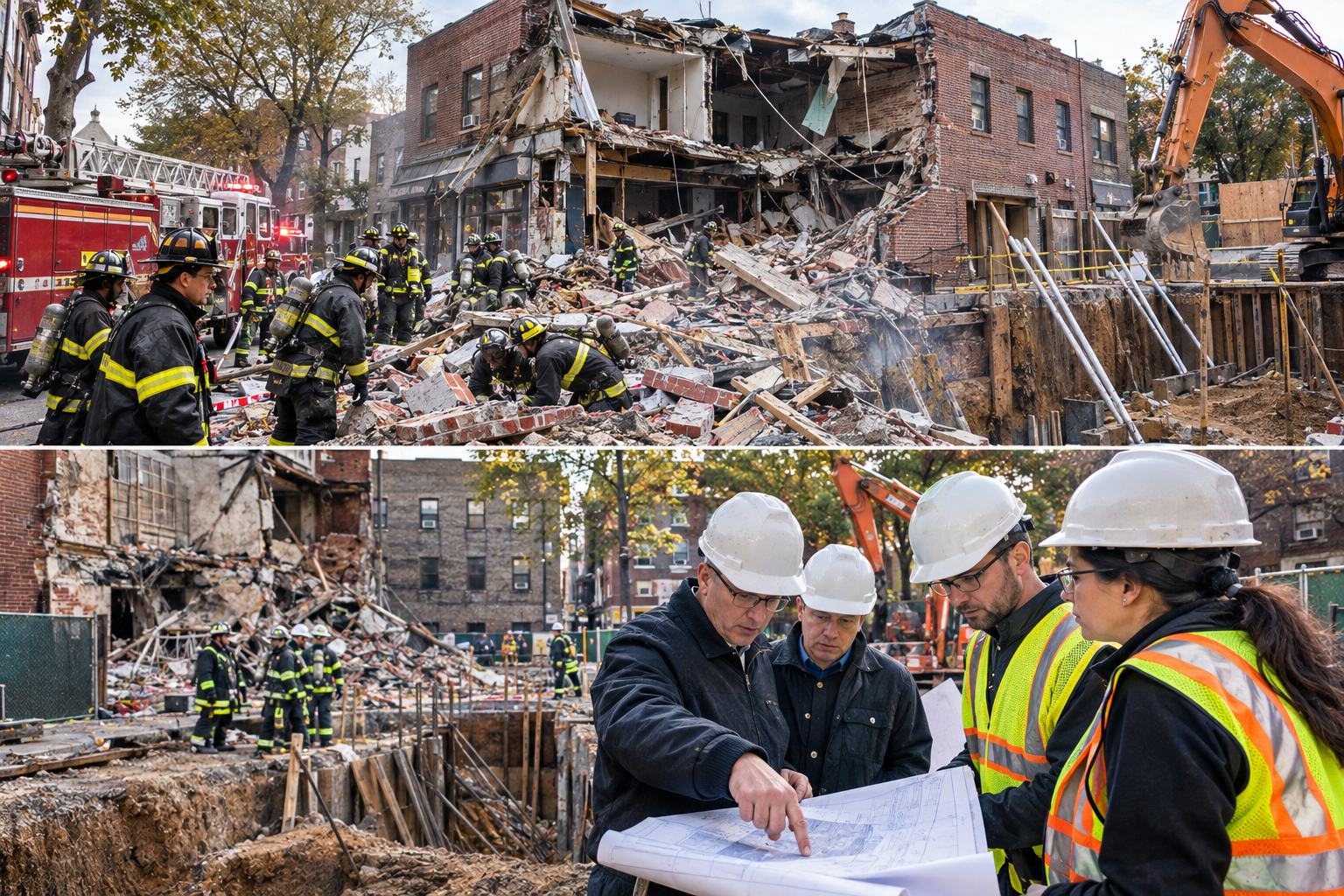
A devastating building collapse in Brooklyn’s Flatbush neighborhood has left eight people dead, including two children, and 18 injured. With rescue operations completed, investigators are examining nearby excavation work, previous safety violations, and possible failures in New York City’s building inspection system.
BROOKLYN, NEW YORK — November 14, 2026
A devastating building collapse in Brooklyn has triggered a major investigation into construction safety and government oversight after eight people lost their lives and 18 others were injured.
The three-story mixed-use building collapsed shortly after 4 p.m. on Wednesday, November 11, at 1321 Flatbush Avenue, near Bedford Avenue in Brooklyn’s Flatbush neighborhood.
The structure, which contained a street-level business and residential apartments above, fell into an excavation site next door, while the collapse also severely damaged an adjacent building.
Among the eight people killed were two children and two construction workers, according to New York City Mayor Zohran Mamdani.
Rescue Operations End After More Than 24 Hours
Hundreds of firefighters, emergency medical personnel, and police officers responded to the disaster.
Rescue workers spent more than 24 hours searching through mountains of concrete, bricks, damaged walls, and household debris.
Crews used search dogs, specialized equipment, drones, and careful manual searches to locate people who might have survived beneath the wreckage.
Six victims were recovered dead at the scene, while two others died after being transported to hospitals.
The Fire Department of New York announced that rescue operations had officially ended at approximately 3:37 p.m. on November 12 after crews determined that no additional victims remained at the site.
Authorities reported 18 injuries, including four firefighters. One injured person was initially reported in critical condition.
Investigators Examine Nearby Construction Work
Attention has now shifted to the construction site beside the collapsed building.
The neighboring property was undergoing excavation and foundation work under an active construction permit.
Investigators are examining whether excavation activities, structural support measures, construction vibrations, or changes in the surrounding ground conditions contributed to the disaster.
The Associated Press reported that contractors working at the neighboring site had previously received a stop-work order in March after inspectors found inadequate overhead protection during demolition work.
Inspectors also discovered that work had resumed in violation of that order in April, although the city subsequently allowed operations to continue after the identified problems were corrected.
These earlier findings do not establish that the construction work caused Wednesday’s collapse.
Questions About Building Inspections Grow
The disaster has raised broader questions about whether New York City’s building inspection system has sufficient resources to monitor construction projects across the five boroughs.
City housing records showed that the collapsed property had 98 outstanding violations, including reports involving leaks and other maintenance problems.
Mayor Mamdani also announced that the Department of Buildings would inspect more than 160 additional sites connected to six entities involved in the neighboring construction and demolition work.
The city has hired an independent engineering firm to help examine the circumstances surrounding the collapse.
Meanwhile, the Department of Buildings is reviewing whether contractors and property owners followed the required safety procedures.
Accountability Becomes the Next Major Challenge
The Brooklyn District Attorney’s Office is examining whether criminal charges may be appropriate, while New York Attorney General Letitia James has offered assistance if prosecution becomes necessary.
Officials have not announced a final determination about the cause or identified anyone as criminally responsible.
For the families who lost loved ones, the investigation represents an important step toward understanding how such a devastating disaster could occur.
For the Flatbush community, the tragedy has also raised difficult questions about the safety of older buildings and the responsibilities of landlords, developers, construction companies, and city inspectors.
Eight lives have been lost, 18 people have been injured, and an entire neighborhood is grieving. Now, investigators must establish what happened, whether safety rules were violated, and whether anyone should be held accountable.



