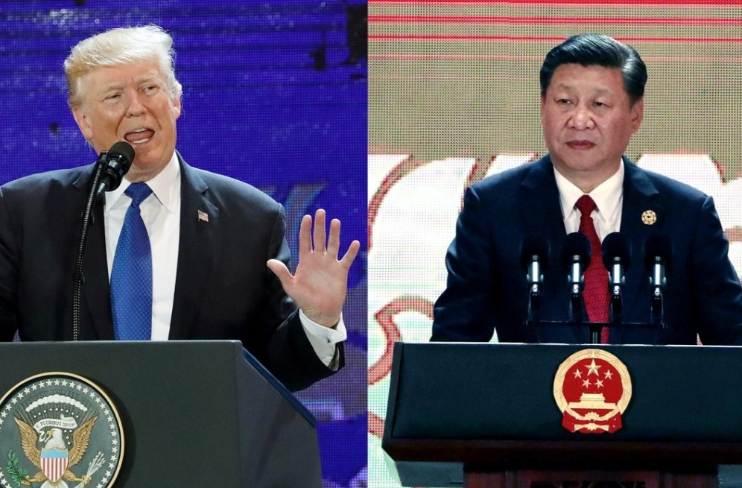
WASHINGTON, D.C. & BEIJING — In what national security scholars, defense analysts, and seasoned diplomats characterize as the most astonishing departure from established foreign policy doctrine since the opening of diplomatic relations with the People’s Republic of China, a stunning on-the-record disclosure by the United States Ambassador to China, David Perdue, has revealed that President Donald Trump directly questioned Chinese President Xi Jinping regarding potential acquisitions of American military equipment. Speaking during an interview on Fox News Sunday, Ambassador Perdue recounted that during restricted bilateral summit sessions, the American president bluntly raised the prospect of military procurement directly with the leader of Washington’s primary geopolitical rival.
“President Trump continues to say, ‘Hey, we sell arms to other people around the world,'” Perdue disclosed. “He actually asked President Xi, would he like to buy some, at one point.”
The revelation has sent seismic shockwaves through Capitol Hill, Asian defense ministries, and the Pentagon. It exposes how completely Donald Trump has discarded conventional diplomatic scripts in favor of high-stakes, transactional negotiation—even when that posture challenges longstanding statutory export controls, rattles treaty allies, and blurs the lines of the Indo-Pacific military balance.
The Negotiating Room: Demolishing Diplomatic Protocols
The encounter reportedly unfolded as the two leaders navigated intensely fraught discussions over regional security architectures, semiconductor supply chains, and the ongoing conflict in the Persian Gulf. According to diplomatic accounts, the dialogue turned to Washington’s pending weapons transfers to Taiwan. Taipei has spent months awaiting final executive clearance for an expansive, record-breaking $14 billion arms package comprising advanced anti-ship cruise missiles, specialized radar networks, and automated counter-drone defense platforms.
As President Xi pressed the administration to honor Beijing’s long-standing red line opposing all military transfers to the self-governed island, Trump pushed back using an unapologetically commercial framework. Rather than reiterating standard diplomatic boilerplate regarding the Taiwan Relations Act, the former president framed defense manufacturing as a premier American export engine—asking Xi why China itself should not be a customer.
The gambit left observers and summit attendees paralyzed in astonishment. Since the Tiananmen Square crackdown in 1989, the United States and the European Union have maintained strict statutory arms embargoes barring the transfer of lethal defense articles and dual-use military systems to the People’s Liberation Army. To casually offer American military equipment to the very rival the Pentagon describes as its pacing military threat represents a conceptual rupture that no defense strategist anticipated.
“What we are seeing is the total commodification of foreign policy,” observed a senior fellow in Indo-Pacific defense strategy at the American Enterprise Institute. “To traditional statecraft, military equipment represents an ideological alignment, sovereign deterrence, and alliance protection. To Donald Trump, an advanced weapons system is ultimately an American-manufactured commodity with a price tag. Asking Xi Jinping if he wants to buy American weapons may have been an audacious rhetorical tactic to disarm Beijing’s objections over Taiwan, but it sends a destabilizing signal to allies who rely on Washington’s technological edge for their survival.”
The Taiwan Dilemma and the Leverage Play
The revelation lands at a moment of acute vulnerability for Taipei. While Ambassador Perdue vigorously defended the president’s record, emphasizing that Trump has authorized significant weapons transfers to Taiwan since 1979, the continued procedural hold on the latest $14 billion package has fueled intense anxiety across East Asia.
Trump has previously referred to weapons sales to Taiwan as a “very good negotiating chip” in broader trade and geopolitical negotiations with Beijing. Defense experts warn that floating potential arms transactions with China while delaying scheduled shipments to Taiwan risks eroding the deterrent credibility that has preserved peace in the Taiwan Strait for generations.
In Asian capitals—most notably Tokyo, Seoul, and Manila—security planners are quietly assessing the implications of a Washington administration that treats sovereign defense pacts through an unyielding transactional lens. If weapons systems can be pitched as bargaining chips across the table from America’s greatest competitor, regional allies fear that long-term security guarantees could be subjected to arbitrary recalibration depending on the commercial temperature of the day.
“Xi Jinping’s objective in Washington was clear: get the United States to absorb Beijing’s red lines as the baseline for a stable relationship,” noted a former director for Asian affairs on the National Security Council. “By freezing the Taiwan weapons package and opening an informal conversation about selling weapons to China, Trump believes he is maintaining maximum leverage. But in the fragile calculus of deterrence, ambiguity can easily be mistaken for retreat.”
Pentagon Alarm and Legal Realities
Inside the halls of the Department of Defense and congressional oversight committees, the reaction has been one of deep institutional discomfort. Any formal sale of lethal American defense hardware to Beijing would violate binding federal statutory law under Title 22 of the United States Code and the International Traffic in Arms Regulations (ITAR), requiring explicit statutory waivers that Congress would overwhelmingly refuse to grant.
Lawmakers on both sides of the aisle expressed disbelief that such a proposal was voiced, even rhetorically. Congressional leaders pointed out that while Secretary of Defense Pete Hegseth recently testified regarding concerns that Chinese dual-use components and satellite tracking data are enabling hostile state actors across multiple combat theaters, offering front-line American military hardware to Beijing contradicts the core premises of the National Defense Strategy.
“You cannot spend hundreds of billions of dollars hardening the First Island Chain against potential aggression while casually asking the opposing commander-in-chief if he wants to place an order for American hardware,” remarked a senior member of the House Armed Services Committee. “Our defense technology is engineered to protect democracies, not to serve as icebreakers in bilateral summit meetings. The statutory arms embargo on China is non-negotiable.”
Transactional Diplomacy on the World Stage
Despite the storm of criticism, Trump’s inner circle views the exchange as an authentic demonstration of unconstrained power. Surrogates argue that the president’s willingness to say the unspeakable shatters Beijing’s predictable diplomatic maneuvers, forcing Xi Jinping out of rehearsed communist ideological postures and into an unpredictable negotiating arena where the White House commands the narrative.
By portraying American industrial might as so dominant that Washington could theoretically supply weapons to friend and foe alike, the administration seeks to project an image of absolute economic and technological supremacy that transcends traditional geopolitical anxieties.
As diplomatic cables continue to circulate through foreign ministries and defense attaches scramble to parse the implications of Ambassador Perdue’s interview, one undeniable reality has emerged: the post-Cold War diplomatic architecture has been permanently dismantled. Donald Trump has redefined the rules of 21st-century statecraft—leaving the global community to grapple with a world where even the most sacred boundaries of national defense can be put on the table in pursuit of the ultimate deal.



