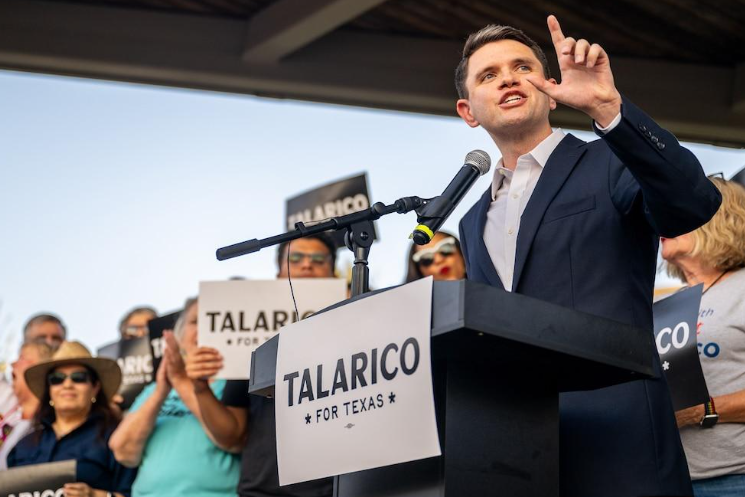
A dispute over God, gender, immigration, healthcare and Republican policies has become a defining moment in James Talarico’s Senate campaign, raising a larger question: who gets to decide what Christian values should mean in American politics?
A political confrontation involving President Donald Trump and Texas Democratic Senate nominee James Talarico has brought religion into the spotlight of one of the country’s most closely watched political contests.
At the center of the dispute is a question that reaches far beyond a single speech or television interview: What does it mean to represent Christian values in public life?
Trump has criticized Talarico over earlier remarks about God and gender, portraying the Democrat’s theological interpretation as excessively progressive and offensive to traditional Christian beliefs. Talarico’s response, as described in the circulating speech, redirected the argument toward public policy, challenging Republicans to consider how their positions on healthcare, taxation, immigration and military action align with the teachings of Jesus.
The exchange has attracted attention because both men are invoking Christianity, but using it to make sharply different political arguments.
For Trump and his allies, Talarico’s language about God raises questions about theology, cultural change and whether the Democratic candidate reflects the religious traditions of many Texas voters. For Talarico, the controversy provides an opportunity to argue that faith should be judged not simply by theological language but also by how political leaders treat people who are poor, sick, displaced or vulnerable.
Neither side has a monopoly on the interpretation of Christianity. But the dispute illustrates how religious identity has become an increasingly visible part of American electoral politics.
And with Talarico now the Democratic nominee for the U.S. Senate in Texas, the argument has consequences that extend well beyond social media.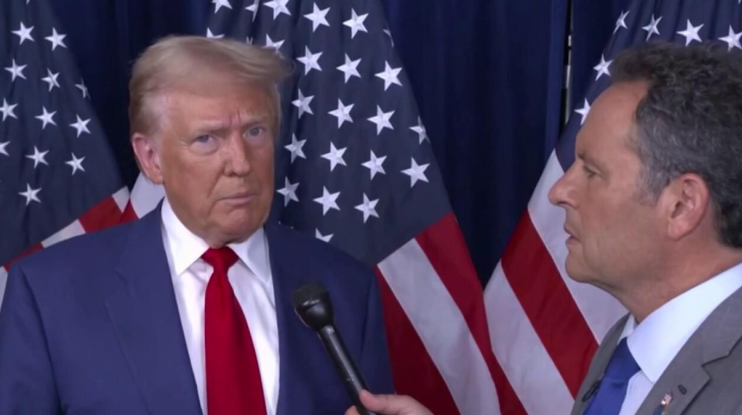
Trump’s criticism turns a theological statement into a political controversy
The disagreement centers partly on comments Talarico made in 2021 while addressing a Texas House committee.
During that discussion, Talarico argued that God should not be confined to conventional human categories of gender. His description included masculine, feminine and nonbinary language, an interpretation that quickly became controversial among critics who believe such terminology is inappropriate when discussing God.
Trump subsequently criticized the remarks during an appearance on a radio program hosted by Fox News personality Brian Kilmeade, according to the account of the exchange. He characterized Talarico’s position as “beyond woke” and suggested that the Democrat’s interpretation insulted Jesus Christ.
Trump also reportedly mocked Talarico’s vegan diet and use of face masks, extending the dispute beyond theology into a broader critique of the candidate’s personal choices and public image.
Those comments helped frame the controversy as more than a disagreement about religious language. They turned it into a debate over cultural identity, masculinity, personal values and what kind of person should represent Texas in the Senate.
For Talarico, the challenge was to respond without allowing the entire discussion to revolve around one sentence from five years earlier.
His answer, as presented in the circulating account of his speech, was to reverse the central question.
Instead of focusing exclusively on whether his description of God was appropriate, he asked his audience to consider what he believed should matter when evaluating the conduct of political leaders.
“The president of the United States just said that I insulted Jesus,” Talarico told the audience.
He then posed a question that became the organizing theme of his response: “You want to know what insults Jesus?”
The question shifted the discussion from theological terminology to the moral implications of government policy.
It also placed the competing interpretations of Christianity at the center of the political dispute.
What Talarico meant when he talked about God and gender
The controversy surrounding Talarico’s earlier remarks did not disappear after his response to Trump.
During an October 2026 CNN and Jubilee town hall, Talarico was questioned directly about his description of God as nonbinary. He acknowledged that his earlier wording had been deliberately provocative and conceded that it could have been expressed differently.
“I was being provocative,” he said, according to CNN’s transcript. He explained that his underlying argument was that God cannot be defined entirely through human categories. He also accepted a voter’s criticism that modern cultural terminology should be used carefully when discussing God.
That clarification is important because it adds context to a controversy frequently reduced to a short quotation.
Talarico was not simply repeating the phrase without qualification. He acknowledged that his language had been provocative while maintaining the theological point he intended to make.
His explanation does not resolve the disagreement. Some Christians believe that traditional descriptions of God, including masculine language drawn from Scripture, should be preserved and that importing contemporary gender terminology risks distorting religious teachings.
Others emphasize that God is not human and cannot be fully contained by human categories, including categories associated with biological sex or social identity.
These differences involve theology, biblical interpretation and cultural assumptions. They cannot be settled merely by deciding which political party has the more compelling slogan.
For conservative critics, Talarico’s original language remains a legitimate subject of scrutiny. For supporters, his clarification demonstrates a willingness to explain his reasoning and engage people who disagree with him.
The distinction between the original statement and his later explanation matters, particularly when short clips circulate without the questions and answers surrounding them.
Talarico redirects the fight toward healthcare and economic fairness
After addressing Trump’s accusation, Talarico’s speech turned toward public policy.
His argument was that Christian values should not be evaluated only through statements about God, gender or religious identity. They should also be considered in relation to decisions affecting ordinary people.
Healthcare was one of his central examples.
Talarico criticized Republican policies that he argued leave vulnerable Americans without adequate support. He connected the debate to the Christian responsibility to care for the sick, help people experiencing poverty and respond compassionately to those facing hardship.
The underlying political disagreement is substantial.
Democrats frequently argue that government has a responsibility to ensure access to healthcare and protect people who cannot afford necessary treatment. Republicans differ among themselves, but many emphasize private insurance, market competition, limits on federal spending and the role of individual responsibility, families, charities and local institutions.
Those policy differences cannot be reduced to a simple test of whether someone is Christian.
A religious voter may believe that helping the poor requires expanding government programs. Another may believe that the most effective response involves economic growth, private initiative, religious charities or a combination of approaches.
The political question is what particular policies accomplish, whom they help, what they cost and what consequences they produce.
Talarico’s argument nevertheless places an important challenge before politicians who invoke religious values: voters can examine not only what leaders say they believe, but also the practical effects of the decisions they support.
That is the broader significance of his approach. He is attempting to make Christian faith relevant to discussions about budgets, public services and the responsibilities of government.
Whether voters accept his interpretation will depend partly on their own religious beliefs and partly on their assessment of the policies he advocates.
Taxes, wealth and the question of whom government serves
Talarico also criticized tax policies that he believes disproportionately benefit wealthy Americans.
He presented economic fairness as another issue through which voters could evaluate the relationship between religious teachings and political decisions.
His broader message was that a society should consider the circumstances of people struggling to meet basic needs, rather than judging economic policy exclusively by aggregate growth or benefits to businesses and investors.
That argument reflects a familiar division in American politics.
Democrats often emphasize progressive taxation, social spending and the use of government programs to reduce economic insecurity. Republicans commonly argue that lower taxes and fewer regulatory burdens can encourage investment, business expansion and job creation, with benefits extending throughout the economy.
The effects of any particular tax proposal depend on its details. Who receives the tax reduction? How is it financed? Does it change investment, wages or consumer spending? What happens to government revenue and public services?
Those are empirical questions, not simply theological ones.
Yet Talarico’s rhetoric attempts to connect them to a moral framework familiar to many religious voters: the obligation to care for people who have fewer resources and to consider how wealth and power are distributed.
That approach could appeal to voters who believe their faith should inform their views on economic justice. It could also face resistance from Christians who interpret the same moral principles through different economic or political traditions.
The disagreement demonstrates why religious language can be politically powerful without producing agreement on policy.
Two people may share a belief in generosity and human dignity while reaching very different conclusions about taxation, welfare programs and the proper size of government.
In the end, the clash is not simply about who can quote Jesus most forcefully. It is about how competing interpretations of faith are being used to explain what government should do, whom it should protect and how political leaders should be held accountable.
The answer will not be decided by a viral clip alone. It will depend on the evidence, the policies under debate and the judgment voters bring to the ballot box.



