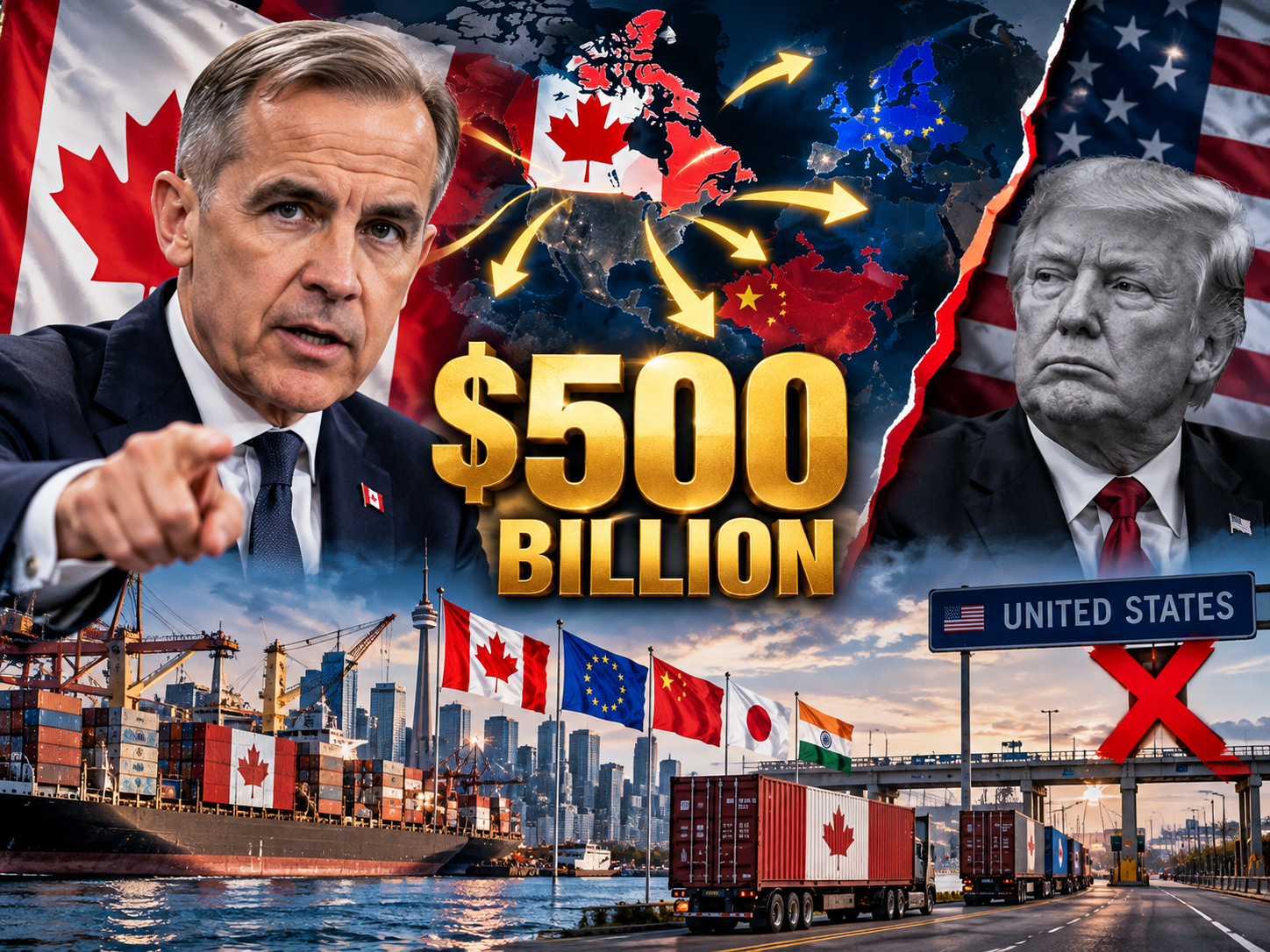
A nearly $500 billion investment announcement is fueling claims that Canada is preparing to abandon its economic relationship with the United States. But the real story is more complicated. Prime Minister Mark Carney is pushing to make Canada’s economy less dependent on its southern neighbor, attracting international investment and opening new markets as trade tensions with President Donald Trump continue.
The $500 billion figure is real. What is misleading is describing it as a secret decision to cut off the United States. The money represents investment and financing commitments announced at Canada’s first Investment Summit on September 15, 2026. The initiative is designed to strengthen Canadian industries, infrastructure and economic independence—not immediately end cross-border trade.
Where the $500 Billion Comes From
Carney’s government announced the investment commitments after bringing together investors from nearly 30 countries, representing organizations managing more than $100 trillion in assets.
The commitments include nearly C$100 billion in new capital from Canadian pension funds, insurers and institutional investors, alongside almost C$325 billion in financing from Canada’s major banks.
Among the headline announcements:
-
TD Bank: C$150 billion in financing over five years.
-
Scotiabank: More than C$100 billion in financing over five years.
-
BMO: C$70 billion in investment and financing over 10 years.
-
CPP Investments and Brookfield: A C$50 billion fund targeting critical infrastructure and strategic industries.
These commitments cover sectors including energy, critical minerals, artificial intelligence, defense, transportation and advanced manufacturing.
Importantly, this is not C$500 billion in government spending delivered overnight. Much of the figure consists of private investment commitments and financing to be provided over several years. The announcement is intended to mobilize capital and encourage companies to build in Canada.
Why Carney Wants Less Dependence on America
The investment strategy comes amid a difficult period in Canada-U.S. relations.
Trump’s administration has imposed substantial tariffs on Canadian products, including steel and automobiles. On August 21, Carney suspended broader trade negotiations after rejecting what he described as unacceptable last-minute U.S. demands. Canada also announced retaliatory tariffs.
Carney said his government had originally sought to preserve tariff-free access to the American market for the vast majority of Canadian businesses. However, he argued that Canada needed greater economic independence and more reliable international partnerships.
The economic challenge is substantial. According to Statistics Canada, 71.7% of Canada’s merchandise exports went to the United States in 2025. Although exports to other countries increased by 17.2% that year, replacing the American market would be extremely difficult.
Canada Builds New Partnerships in Europe and the Middle East
Carney’s diversification strategy is already producing new agreements.
On October 27, Canada and the United Arab Emirates signed a Comprehensive Economic Partnership Agreement designed to reduce or eliminate tariffs on more than 99% of current Canadian exports to the UAE. The agreement is expected to take effect in 2027, subject to the necessary steps toward implementation.
Meanwhile, Carney hosted European leaders in Montreal on October 29 as Canada and the European Union pursued a broader economic and security partnership.
European Commission President Ursula von der Leyen and Carney promoted an initiative called the Alliance for the Future, focusing on trade, critical minerals, defense, technology and stronger supply chains.
The proposal also included discussions about a closer associate relationship between Canada and the EU. However, Canada is not preparing to become a full EU member, and Carney has said any enhanced arrangement would require Canadian parliamentary approval.
Is Canada Actually Abandoning the United States?
Not according to the latest developments.
On October 28, Reuters reported that Canadian and American officials were still discussing ways to ease tariffs on steel, automobiles and other products. Canadian officials described progress as limited, but Carney reiterated that Canada remained willing to reach an agreement benefiting both countries.
The White House also confirmed that trade discussions were continuing.
That distinction is important. Canada remains deeply connected to American manufacturing, energy markets, transportation networks and consumers. A sudden economic separation would hurt businesses and workers on both sides of the border.
Carney’s strategy is not to stop doing business with America. It is to make sure Canada has more options when disagreements arise.
The nearly C$500 billion investment push, new trade agreements and closer European partnerships represent a significant shift in Canada’s economic planning. Whether the strategy succeeds will depend on whether announced commitments become completed projects, new jobs and lasting export growth.
For Washington, the message is clear: Canada is no longer willing to rely on a single trading relationship without building alternatives.



