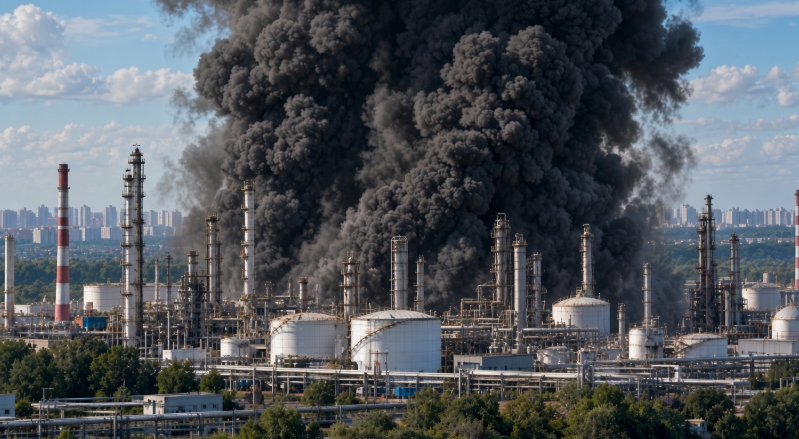
Ukraine launched one of its largest combined drone and missile attacks against Moscow on September 20, striking the Gazprom Neft Moscow Oil Refinery in the Kapotnya district and triggering a major industrial fire. The attack damaged critical processing equipment at a facility responsible for a substantial share of the Russian capital’s fuel supply.
The operation came on the final day of Russia’s parliamentary elections, adding political significance to an attack that demonstrated Ukraine’s growing ability to reach strategically important targets deep inside Russian territory.
A Major Attack Near the Kremlin
The targeted refinery is located approximately 15 kilometers from the Kremlin, according to Ukraine’s Security Service (SBU).
On September 20, the SBU announced that its special operations personnel, working with Ukraine’s Unmanned Systems Forces, Special Operations Forces and military intelligence, had struck the facility.
The agency said its long-range drones traveled more than 500 kilometers before penetrating Russian air defenses and reaching the refinery.
The facility has an annual processing capacity exceeding 11.6 million metric tons of crude oil and supplies up to 35% of the demand for high-quality fuel in Moscow and the surrounding region, according to the SBU.
Moscow Mayor Sergei Sobyanin acknowledged that several drones had reached the refinery grounds and confirmed damage to an industrial facility.
Russian Air Defenses Face an Unprecedented Challenge
The scale of the wider attack attracted international attention.
Sobyanin claimed that Russian air defenses had intercepted more than 1,600 Ukrainian drones since September 19, including approximately 450 approaching Moscow. Russia’s Defense Ministry separately reported intercepting more than 1,100 drones overnight across the country.
Those figures were Russian official claims and have not been independently verified in full. Nevertheless, the attack represented a major challenge for Russian air defenses, which were forced to respond across multiple locations.
Ukraine also confirmed using its domestically developed FP-1 long-range drones. President Volodymyr Zelenskyy said the wider operation involved several Ukrainian weapons, including Flamingo cruise missiles.
However, claims that exactly 16 FP-1 drones attacked the refinery, or that a specific Flamingo missile penetrated a particular air-defense position, have not been independently established.
Refinery Operations Halted After the Attack
The most significant confirmed consequence emerged the following day.
On September 21, Reuters reported that fires had broken out at both of the refinery’s primary crude distillation units, forcing the suspension of crude processing.
Three industry sources told Reuters that repairs could take several weeks.
The damaged AVT-6 unit accounts for approximately 53% of the refinery’s processing capacity, while the EURO+ complex handles the remaining 47%. Fuel produced at the facility had also stopped appearing on the St. Petersburg International Mercantile Exchange after September 21.
The facility’s importance extends beyond gasoline and diesel. It also produces aviation kerosene, fuel oil and bitumen, making prolonged disruptions potentially significant for regional industry and transportation.
A Growing Threat to Russia’s Energy Infrastructure
The wider attack also caused casualties in the Moscow region. Russian authorities reported at least three deaths, alongside damage to residential buildings and other facilities.
For Ukraine, long-range attacks on Russian energy infrastructure have become an important part of its strategy to disrupt the economic resources supporting Moscow’s war.
The September 20 operation demonstrated that even facilities located close to the Russian capital can be vulnerable to coordinated attacks.
The biggest confirmed result was not the destruction of the refinery, but the suspension of its operations after critical processing units caught fire. Whether Russia can protect its energy infrastructure against future attacks remains a significant challenge as the war continues.



