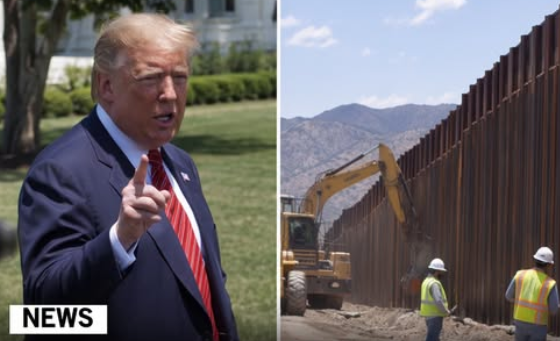
WASHINGTON, D.C. — November 6, 2026 — President Donald Trump is calling on Congress to place tougher restrictions on future presidential authority over immigration, promoting a proposal he says would prevent any successor from reopening the U.S. border to illegal immigration.
The measure, which Trump has named the “No Invasion of Our Country Act,” raises a significant question about the balance of power in Washington: Can one president persuade Congress to make his border policies binding on every administration that follows, including a future Republican president?
Trump has repeatedly presented the proposal as a way to prevent a future administration from reversing his immigration approach through executive action alone. But despite his ambitious language, the proposal is not an enacted law, and important details about its final legislative form remain unclear.
Trump Says Future Presidents Should Not Be Able to Reopen the Border
Trump first announced the proposal during the Republican National Committee’s midterm convention in Dallas on September 9, 2026.
“We will make it legally impossible for any future president to destroy our country by having the right to open the border again,” Trump told the audience.
He repeated the message during an October 27 campaign rally in Corpus Christi, Texas, saying the proposed act would prohibit future presidents from reopening the borders to illegal immigrants.
The president’s stated objective is to make his administration’s border-enforcement approach more difficult for a successor to reverse. His argument reflects a familiar problem in American immigration policy: presidents from opposing parties have frequently changed enforcement priorities and administrative rules after taking office.
Trump wants Congress to turn more of his preferred border restrictions into federal law rather than leave them dependent on executive orders and agency decisions.
A Related Border Bill Is Already in Congress
Although the president has promoted the “No Invasion” name, a related legislative measure already has a formal congressional record.
Representative Chip Roy, a Republican from Texas, introduced H.R. 9773, known as the Permanent Trump Secure Border Act, on July 20, 2026.
The legislation proposes significant changes to immigration law, including revisions to asylum eligibility, employment authorization for asylum applicants, border processing, detention and immigration parole.
The House Judiciary Committee considered the bill on July 21 and voted 16–14 to advance it in a substitute form. However, the measure had not passed the full House or Senate and had not become law in the congressional records reviewed for this report.
The distinction is important: H.R. 9773 is a formally introduced border bill, while Trump’s “No Invasion of Our Country Act” is the name he has publicly used for his broader legislative goal. The precise relationship between that public proposal and any eventual legislation requires clarification through an official bill text.
Could a Law Actually Bind Future Presidents?
There is a real constitutional difference between an executive order and a federal statute.
A president can generally revoke or modify executive orders issued by a predecessor, provided the orders are not protected by some separate legal requirement. That is one reason immigration policies can change quickly when a new administration takes office.
A law passed by Congress operates differently. Once legislation passes both chambers and is signed by the president—or enacted over a veto—it becomes federal law. A future president generally cannot simply disregard a clear statutory requirement by signing a new executive order.
That means a border law could apply to future administrations regardless of whether the president is a Democrat or Republican.
But there is an important limit to Trump’s stated ambition: one Congress cannot permanently prevent a later Congress from changing the law. A future House and Senate could amend or repeal the legislation through the normal lawmaking process. Courts could also review whether particular provisions comply with the Constitution.
The exact effect would depend on the language Congress ultimately passes.
The Debate Goes Beyond Party Politics
The proposal raises questions that extend beyond the next presidential election.
Supporters of stronger statutory border restrictions argue that immigration policy should not shift dramatically every time a new administration enters the White House. They contend that Congress should establish clear rules that provide continuity and give federal agencies a more consistent legal framework.
Critics may question whether broad restrictions would give future administrations enough flexibility to respond to humanitarian emergencies, changing conditions at the border and America’s legal obligations.
There is also a practical issue: immigration policy involves multiple authorities, including asylum processing, detention, parole, deportation priorities and the management of legal ports of entry. A general promise to prevent a future president from “opening the border” does not explain precisely how each of those powers would be regulated.
Any final legislation would need to define what federal agencies must do, what discretion they retain and how disputes would be handled in court.
The Real Test Comes When Congress Sees the Details
For now, Trump’s proposal remains a legislative goal rather than a permanent restriction on presidential power.
The president wants Congress to make his border agenda more durable. But whether lawmakers can agree on the details, pass the legislation and withstand future legal challenges remains a separate question.
And even if a bill becomes law, it would not eliminate the authority of future Congresses to change immigration statutes.
The central issue is not whether a president can influence border policy for years after leaving office. It is how much authority Congress is willing to place in federal law—and how much room future presidents should retain to carry out their own responsibilities.



