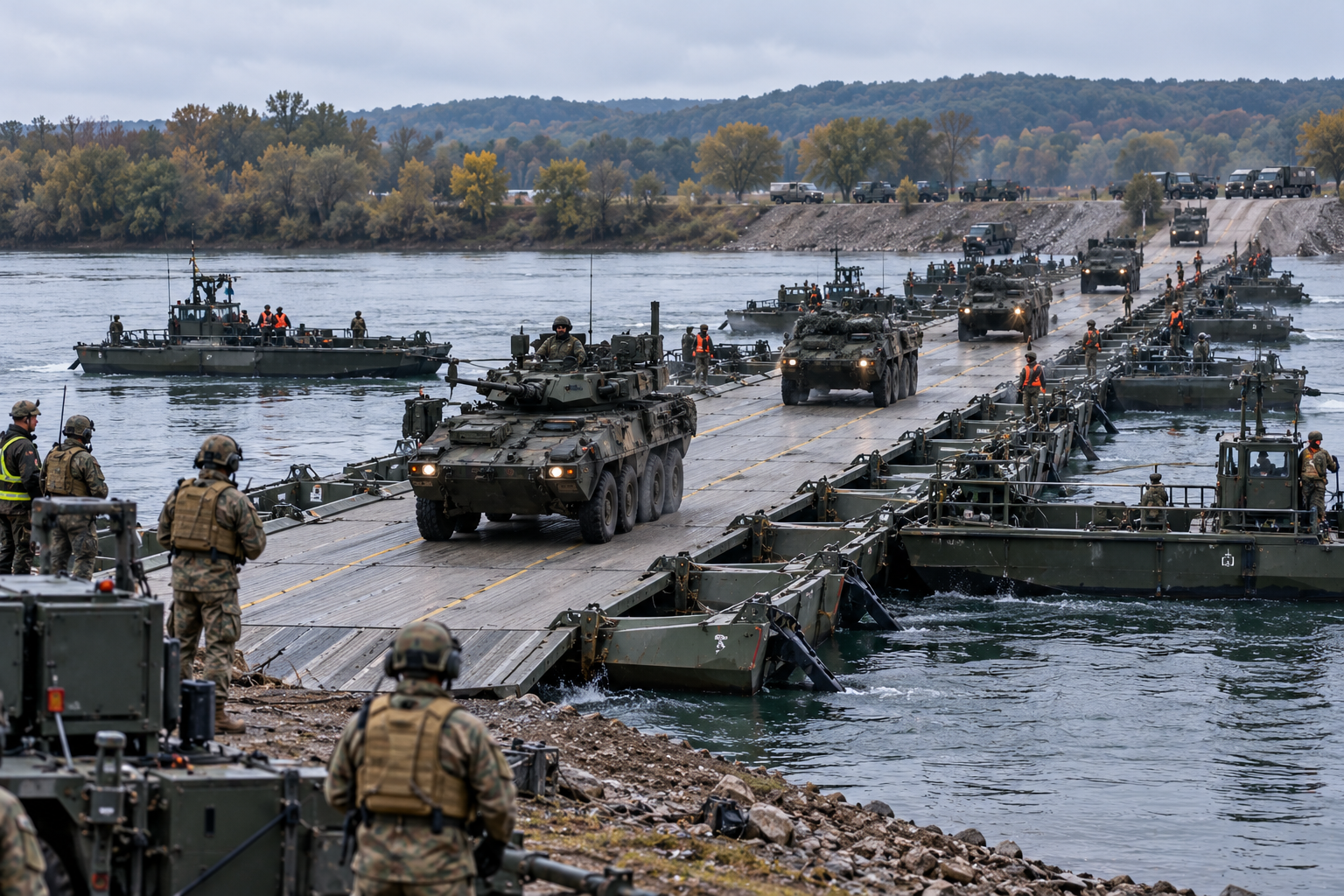
A river can become a major obstacle for an armored force. Tanks, infantry fighting vehicles, fuel trucks, and ammunition carriers cannot always use existing roads or permanent bridges. When those routes are unavailable, military engineers may have to build a temporary crossing capable of supporting heavy vehicles under difficult environmental conditions.
During a documented exercise in Poland in April 2026, U.S. Army engineers and Italian Armed Forces personnel constructed separate temporary bridges while Polish forces participated in the wider operation. The exercise demonstrated an important element of NATO readiness: moving military equipment across difficult terrain while coordinating personnel, vehicles, and engineering systems from different countries.
1. Why Military Bridging Matters
Military planners use the term wet-gap crossing for an operation that moves troops, vehicles, and equipment across a water obstacle such as a river or lake. Depending on the terrain and available equipment, engineers may establish a floating bridge, construct a temporary supported bridge, or assemble a raft that transports vehicles across the water.
These systems help preserve movement when existing infrastructure cannot meet operational requirements. A permanent bridge may be too weak for heavy vehicles, damaged, unavailable, or located on an unsuitable route.
The challenge is not simply getting a bridge into the water. Engineers must assess the river, approaches, current, expected vehicle loads, and available equipment before determining whether a crossing can operate safely. The U.S. Army’s 2025 lessons-learned report documents how weather, upstream water conditions, and floating debris can significantly complicate such operations.
2. How the Improved Ribbon Bridge Works
One important U.S. military system is the Improved Ribbon Bridge (IRB). It consists of modular bridge sections that can be transported to a crossing site, moved into position, connected, and configured as a continuous floating roadway.
The modules provide buoyancy while their connected structure creates a surface for vehicles to cross. Dedicated Bridge Erection Boats help crews position and maneuver bridge sections in the water.
The IRB can also be configured as a raft, allowing vehicles to be transported across a waterway when a continuous bridge is not the preferred arrangement. The configuration selected depends on the crossing requirements, available equipment, water conditions, and vehicle loads.
The system is more than a collection of floating platforms. Its components, connections, ramps, boats, and supporting equipment must work together. Crews also need suitable ground at both riverbanks so that vehicles can enter and leave the bridge without becoming immobilized.
3. Load Capacity: Why Heavy Vehicles Are a Challenge
A temporary military bridge must carry the vehicles expected to cross it. Military engineers use Military Load Classification (MLC) to communicate bridge and vehicle load requirements. MLC is a military classification system, not simply a direct statement of a vehicle’s weight in tons.
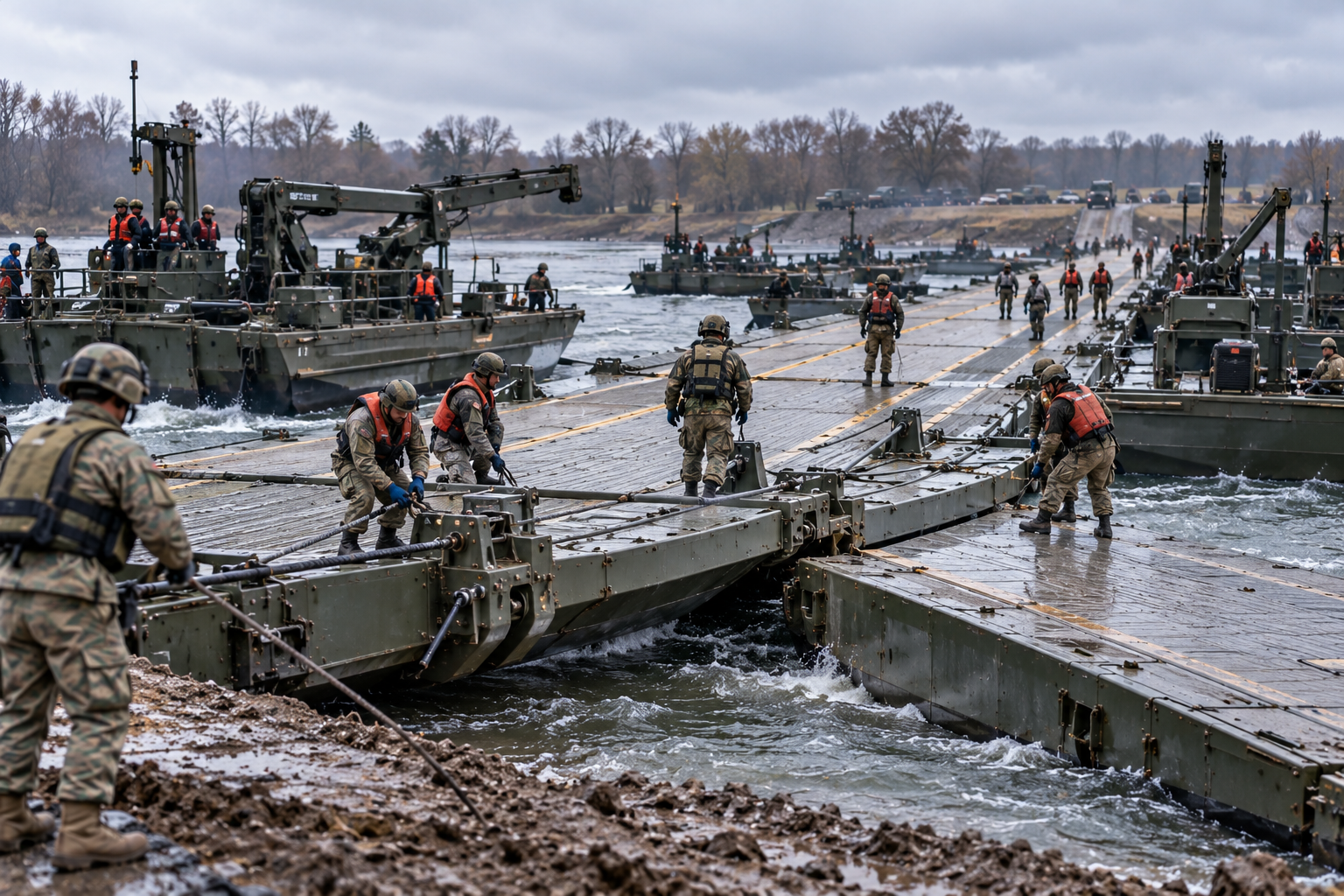
The U.S. Army Engineer Research and Development Center has conducted testing to assess how the IRB responds to heavy vehicles and different operating conditions. Researchers have examined structural loads alongside the effects of water movement.
In a 2024 field test discussed in the Army’s 2025 report, engineers evaluated a heavily loaded vehicle surrogate representing an M1A2 SEPv3 Abrams tank configuration at approximately MLC 120. The objective was to study the challenges of high-load raft crossings, not to establish that every bridge arrangement can support that load under every condition.
That distinction matters: a system’s ability to carry a vehicle depends on its configuration and the conditions under which it is used.
4. Extreme Conditions: Water, Weather, and Debris
Fast-moving water creates forces on floating structures and can make positioning or controlling a bridge more difficult. Rainfall upstream may raise river levels even when local weather appears manageable. Logs, ice, branches, and other debris can obstruct bridge boats or strike floating sections.
The Army’s field-testing report describes a test period when the river rose substantially following overnight conditions. Debris and reduced traction complicated operations, while equipment and recovery constraints caused further delays.
These experiences highlight why engineers use weather forecasts, water-level information, site assessments, and physical testing to evaluate a planned crossing. A bridge that performs safely in still water may face different constraints when river currents, changing depth, and heavier loads are introduced.
5. How Allied Bridge Systems Differ
NATO countries do not all use identical bridging equipment. In the April 2026 exercise in Poland, the U.S. team employed a modular IRB, while the Italian Armed Forces used a self-propelled bridge system assembled to provide a crossing. Both methods were used to achieve the same broad objective: enable vehicles to move across the water obstacle.
Other NATO exercises have demonstrated amphibious bridge-and-ferry equipment, including Germany’s M3 Amphibious Bridging and Ferrying System. In a 2017 exercise in Lithuania, German M3 vehicles were connected to form a bridge and later separated to operate as a ferry.
Interoperability therefore depends on more than equipment. Allied personnel must communicate, coordinate movement, understand each other’s procedures, and work within the same operational plan.
6. The Real Measure of Success
A massive temporary bridge may appear to be a single structure, but it represents a coordinated engineering effort involving transport vehicles, boat crews, bridge modules, site preparation, safety measures, and vehicle movement control.
Its performance is measured not only by how quickly it can be assembled, but by whether it can carry the required vehicles safely and reliably under the prevailing conditions.
Military bridging is a force-mobility capability, not a weapon in itself. It allows troops and equipment to overcome terrain that might otherwise delay a movement. For NATO, training together on these demanding tasks helps test equipment, procedures, and coordination across allied forces.
The bridge is only the visible part of the operation. The engineering assessments and teamwork behind it are what make the crossing possible.