The Boeing 747 is famous for its distinctive upper-deck hump and long-range transport capability. But two U.S. government versions conceal a less obvious engineering feature: self-contained boarding stairs built into the aircraft.
The VC-25A presidential aircraft and the E-4B Nightwatch airborne command center share the Boeing 747-200 family heritage, yet serve very different missions. Their integrated stairs are a practical example of how specialized military aircraft are modified to operate with greater independence from airport infrastructure.
1. Two Aircraft, Two Very Different Missions
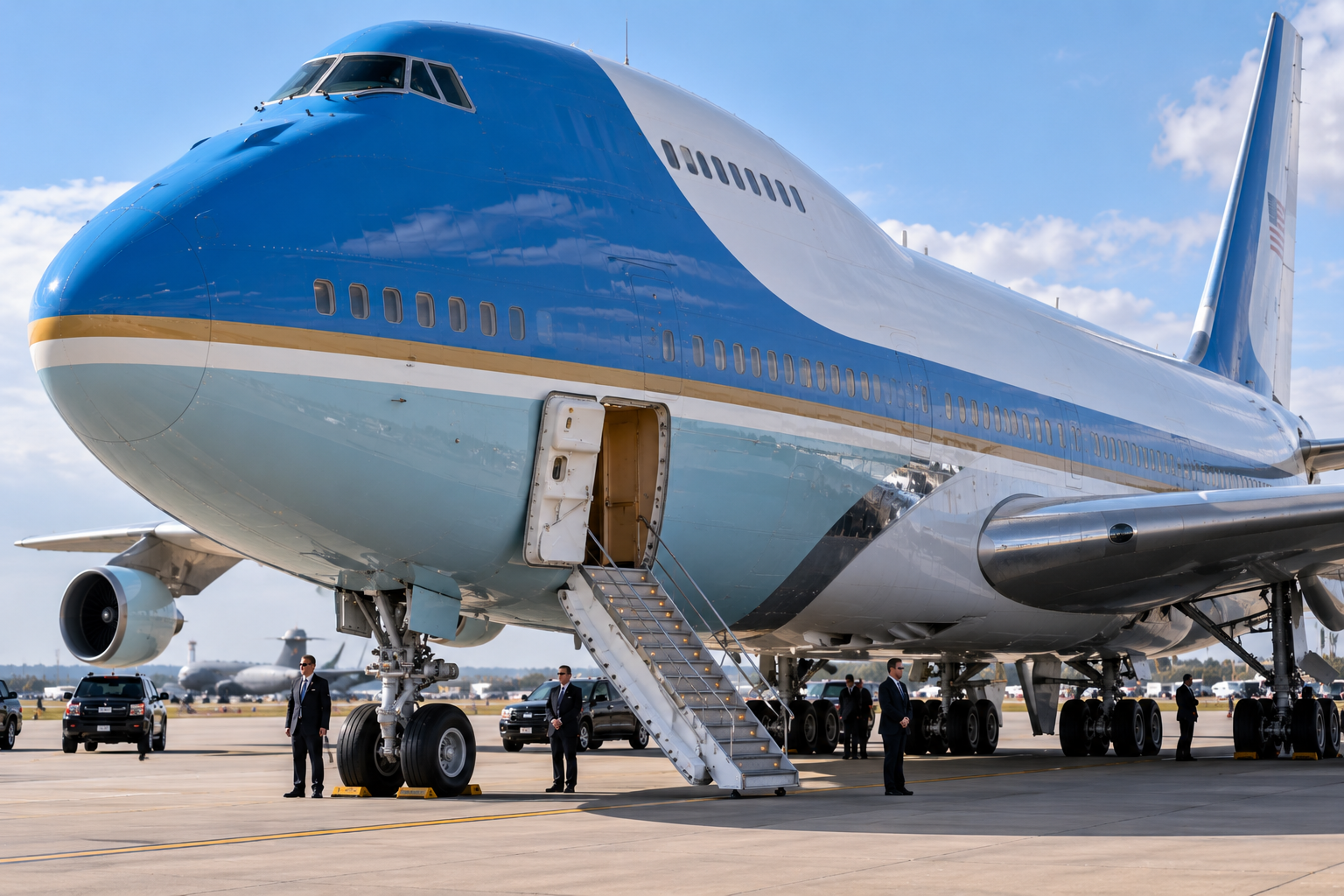
The VC-25A fleet consists of two specially configured Boeing 747-200B aircraft, tail numbers 28000 and 29000. Their mission is to transport the U.S. president, supported by advanced communications systems, specialized working areas, and equipment that differs significantly from a standard commercial airliner.
“Air Force One” is technically the radio call sign used when the president is aboard a U.S. Air Force aircraft. VC-25A is the designation of the presidential aircraft itself.
The E-4B Nightwatch has another purpose. The U.S. Air Force identifies it as the National Airborne Operations Center (NAOC). It is intended to provide a highly survivable airborne command, control, and communications center for senior national leaders if ground-based command facilities become unavailable. Its systems include protection against electromagnetic pulse effects and equipment for maintaining communications during national emergencies.
Although the E-4B is popularly called the “Doomsday Plane,” that nickname is not its official designation. Its central mission is command and communications continuity—not carrying out a conventional bombing or missile-attack role. The U.S. Air Force publishes additional details in its VC-25A fact sheet and E-4B fact sheet.
2. How the VC-25A’s Hidden Stairs Work
Unlike a conventional boarding staircase brought to an aircraft by ground personnel, the VC-25A has two self-contained airstair units, positioned at forward and aft locations.
The stairs provide entry and exit through doors below the main passenger-deck entrance. A person using one of these routes enters the lower-deck area and then climbs an internal staircase to reach the main deck.
This arrangement is possible because the 747’s large fuselage and lower-level spaces can accommodate equipment that an ordinary passenger aircraft might leave to airport ground services. The VC-25A also has a self-contained baggage loader, another feature that can reduce its dependence on external support equipment.
The U.S. Air Force lists front and aft airstairs among the principal differences between the VC-25A and a standard Boeing 747. A detailed description published by Defense Media Network explains how the onboard stair units support entry and exit through the lower-level doors.
3. The E-4B’s Retractable Stair System
The E-4B also carries an onboard stairway, but its published technical description differs from the VC-25A’s two-stair arrangement.
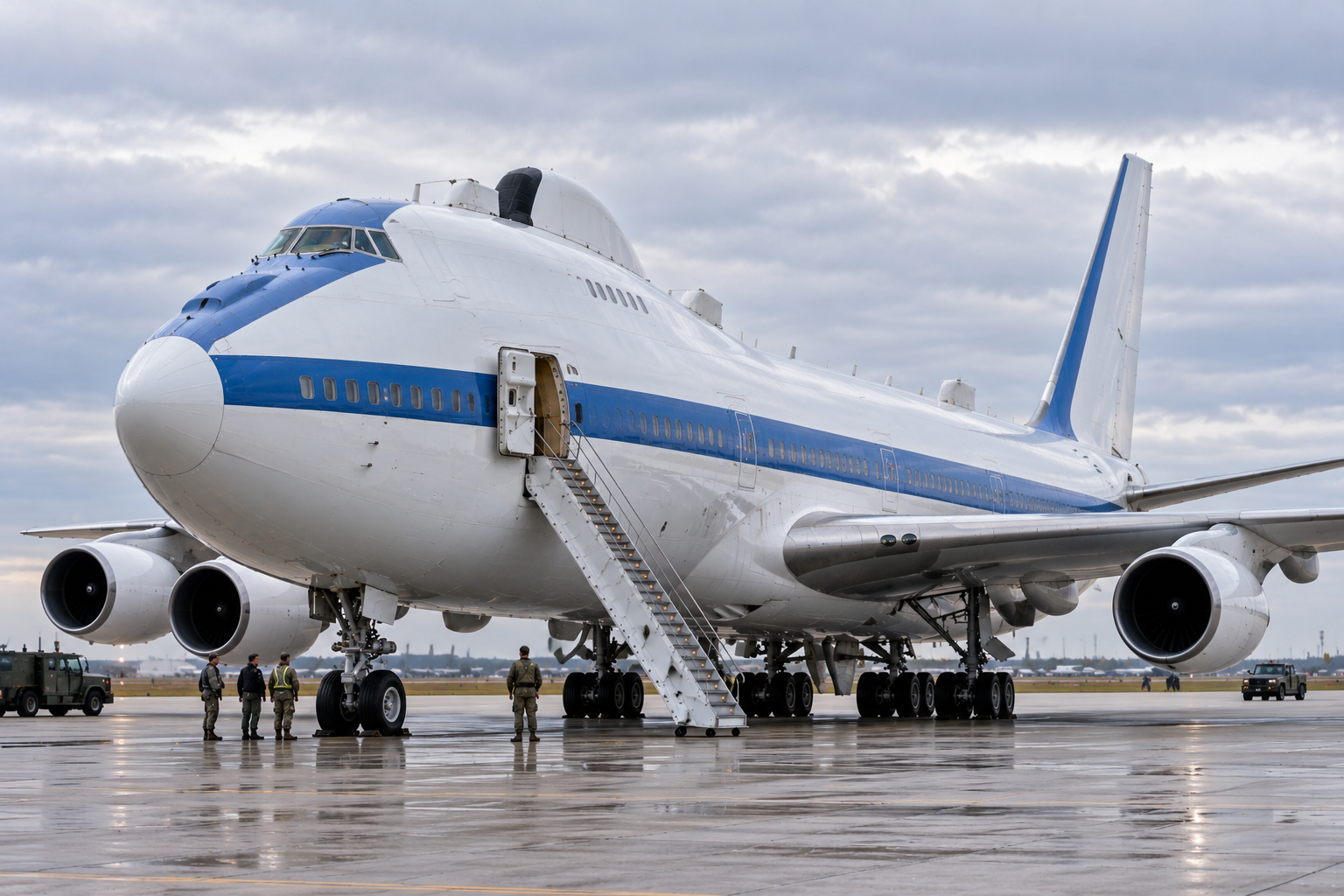
An Air Force document describing E-4B compartments identifies electrically operated retractable stairs in the forward lower equipment area, installed for aircraft entry and exit. That confirms the aircraft has a built-in access system rather than relying exclusively on mobile external boarding stairs.
The E-4B’s lower areas also support mission equipment and aircraft services. Integrating access equipment within this complex layout requires careful coordination between the aircraft structure, internal spaces, and the systems needed to keep the command center operational.
Public sources establish the stair system’s location and function, but they do not describe every mechanical detail or every procedure used by crews. It is therefore more accurate to explain the feature at a general engineering level than to speculate about its internal mechanisms.
4. Why Build Stairs Into a Military 747?
The main benefit is reduced dependence on ground support equipment. Conventional mobile stairs require suitable equipment, positioning, and sufficient space beside the aircraft. A self-contained system gives the aircraft another way to board and disembark personnel when the necessary ground equipment is unavailable or unsuitable.
This is particularly relevant for specialized government aircraft that may operate at different airports and military facilities. The built-in stairs provide an alternative access route; they do not make the aircraft independent of every airport service, eliminate security requirements, or guarantee that all boarding conditions can be accommodated.
The distinction is important: these stairs are a practical logistical feature, not proof of a secret escape system or an advanced defensive weapon.
5. The Bigger Engineering Picture
The VC-25A and E-4B demonstrate two different ways to adapt a commercial airliner design for demanding government missions. The presidential aircraft combines transport accommodations with specialized communications and support equipment. The E-4B prioritizes resilient command-and-control functions, technical workspaces, and communication systems.
Their built-in stairs are a relatively small part of that transformation, but they illustrate a wider principle of aircraft design: operational independence often comes from integrating many practical systems, not just improving engines or adding sophisticated electronics.
The hidden stairs are real, but their significance is straightforward. They provide onboard access when conventional ground stairs are not the preferred option. The larger story is how a familiar passenger-aircraft design has been adapted to support two of the U.S. government’s most distinctive airborne missions.