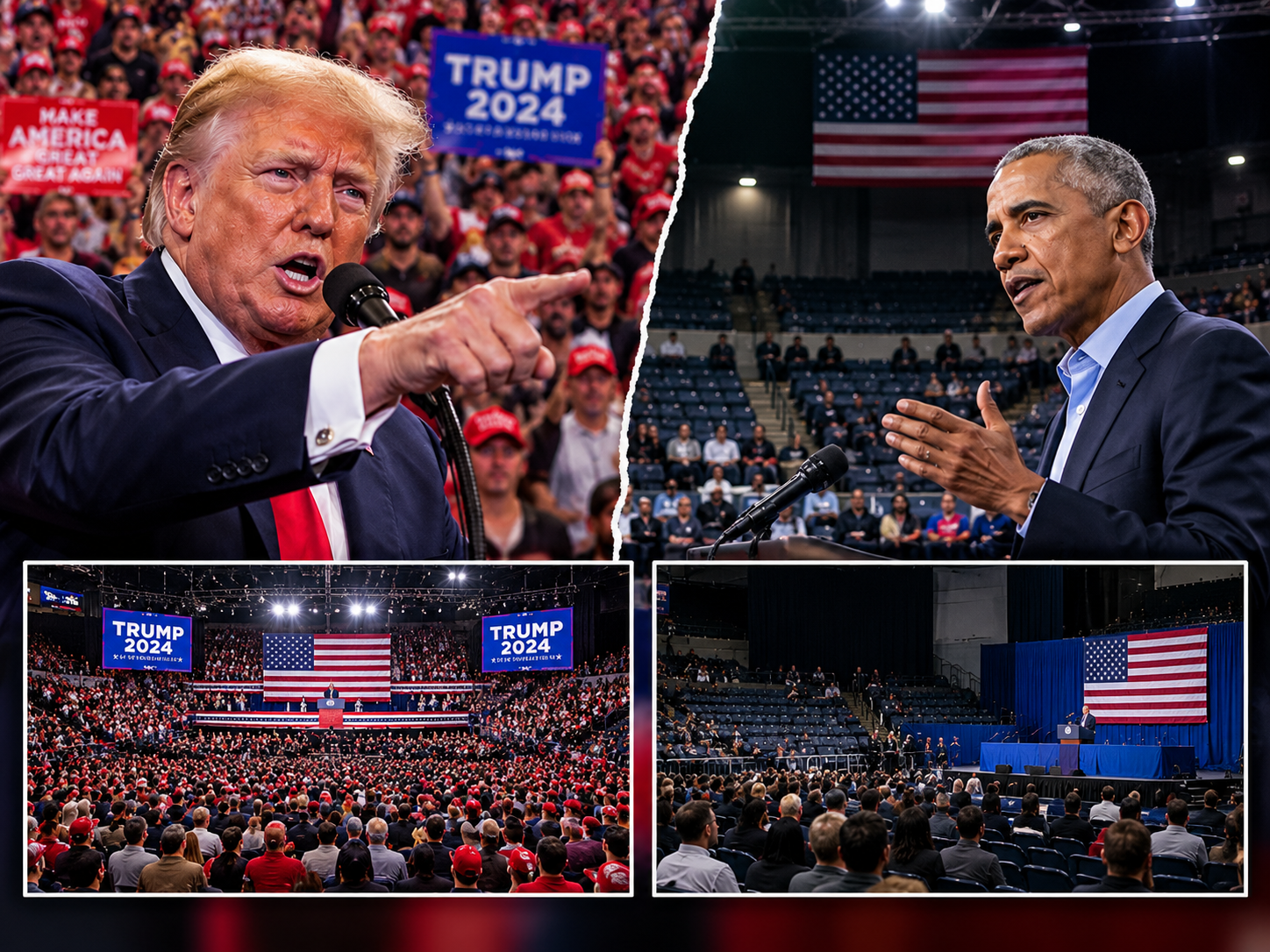
President Donald Trump claimed that Barack Obama’s campaign appearance in Michigan drew an almost empty crowd, but local reporting documented thousands of people attending the former president’s Detroit rally. The dispute has added another flashpoint to the political battle ahead of the November 3, 2026, midterm elections.
Trump made the remark during a Republican rally in Perry, Georgia, on Saturday, October 24, the same day Obama campaigned for Democratic candidates in Ohio and Michigan. Trump told supporters that Obama’s Michigan event was empty and that people had been “trickling through.” However, contemporaneous reports described a large turnout in Detroit, including an overflow space for additional attendees.
The disagreement highlights how political leaders use crowd size to project enthusiasm and momentum. But while large rallies can generate attention, attendance figures alone do not establish which candidate has greater voter support or who will win an election.
What Happened at Obama’s Detroit Rally?
Obama appeared in Detroit on October 24 alongside Abdul El-Sayed, the Democratic Senate nominee, and Jocelyn Benson, the party’s gubernatorial nominee.
The event was part of a broader Democratic effort to mobilize voters in Michigan before Election Day. Both races are important to the parties as they compete for control of Congress and key state offices.
According to reporting by BridgeDetroit, more than 4,000 people attended the event at Cass Technical High School, with supporters spilling into an overflow area. Another report, citing a Michigan Democratic official, put attendance at approximately 4,350 people across the main venue and overflow space.
Those figures are not an independently audited headcount. Nevertheless, the reported turnout and the use of overflow space do not support a straightforward description of the event as having virtually no audience.
Obama used the appearance to criticize the Trump administration and encourage supporters to vote. His remarks addressed the economy, rising costs, the administration’s conduct and the importance of holding elected officials accountable.
The rally also gave Benson and El-Sayed an opportunity to appear alongside a former president as their campaigns entered the final stretch.
Trump Questions the Crowd—and Compares It With His Own
Trump attacked Obama’s turnout during his Georgia rally later that Saturday.
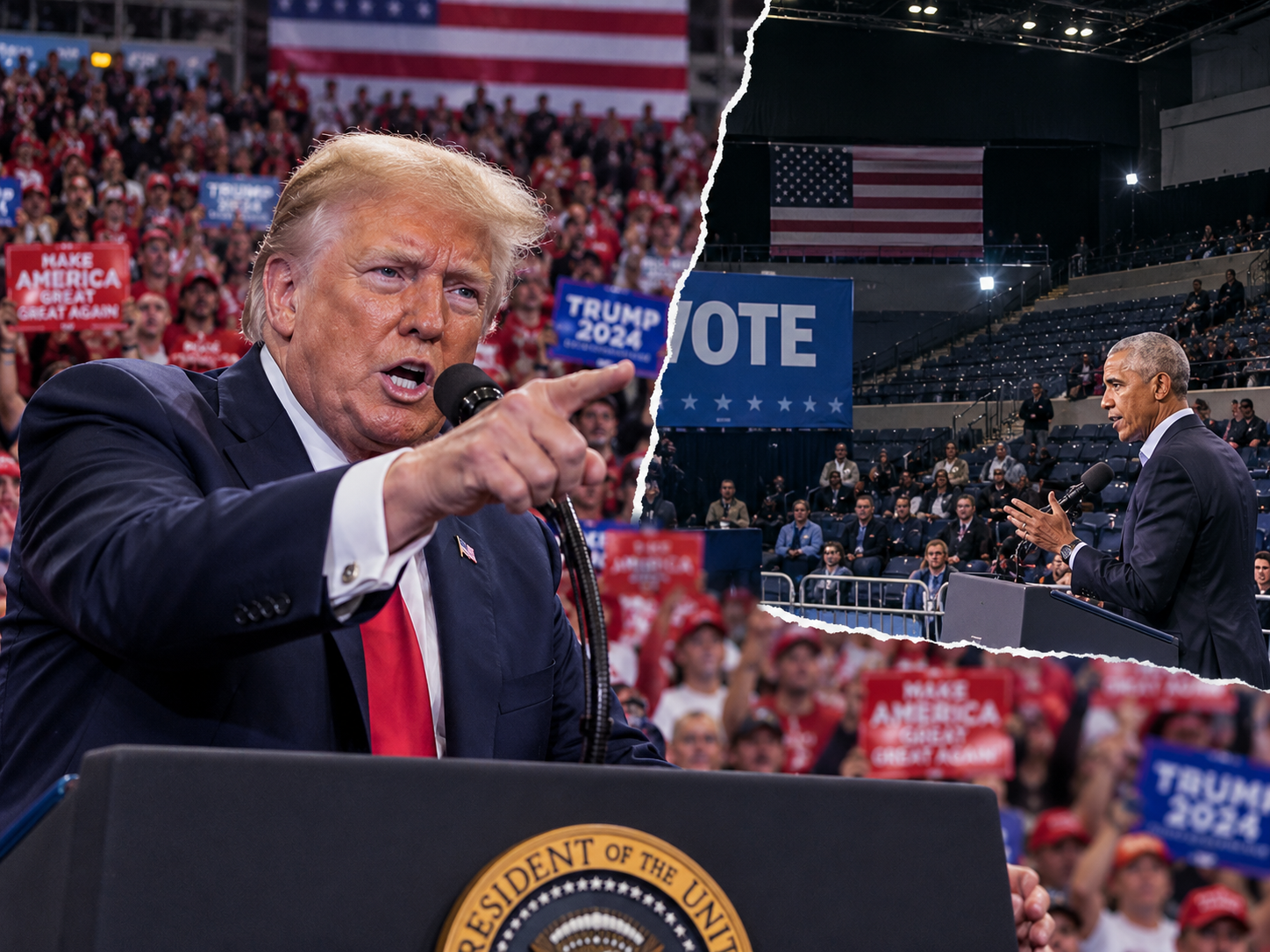
“I saw Barack Hussein Obama was in Michigan, and the place was empty,” Trump said, according to a transcript of the remarks. He went on to criticize media coverage of his own rallies and emphasize the size of his audiences.
The comments turned a routine measure of campaign activity into a public dispute over the credibility of competing political narratives.
The following day, Trump held another rally in Port Huron, Michigan, where he again contrasted his audience with Obama’s Detroit appearance, describing the earlier event as “sparse.” Local reporting said Trump’s own event reached arena capacity, with organizers using an overflow venue.
The comparison is politically useful for both sides: a candidate can use a large crowd to signal enthusiasm, while dismissing an opponent’s turnout can suggest weakness. But the reliability of either argument depends on the actual evidence.
Cleveland Rally Also Draws a Large Audience
Detroit was not Obama’s only campaign appearance that weekend.
Earlier on October 24, he spoke in Cleveland, Ohio, alongside Democratic gubernatorial nominee Amy Acton and U.S. Senate candidate Sherrod Brown.
NBC News reporting described a near-capacity audience at Cleveland Public Auditorium, a venue that holds more than 10,000 people. Local coverage likewise described the auditorium as packed with supporters. That establishes a substantial gathering, although the venue’s capacity should not be mistaken for an independently verified attendance count.
Obama criticized Trump’s leadership and urged Ohio voters to support Democratic candidates. The visit was intended to energize the party’s supporters in a state where competitive races could influence the balance of power in Washington.
Together, the Cleveland and Detroit appearances demonstrated the role high-profile political figures play in helping candidates attract attention and encourage turnout.
Why Accurate Crowd Reporting Matters
Crowd-size arguments have long been part of American politics, but photographs, venue capacity and reported estimates can provide useful checks against sweeping claims.
In this case, reports of thousands attending Obama’s Detroit rally contradict Trump’s characterization of the venue as empty. At the same time, the available reports do not establish a precise, independently verified count for every attendee.
That distinction matters. A supported conclusion is that Obama’s Detroit event attracted thousands, not that a definitive attendance figure proves one party has greater electoral momentum.
With Election Day approaching, both parties are working to turn campaign enthusiasm into actual votes. The outcome will depend on ballots cast—not on which candidate wins a dispute over rally attendance.



