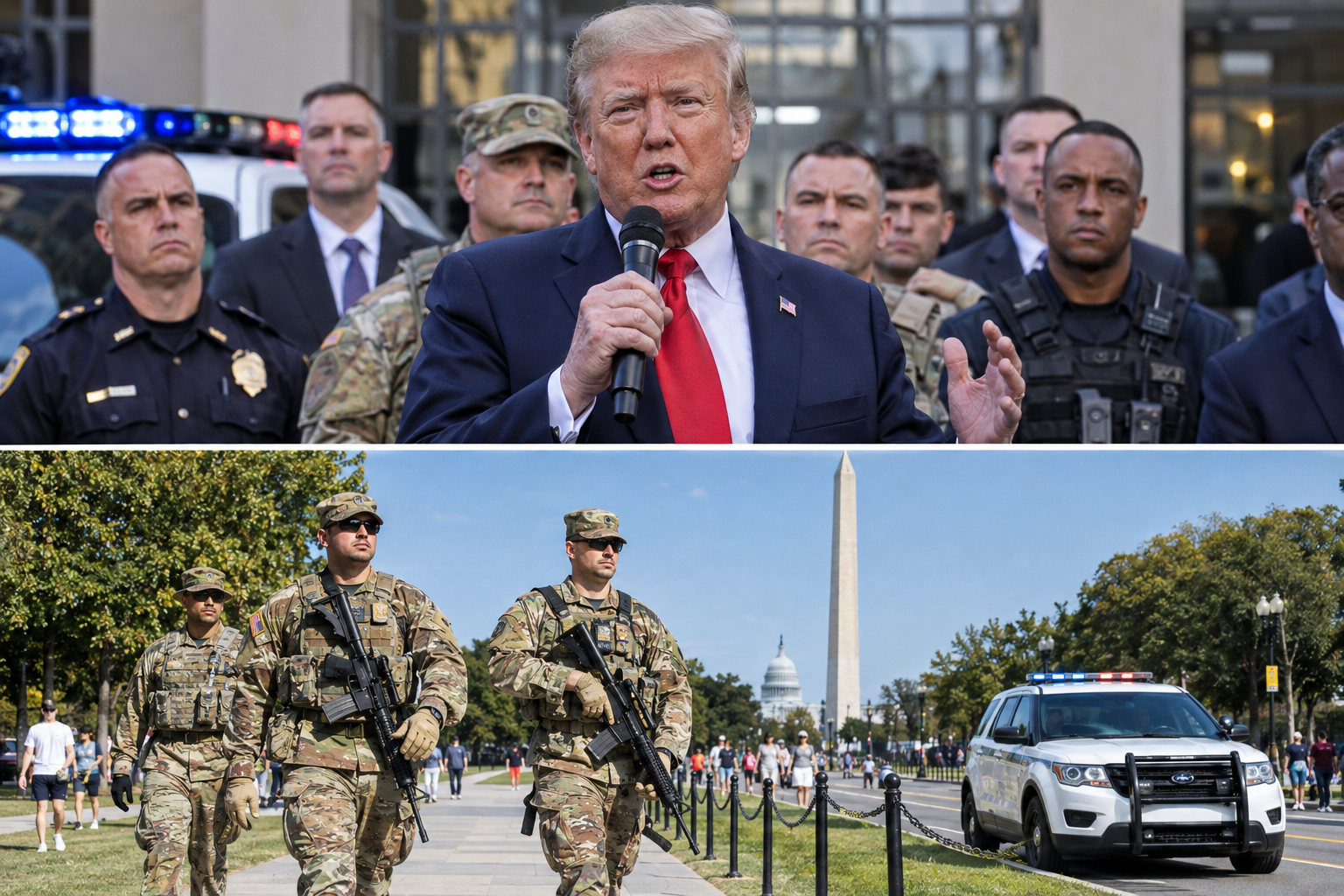
President Donald Trump’s federal law-enforcement operation in Washington, D.C., is facing renewed scrutiny as thousands of National Guard personnel remain in the nation’s capital and a major legal battle over presidential authority moves through the federal appeals court system.
The operation, originally announced in August 2025, was presented by Trump as an effort to combat violent crime, strengthen public safety, and restore order in the capital. More than a year later, however, the debate has expanded beyond crime statistics to include constitutional authority, local government independence, civil liberties, and the financial cost of maintaining a prolonged military presence in an American city.
1. How Trump’s Federal Operation Began
On August 11, 2025, Trump announced that he was declaring a public safety emergency and invoking Section 740 of the District of Columbia Home Rule Act.
The president announced plans to place the Metropolitan Police Department under temporary federal control and deploy National Guard personnel to Washington.
Attorney General Pam Bondi was assigned a leading role in the federal oversight arrangement, while DEA Administrator Terry Cole was named interim federal commissioner of the police department.
Defense Secretary Pete Hegseth initially announced that approximately 800 National Guard members would be deployed.
The administration described the operation as necessary to address violent crime and improve security. Critics questioned the decision, noting that several crime categories in Washington had already been declining before the federal intervention began.
2. Thousands of National Guard Members Remain in Washington
The operation, known as Make DC Safe and Beautiful, expanded substantially after its launch.
According to an Associated Press report published October 14, 2026, the deployment reached approximately 5,000 troops during its summer peak. The number had subsequently fallen to roughly 2,900 as of the week before that report.
The mission includes patrols, support for local law-enforcement operations, security around federal sites, and other public-service assignments.
The administration has extended the mission through January 2029, according to the Associated Press.
The financial burden is also becoming a major issue. ABC News reported on August 4 that Defense Department estimates projected another $1.4 billion in costs through the remainder of Trump’s administration, assuming an average deployment of approximately 2,500 troops.
The National Guard has also arranged housing for personnel, including a reported $292 million contract for approximately 2,000 apartment units.
3. Does the Operation Actually Reduce Crime?
The administration argues that the expanded federal presence has contributed to improved public safety.
On August 10, 2026, the U.S. Attorney’s Office for Washington reported substantial year-over-year declines in several categories. Its figures showed homicides down 45%, carjackings down 64%, robberies down 33%, and motor vehicle thefts down 53%.
Federal prosecutors also reported nearly 2,000 illegal firearms seized and a 67% increase in cases charged in D.C. Superior Court.
However, Washington Mayor Muriel Bowser offered a broader perspective. She said crime had already reached a 30-year low before the federal intervention and reported that overall crime had fallen another 20% year over year by August 2026.
An investigation by The Washington Post, examining more than 16,000 arrest records, found that the president’s claims about the operation’s impact oversimplified the situation. Researchers noted that crime had been declining before the deployment and that identifying the precise effect of federal intervention remained difficult.
The evidence therefore shows declining crime in several categories, but does not establish that the National Guard deployment alone caused those reductions.
4. A Major Constitutional Battle Reaches the Appeals Court
Washington’s elected leadership has strongly challenged the federal operation.
The District’s Attorney General argues that the deployment violates the city’s Home Rule protections and improperly places military personnel into domestic law-enforcement activities.
On November 20, 2025, U.S. District Judge Jia Cobb ruled that the deployment exceeded the federal government’s statutory authority. However, the ruling was temporarily prevented from taking effect while the administration appealed.
The next major development came on October 14, 2026, when the U.S. Court of Appeals for the D.C. Circuit heard arguments in the case.
The administration argues that the president has broad authority over the National Guard in the federal capital. Washington officials maintain that the continuing operation improperly interferes with local self-government.
The appeals court’s earlier decision allowing the deployment to continue while the case proceeded means the troops have remained in place during the legal dispute.
5. Residents and Civil Rights Groups Remain Divided
The extended federal presence has generated different reactions throughout Washington.
Supporters point to increased patrols, firearm seizures, federal prosecutions, and visible security as reasons the operation should continue.
Critics argue that a prolonged military presence risks undermining public confidence, particularly in neighborhoods where residents have questions about enforcement practices and accountability.
Mayor Bowser has emphasized that Washington residents deserve both public safety and local control over their government. She has also questioned the need for an extended emergency intervention.
The disagreement reflects a broader national debate over how much power the federal government should exercise over local policing.
6. What Happens Next?
The October 14 appeals hearing represents another important stage in the dispute, but it does not by itself settle the legality of the deployment.
For the Trump administration, the operation remains part of its broader public-safety strategy. For Washington officials, the case concerns the city’s authority to govern itself and determine how law enforcement operates within its borders.
The central question is no longer simply how many officers or soldiers are patrolling Washington. It is how far presidential authority can extend into local law enforcement—and how long an emergency deployment can remain in place.
As the legal process continues, Washington’s experience could become an important test of the balance between federal power, local government, public safety, and constitutional protections.



