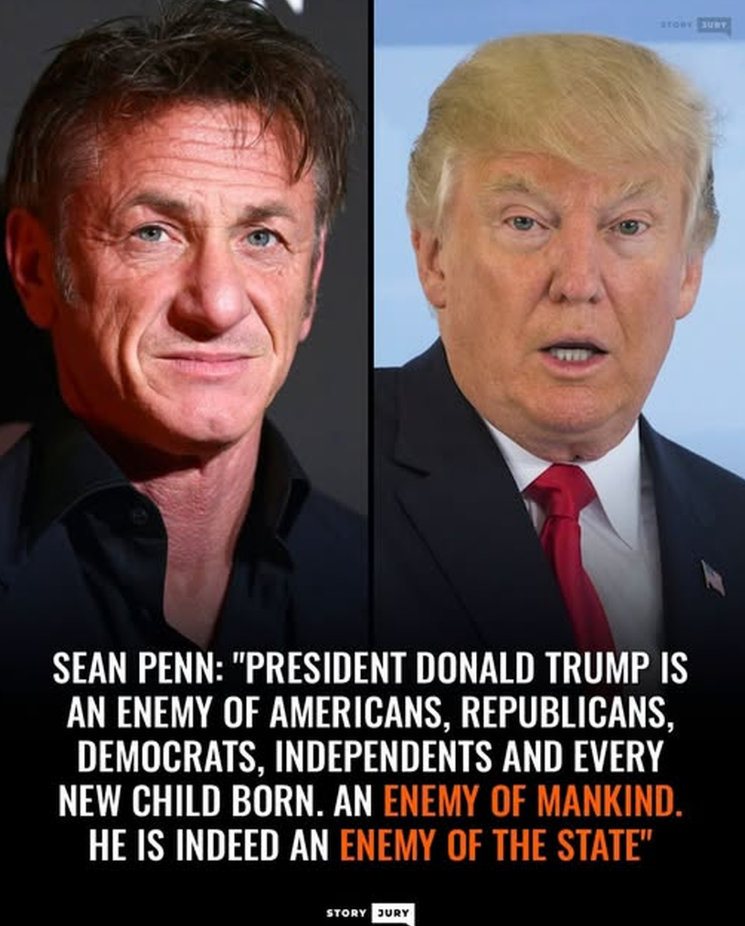
Actor Sean Penn delivered one of his strongest public criticisms of Donald Trump in January 2018, describing the president as an enemy of compassion, American unity, and humanity itself.
His comments appeared in an opinion essay published by TIME on January 13, 2018, marking the eighth anniversary of Haiti’s devastating earthquake. Penn connected his personal experiences in Haiti with Trump’s controversial remarks about immigrants from Haiti and African nations during an Oval Office immigration meeting.
The essay became a widely discussed example of Hollywood’s opposition to Trump’s early presidency—and a reminder of how humanitarian experiences can shape political convictions.
1. The Haiti Earthquake That Changed Sean Penn’s Life
On January 12, 2010, a powerful magnitude 7.0 earthquake struck near Port-au-Prince, Haiti, causing enormous destruction and a humanitarian emergency.
Penn traveled to Haiti within days of the disaster with a group of American volunteers. He worked alongside military personnel, doctors, educators, and humanitarian organizations to support injured people and displaced families.
What began as an emergency relief effort eventually developed into the J/P Haitian Relief Organization (J/P HRO), which later became part of CORE (Community Organized Relief Effort).
According to CORE’s official history, Penn mobilized medical professionals and emergency workers within hours of the earthquake. The organization helped provide medical assistance, manage displacement camps, clear debris, and support reconstruction.
Penn later emphasized that Haitian people themselves were central to rebuilding their country, describing their resilience and determination as among the most important lessons of his humanitarian experience.
2. The Controversial Trump Remarks That Sparked the Essay
The political controversy began on January 11, 2018, during an Oval Office meeting involving Trump and lawmakers discussing immigration legislation.
Republican Senator Lindsey Graham and Democratic Senator Dick Durbin were among those discussing a bipartisan proposal addressing protections for young immigrants brought to the United States as children under the Deferred Action for Childhood Arrivals program.
The discussion also involved immigration protections affecting people from Haiti, El Salvador, and African countries.
According to accounts provided by lawmakers and other participants, Trump questioned why the United States accepted immigrants from certain countries and reportedly used a vulgar expression to describe them.
Durbin publicly confirmed the reported language. Trump initially disputed the wording, saying his language had been tough but was not the language attributed to him.
The controversy quickly spread internationally, drawing criticism from politicians, civil rights advocates, and public figures.
3. Penn’s Powerful Words in TIME
Penn published his response two days after the eighth anniversary of the earthquake.
Rather than focusing exclusively on immigration policy, he used the experiences of Haitian families and communities to argue that compassion should be central to American identity.
He praised Haitian immigrants for their contributions to American society, their commitment to their families, and their efforts to maintain connections with their homeland.
Penn also challenged the idea that national strength should be measured through hostility toward vulnerable communities.
His most memorable passage described Trump as an “enemy of compassion” and an “enemy of mankind.” He concluded the criticism with another striking phrase: “an enemy of the state.”
The wording was deliberately forceful, reflecting Penn’s belief that presidential language could influence how Americans viewed entire populations and communities.
These statements were Penn’s personal political judgments, expressed through an opinion essay rather than an official political or humanitarian statement.
4. Trump Initially Denied the Reported Language
The controversy did not end with Penn’s article.
Trump publicly rejected the specific wording reported by lawmakers and journalists. He said his language had been tough but denied using the expression attributed to him.
However, an important development occurred on December 9, 2025, when Trump spoke at an event in Pennsylvania.
During his remarks, he referred to the 2018 immigration meeting and recalled asking why the United States accepted people from what he called “shithole countries.”
According to FactCheck.org, Trump’s later account confirmed the central detail reported by Senator Durbin nearly eight years earlier.
This later acknowledgment added another chapter to a controversy that had begun with conflicting accounts of a private presidential meeting.
5. Why the Essay Became So Memorable
Penn’s criticism attracted attention partly because it connected an international humanitarian crisis with a domestic political debate.
For him, Haiti was not simply another country mentioned during an immigration discussion. It was a place where he had witnessed suffering, worked alongside relief teams, and developed relationships with people struggling to rebuild their communities.
His argument contrasted the humanitarian assistance Americans had provided following the earthquake with political language that he believed undermined respect for those same communities.
Supporters of Penn’s position viewed the essay as a strong defense of compassion and immigrant dignity. Others questioned whether celebrity figures should use such confrontational language when criticizing elected officials.
That disagreement reflects a broader American debate about the role of entertainers, public figures, and humanitarian advocates in political discussions.
6. A Historical Criticism That Still Resonates
Nearly nine years after its publication, Penn’s essay remains an important historical example of how Trump’s immigration rhetoric generated international reactions.
The article was not a new declaration, and Penn’s words should not be presented as a recent political development.
But its central subject—how national leaders speak about immigrants, vulnerable communities, and America’s humanitarian responsibilities—remains relevant to discussions about American identity and foreign policy.
Penn’s most memorable message was that compassion should be treated as a national responsibility rather than a political weakness.
Whether readers agree with his criticism or consider his language excessive, the January 2018 essay remains a striking moment in the intersection of Hollywood, humanitarian work, and American politics.



