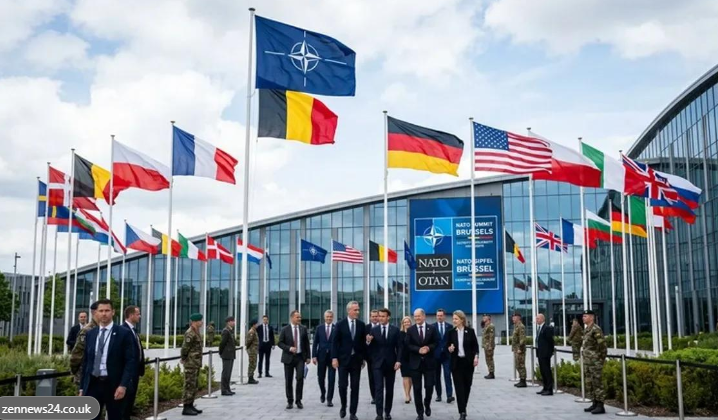
South Korea is moving its naval operations closer to the Strait of Hormuz, European countries are examining greater defense independence, and concerns about America’s weapons inventories are raising difficult questions about Washington’s ability to manage multiple international crises.
WASHINGTON, D.C. — November 5, 2026
A series of international developments is raising new questions about America’s global leadership as President Donald Trump confronts mounting challenges involving Iran, European security, military readiness, and increasingly sophisticated cyber threats.
The latest development came Thursday, when South Korea announced plans to expand its naval operations closer to the strategically important Strait of Hormuz. The decision comes amid growing pressure from Washington for international partners to contribute more to maritime security during the ongoing confrontation with Iran.
At the same time, European governments are examining ways to strengthen their own military capabilities, while American lawmakers and defense analysts are debating the consequences of substantial weapons expenditures during the conflict.
Together, these developments highlight a difficult strategic reality for the White House: America’s allies increasingly want the ability to protect their interests even when Washington’s priorities or decisions do not perfectly align with their own.
South Korea Makes a Significant Move Near the Strait of Hormuz
According to Reuters, South Korea plans to expand the operating area of its Cheonghae anti-piracy naval unit to waters near Oman’s port of Duqm, approximately 650 kilometers (403 miles) from the Strait of Hormuz.
The proposed expansion would extend the deployment of the naval unit beyond its current December 2026 deadline, subject to parliamentary approval.
South Korea also plans to deploy a P-8A maritime patrol aircraft and increase the unit’s personnel by approximately 75.
The decision is particularly important because South Korea depends heavily on energy supplies passing through the Middle East. Approximately 70% of its oil imports came from the region in 2025, with most transported through the Strait of Hormuz.
However, President Lee Jae Myung has previously indicated that Seoul does not want to deploy military assets in a way that could draw the country directly into the Iran conflict.
The expanded mission is therefore focused on protecting commercial navigation rather than committing South Korean forces to offensive military operations.
Europe’s Growing Interest in Defense Independence
Across the Atlantic, European governments are also considering what their security arrangements might look like if American military support becomes less predictable.
An October 2026 analysis by the Council on Foreign Relations identified three possible approaches: strengthening a more European-led NATO, developing an independent European Union defense structure, or creating a separate coalition of European countries prepared to coordinate military operations.
The debate is not simply theoretical.
European NATO members are already assuming greater responsibilities within the alliance’s command structure. The United Kingdom is set to take command of NATO’s Joint Force Command Norfolk, Italy will take command of Joint Force Command Naples, and Germany and Poland will share leadership of Joint Force Command Brunssum.
These changes represent a significant adjustment in the distribution of military responsibilities.
However, European countries are not collectively abandoning NATO. The Council on Foreign Relations identifies a more European NATO as the most viable option for maintaining continuity while increasing Europe’s ability to defend itself.
The underlying concern is whether European governments can maintain credible security arrangements if American priorities shift elsewhere.
America’s Weapons Inventories Become a Strategic Concern
Another issue attracting attention in Washington is the cost of the military confrontation with Iran.
A September 15 report from the Congressional Budget Office estimated that American military operations against Iran had already generated approximately $38 billion in Defense Department costs as of August 1, 2026.
The report also examined the impact on missile-defense inventories.
Based on publicly available information, the CBO estimated that the United States had probably used between one-half and two-thirds of its inventory of certain missile-defense interceptors since June 2025.
Rebuilding those inventories could take at least five years, even if production increases.
These figures do not mean America has exhausted its overall weapons stockpile. The Pentagon does not publicly disclose its complete inventories, and the CBO acknowledged that its estimates relied partly on public reporting.
Nevertheless, the findings illustrate the difficult decisions confronting American defense planners.
The United States must maintain its ability to respond to threats in the Middle East while also preparing for potential challenges involving China, Russia, and other strategic competitors.
Cyber Threats Add Another Layer of Pressure
Military resources are not the only concern.
On November 2, Reuters reported that emergency alert applications in both Ukraine and Russia had been hacked, resulting in false warnings about air raids, chemical attacks, and nuclear strikes.
Ukraine’s air force accused Russia of interfering with its alert system, while Russian authorities also reported an attack against their emergency application.
Reuters could not independently establish who was responsible for the incidents.
The attacks nevertheless demonstrated how digital vulnerabilities can create confusion during an international security crisis, particularly when populations are already living under the threat of military confrontation.
For American policymakers and their allies, cyber defense is becoming an increasingly important part of national security planning.
What This Means for Trump’s International Strategy
The developments do not demonstrate that America’s allies have abandoned Washington or that a new international coalition has formed against the United States.
Instead, they reveal a more complicated shift.
South Korea is seeking to protect vital shipping routes without becoming directly involved in another country’s war. European governments are preparing to assume greater responsibility for continental defense. Meanwhile, American defense planners must consider how extensive military operations affect the resources available for future conflicts.
These decisions have implications far beyond the current administration.
The United States remains a central military and economic power, and NATO continues to provide the foundation for transatlantic security. But maintaining that position requires more than military strength alone.
It also requires confidence, coordination, reliable commitments, and the ability to sustain international partnerships through periods of disagreement.
For Trump, the emerging challenge is whether his administration can preserve those relationships while pursuing a foreign policy that demands greater contributions from America’s allies.
The coming months could reveal whether these developments lead to stronger international cooperation or a more fragmented security environment.
One thing is becoming increasingly clear: America’s partners are preparing for a world in which they may need more options of their own.



