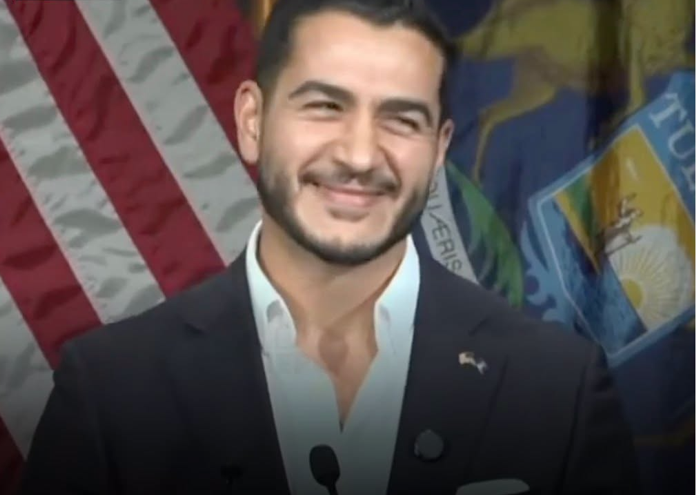
Democrat Abdul El-Sayed has defeated Republican Mike Rogers in Michigan’s closely watched U.S. Senate race, becoming the first Muslim ever elected to the United States Senate.
But his victory speech in Detroit was about more than making history. El-Sayed used the moment to respond directly to President Donald Trump and Vice President JD Vance, who had repeatedly targeted his Muslim faith, questioned his loyalty, and mocked his name during the campaign.
His message to Trump was particularly memorable: after Vance swears him into the Senate in January, Trump can simply call him “Senator.”
1. A Historic Victory in Michigan
The Associated Press called the race for El-Sayed early Wednesday, November 4, after Election Day voting showed him defeating Rogers by approximately seven percentage points, with about 97% of votes counted.
The victory gives Democrats another important Senate seat in a state that has become one of the country’s most closely watched political battlegrounds.
El-Sayed, the son of Egyptian immigrants, was born in Michigan and previously worked as a physician, epidemiologist, and public health official. He had never held elected office before winning the Senate contest.
His campaign focused on Medicare for All, reducing the influence of wealthy donors in politics, and making healthcare and housing more affordable.
Rogers, a former Republican congressman and former FBI agent, had received Trump’s endorsement. He was seeking the open seat being vacated by retiring Democratic Senator Gary Peters.
The election also marked a major breakthrough for progressive Democrats, who supported El-Sayed despite significant opposition spending and divisions within their own party.
2. “My Name Is Abdulrahman Mohamed El-Sayed”
At his Detroit victory celebration, El-Sayed began by proudly introducing himself using his full name.
“My name is Abdulrahman Mohamed El-Sayed,” he told cheering supporters, before saying he was honored to stand before them as Michigan’s senator-elect.
The moment carried particular significance after months of political attacks that focused heavily on his Arabic name and Muslim identity.
Trump had repeatedly referred to El-Sayed by his middle name, Mohamed, while questioning whether a Muslim candidate could be trusted with access to sensitive national security information.
El-Sayed had previously argued that his name and religion were being used to distract voters from issues affecting their everyday lives, including gasoline prices, healthcare, housing, and the cost of groceries.
His election-night remarks transformed that criticism into a direct response to the president.
3. His Message to Trump: “You Can Call Me Senator”
El-Sayed did not stop with introducing himself.
Turning toward Trump, he joked that he knew the president had struggled with his name throughout the campaign.
“Donald, look, I know you struggled with my name,” El-Sayed said. “So after JD swears me in in January, you can just go on and call me Senator.”
The remark drew attention because Trump had repeatedly attacked El-Sayed during Republican campaign appearances.
At an October 25 rally in Port Huron, Michigan, Trump called him a “jihadist Muslim Brotherhood member” and compared the effort to defeat his Senate candidacy with the struggle against the September 11 terrorist attacks.
However, PolitiFact found Trump’s accusation to be false. Its investigation found no evidence that El-Sayed had advocated violent extremism or belonged to the Muslim Brotherhood. El-Sayed had also publicly rejected any association with the organization.
El-Sayed described the attacks during the campaign as an attempt to make voters question his American identity rather than debate his policy proposals.
4. The Awkward Moment for JD Vance
El-Sayed also directed a pointed joke toward Vice President JD Vance, highlighting the irony that Vance would be involved in his eventual Senate swearing-in ceremony.
During the campaign, Vance had criticized El-Sayed’s political positions and questioned his values. The two also clashed publicly over comments involving Vance’s family and his wife, Second Lady Usha Vance.
El-Sayed’s victory speech turned that personal disagreement into a moment of political humor.
There is a technical distinction behind his joke: 2 U.S.C. §21 provides that the President of the Senate administers the oath to senators-elect. The vice president serves as President of the Senate, making Vance the official expected to administer the oath when El-Sayed takes office.
The new senator is scheduled to begin his six-year term in January 2027.
5. A Campaign Marked by Controversy and Division
The Michigan race was among the most contentious Senate contests of the 2026 midterm elections.
El-Sayed faced attacks over his criticism of Israel, his positions on U.S. military assistance to the Israeli government, and his appearances with controversial political commentator Hasan Piker.
His former Democratic primary opponent, Representative Haley Stevens, endorsed Rogers just two days before Election Day, intensifying divisions among Democrats.
Trump and other Republicans also attempted to connect El-Sayed with extremist organizations, although evidence supporting those accusations was not produced.
Despite these controversies, El-Sayed maintained a campaign centered on economic issues and grassroots organizing.
In his victory remarks, he said Michigan voters had rejected what he described as a hateful and spiteful campaign focused on his name and faith rather than the issues facing working families.
6. What His Victory Means for the Senate
El-Sayed’s victory is historic because he will become the first Muslim elected to the U.S. Senate.
It also adds another progressive voice to a Democratic caucus that is preparing to take control of the chamber following the 2026 midterms.
His arrival is expected to bring renewed discussions about universal healthcare, campaign financing, U.S. foreign policy, and American military assistance overseas.
For now, however, El-Sayed’s first major responsibility is preparing to take office and represent Michigan’s residents.
His victory speech sent a message that reached beyond Michigan: a candidate whose name and faith became central targets of a national campaign is now preparing to enter the United States Senate.
And for Trump and Vance, the next time they address him, the title will be different: Senator El-Sayed.



