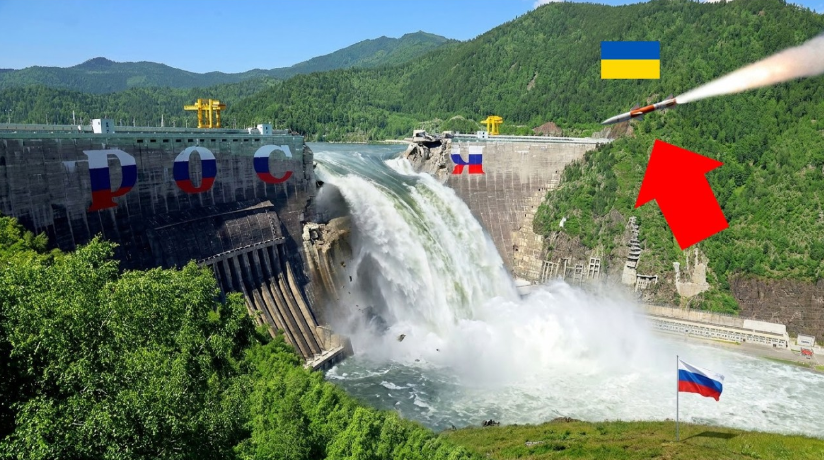
A Ukrainian strike on Russia’s Belgorod Reservoir damaged critical water-control infrastructure, sending water levels falling and threatening Russian military positions along the Siverskyi Donets River. The October 2025 operation became a significant example of how relatively limited damage to strategic infrastructure can create consequences far beyond the original impact site.
A dramatic military documentary circulating about the incident describes a Ukrainian Leleka-100 reconnaissance drone penetrating Russian air defenses, followed by a six-rocket HIMARS attack intercepted by Russian S-400 systems, a Su-35S fighter and Pantsir-S1 defenses.
However, there is an important distinction between the documented attack and the documentary’s reconstruction: the dam damage and its military consequences were confirmed by multiple sources, but the precise six-rocket interception sequence has not been independently verified.
Belgorod Reservoir Becomes a Ukrainian Military Target
The incident emerged on October 24–25, 2025, when reports appeared that Ukrainian forces had struck the Belgorod Reservoir dam in Russia’s Belgorod region.
On October 25, regional Governor Vyacheslav Gladkov confirmed damage to the hydraulic structure. He warned that additional attacks could cause flooding and advised residents in parts of Shebekino and Bezlyudovka to relocate temporarily.
The facility was strategically important because the reservoir and the Siverskyi Donets River form part of the geographical environment in which Russian and Ukrainian forces were operating near the Kharkiv border.
Dam infrastructure can have military consequences beyond its civilian function. Changes in water levels can affect river crossings, defensive positions, supply routes and the movement of ground forces.
HIMARS or Ukrainian Drones: What Actually Hit the Dam?
The weapon used in the initial attack became a subject of disagreement.
On October 25, Russian media reports claimed that three HIMARS rockets had struck the reservoir, damaging technical buildings, a spillway mechanism and sections of the dam crest. However, these early accounts did not independently establish the weapon responsible.
The following day, Ukrainian Unmanned Systems Forces commander Robert Brovdi, known by his callsign Magyar, confirmed that personnel from the 1st Separate Center of the Unmanned Systems Forces had carried out the operation.
Brovdi reported that the reservoir’s water level had fallen by approximately one meter following the strike.
The Conflict Intelligence Team subsequently examined available footage. Its October 27 assessment suggested that drones were involved, based partly on recordings of air-defense activity around the dam. The analysts also cautioned that rockets might have been used alongside unmanned aircraft.
Consequently, the documentary’s specific account of six M31 GMLRS rockets being launched from HIMARS remains an unverified reconstruction.
Russian Air Defenses Face Questions
The documentary describes an elaborate interception sequence involving three Russian defense systems:
-
S-400: Russia’s long-range surface-to-air missile system.
-
Su-35S: A multirole fighter aircraft capable of air-defense missions.
-
Pantsir-S1: A short-range air-defense system designed to engage aerial threats.
The video claims that five of six incoming rockets were intercepted before one reached the dam.
However, available reporting does not independently confirm that sequence, the number of rockets fired or the participation of a Su-35S fighter.
What is established is that Russian forces attempted to defend the facility and that the dam sustained damage. The distinction matters because simulated footage should not be mistaken for verified combat evidence.
Water Levels Fall and Russian Supply Routes Come Under Pressure
The consequences extended beyond the damaged structure.
On October 26, 2025, Ukraine’s 16th Army Corps reported that water began leaking through the damaged dam, affecting Russian military positions near Grafovka and complicating logistics across the Siverskyi Donets River.
Ukrainian military representatives said Russian units operating on the opposite side of the river faced difficulties maintaining their supply routes. The Institute for the Study of War also reported that flooding threatened Russian positions and reduced their operational flexibility.
Russian regional authorities subsequently said the situation had stabilized, although concerns about further damage remained.
The Belgorod Reservoir Was Damaged Again in 2026
The reservoir returned to the headlines in July 2026.
According to Meduza, a section of the dam approximately 30 meters long was reportedly damaged on July 19. Satellite imagery and information from the regional outlet Pepel indicated that water was flowing through the damaged area and that downstream flooding was affecting the Nezhegol River area.
The report relied partly on anonymous sources and satellite analysis, so the full circumstances of the incident remain subject to verification.
One Strike, Wider Military Consequences
The Belgorod Reservoir incident illustrates an important feature of modern warfare: infrastructure can have operational importance beyond its primary civilian purpose.
A damaged dam can alter terrain, complicate military logistics and create serious risks for nearby communities.
The confirmed story is not a verified six-rocket duel between HIMARS and three Russian air-defense systems. It is a Ukrainian operation that damaged a strategically significant reservoir, disrupted Russian military positions and demonstrated the wider consequences of attacks on critical infrastructure.



