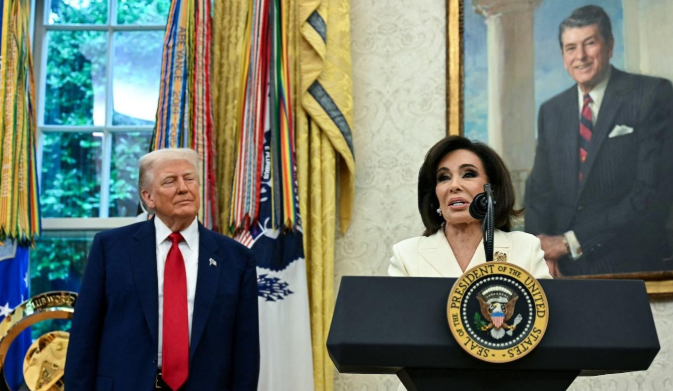
The president’s “folded like an umbrella” attack on his own Washington prosecutor sparked questions about political pressure on the Justice Department. Months later, a judge permanently dismissed the controversial vandalism case that started the dispute.
Updated: November 5, 2026
President Donald Trump returned to the Lincoln Memorial Reflecting Pool on November 2, turning the troubled renovation into the centerpiece of his final midterm campaign message. But the appearance also brought renewed attention to a dispute that once put his handpicked Washington prosecutor, Jeanine Pirro, in the middle of a public clash with the president.
The controversy began after the newly renovated pool developed algae-filled water and sections of its blue lining began to peel. Trump repeatedly blamed vandalism. His administration’s Justice Department, however, later concluded that key damage was linked to flawed installation by the project’s contractor, not deliberate destruction by the people accused.
The case that triggered the dispute involved David Hearn, a former Olympic canoeist. Prosecutors charged Hearn with felony destruction of property, alleging that he had damaged the pool. Hearn pleaded not guilty.
In a court filing seeking to dismiss the indictment, Pirro’s office said it had received additional Interior Department documents only after the grand jury returned the charge. Those records pointed to repeated installation failures and a rushed effort to finish the work before the nation’s July 4, 2026, celebrations.
The filing said the new evidence significantly undermined the basis for the indictment.
Trump’s Public Rebuke and the White House Meeting
The decision angered Trump.
On August 3, he told reporters that Pirro had “choked” under pressure from the judge and “folded like an umbrella.” He said he was disappointed and argued that the damage was vandalism, while Pirro’s office said the evidence pointed to construction problems.
Later that same day, Pirro met with Trump at the White House, ABC News reported, citing sources familiar with the meeting. The gathering came as questions mounted about her future.
On August 4, Trump did not rule out firing her, telling reporters he had not made a determination. ABC also reported that Trump had privately discussed the possibility of removing her with aides, although sources cautioned that no final decision had been made.
The dispute drew attention beyond the personalities involved. A U.S. attorney is responsible for making prosecutorial decisions based on evidence and the law. The public clash raised questions about how an administration should handle disagreements between a president’s political preferences and the independent judgment expected in individual criminal cases.
A Judge Permanently Closes the Case
The legal story did not end when Pirro’s office first moved to dismiss the charge.
The government initially sought dismissal without prejudice, which could have left open the possibility of bringing the case again. Hearn’s lawyers asked the court to make the dismissal permanent.
On October 1, D.C. Superior Court Judge Todd Edelman dismissed the case with prejudice, meaning prosecutors cannot bring the same charge against Hearn again.
In his order, the judge cited the unusual circumstances and the risk that Hearn could face a future prosecution driven by political pressure. The ruling followed the government’s acknowledgment that its new evidence undercut the original allegation.
The decision represented a significant development in a case that had attracted national attention because of Trump’s repeated public comments and his criticism of the prosecutor handling it.
The Controversy Follows Trump Back to the Pool
The reflecting pool remained a focus for Trump even after the court ruling.
On November 2, the day before the midterm elections, he delivered remarks at the site and described the renovation as a success. He again referred to vandalism, even though the Justice Department had dropped the Hearn case and the judge had barred prosecutors from refiling it.
The Associated Press reported that the renovation had run nearly three months behind schedule and cost more than ten times Trump’s original estimate.
Pirro, meanwhile, remains listed as the U.S. attorney for the District of Columbia on the Justice Department’s leadership page, updated October 26. Her position survived the public fallout, at least through that date.
The episode leaves several distinct questions in view: what caused the reflecting pool’s damage, how prosecutors handled the evidence, and how much influence a president should exert over specific criminal cases.
The court has resolved Hearn’s case. The broader debate over the renovation, accountability, and the boundary between political leadership and prosecutorial independence has not disappeared.



