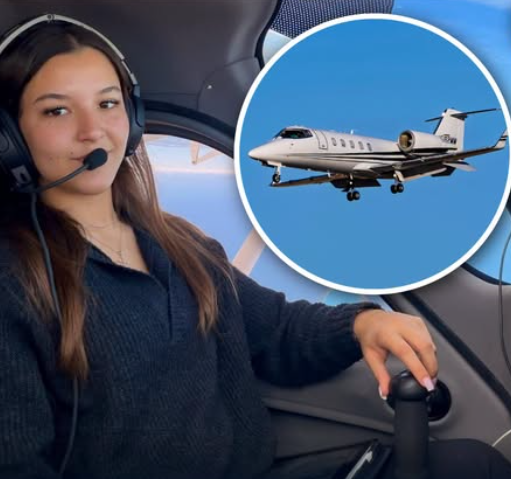
NASA Administrator Jared Isaacman is pushing back against online criticism of a 20-year-old co-pilot killed in a devastating Learjet crash in Florida, saying she continued communicating with air traffic control as the aircraft descended toward the ground.
The young pilot, Nathalia Gadelha Filgueiras, died alongside eight other people when the Learjet 60 crashed in Palm Beach County on November 1, 2026. Following the accident, social media users questioned her age and experience, with some attempting to assign blame before investigators had established what happened.
Isaacman, an experienced pilot with more than 8,000 flight hours, said those accusations were unfair and urged the public to let aviation investigators determine the facts.
Who Was Nathalia Gadelha Filgueiras?
Nathalia was a 20-year-old Boca Raton resident whose family described her as responsible, hardworking and deeply committed to aviation.
According to her stepfather, Thiago Corteleti, she began flying at a young age, obtained her pilot’s license at 17 and trained at American Flyers flight school. Her family told CNN Brasil that she had accumulated more than 1,300 flight hours.
Her mother, Camila Gadelha Corteleti, said her daughter was working when the accident happened.
“She was a very good girl — responsible, hardworking,” she told CNN Brasil. She also emphasized that Nathalia was serving as co-pilot rather than pilot in command.
The distinction is important because the captain, Jeff Gregory, 55, was the pilot responsible for commanding the aircraft.
What Qualifications Does a 20-Year-Old Co-Pilot Need?
Much of the criticism directed at Nathalia focused on her age. However, federal aviation regulations provide a clear framework for determining whether someone can serve as a professional co-pilot.
Under FAA regulations, a commercial pilot certificate cannot be issued before age 18.
For a second-in-command position on a charter flight operated under Part 135, federal rules require at least a commercial pilot certificate with the appropriate aircraft category and class ratings, along with an instrument rating.
Additional requirements cover aircraft-specific familiarity, operational procedures and appropriate training.
The important point is that being 20 years old does not automatically make someone unqualified to serve as a charter co-pilot.
Nathalia’s family reported more than 1,300 flight hours, but her complete FAA certificate and training records have not been publicly released. Those records are among the details that should be assessed through the appropriate investigative and regulatory processes.
What Happened During the Final Flight?
The Learjet 60, registration N722BD, was operated by Aurora Aviation, doing business as Upper Jets.
It departed Austin, Texas, on November 1, bound for North Eleuthera in the Bahamas, with nine people aboard.
According to the NTSB’s preliminary timeline, the crew reported light clear icing and moderate turbulence while cruising at approximately 35,000 feet.
The pilots also reported altitude fluctuations and later requested permission to climb to 37,000 feet after encountering precipitation.
Air traffic control approved the request. Less than 30 seconds later, the aircraft reported a rapid descent, followed by an emergency transmission.
The aircraft crashed near Greenacres in Palm Beach County at approximately 12:50 p.m., killing all nine people aboard.
Investigators Discover Important New Evidence
On November 3, the NTSB revealed that investigators had recovered pieces of the aircraft’s left elevator, a component of the tail that helps control the airplane’s pitch.
The pieces were discovered between 1.3 and 3.8 miles from the main crash site, supporting evidence that the aircraft began breaking apart before reaching the ground.
However, investigators have not determined whether the separation contributed to the loss of control or resulted from the extreme forces experienced during the descent.
Weather remains a major focus, alongside aircraft systems, maintenance records, flight data and communications.
Isaacman Says Online Blame Must Stop
Isaacman’s intervention was particularly significant because he has extensive experience flying similar aircraft.
He said second-in-command pilots are expected to participate in crew resource management and can identify and challenge mistakes when necessary.
But he warned that people watching short recordings of the final emergency communications cannot know everything happening inside the cockpit.
He specifically questioned speculation about possible structural failure, maintenance problems, turbulence and pilot actions.
“Let people investigate, learn, and share the facts,” he urged.
Nathalia’s death deserves compassion, not premature accusations. The investigation must establish what happened before anyone assigns responsibility. For now, the available evidence shows a young professional pilot communicating with air traffic control during an increasingly dangerous emergency.
The nine people aboard never made it to the Bahamas. Their families now face an unimaginable loss while investigators work to understand why the flight ended in tragedy.



