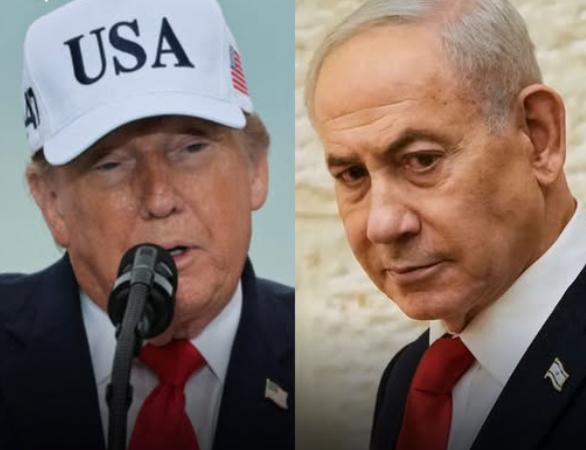
President Donald Trump is facing two major political challenges on opposite sides of the world. In the United States, Democrats won control of both chambers of Congress in the November 3 midterm elections. In Israel, Prime Minister Benjamin Netanyahu’s governing bloc failed to secure a parliamentary majority in the October 27 election.
The two results came just seven days apart, creating new political uncertainty for two leaders who have maintained a close working relationship. But the situations are different: Trump will face a Democratic-controlled Congress beginning in January, while Netanyahu remains prime minister as Israel begins negotiations to form its next government.
1. Democrats Take Control of Congress
The November 3 midterms produced a major shift in Washington. Democrats won control of both the House of Representatives and the Senate, ending unified Republican control of Congress.
The victories included Senate pickups in Iowa, Kansas, Maine, North Carolina, Ohio, South Carolina, and Texas. Some of the most surprising results came in traditionally Republican states, including Texas, where Democrat James Talarico defeated Republican Ken Paxton, and Kansas, where Adam Hamilton defeated incumbent Senator Roger Marshall.
In Maine, Democrat Troy Jackson defeated Republican Senator Susan Collins. In Ohio, former Democratic senator Sherrod Brown defeated Republican Senator Jon Husted. The victories gave Democrats at least 54 Senate seats, with two races still unresolved as vote counting continued.
Democrats also secured a House majority, setting up a divided government for the final two years of Trump’s presidency. The new Congress is scheduled to take office on January 3, 2027.
2. Economic Anxiety and Trump’s Approval Rating
The election results reflected widespread dissatisfaction with the direction of the country.
Early CBS News exit polling placed Trump’s approval rating at 38%, which CBS described as the lowest approval level for a president in a midterm election in its comparison.
The economy was a central concern. Voters reported pressure from the cost of groceries, gasoline, utilities, and other household expenses. CBS’s exit-poll analysis found that the cost of living was a major factor across political parties, alongside concerns about government corruption.
The ongoing war with Iran also became an important political issue. After the election, Trump acknowledged that the conflict and resulting increases in gasoline prices had affected Republican candidates.
Trump rejected the idea that the results represented a personal defeat, saying voters had disliked some of the Republican candidates rather than rejecting him directly.
3. Netanyahu’s Coalition Falls Short in Israel
One week before the American midterms, Israeli voters went to the polls on October 27, 2026, in a parliamentary election with major consequences for Netanyahu’s political future.
The official results left his Likud party with 27 seats in the 120-member Knesset. Together with allied parties, Netanyahu’s bloc secured 53 seats, short of the 61 required for a governing majority.
The opposition bloc led by former Israeli military chief Gadi Eisenkot secured 48 seats. Arab-led parties won a combined 19 seats, their strongest representation in the Knesset to date.
Neither major political bloc emerged with enough seats to govern independently. The Arab-led parties could therefore become important in negotiations, although political disagreements make the formation of a coalition complicated.
The results marked a serious setback for Netanyahu, who has served as Israel’s prime minister for multiple terms and remains one of the country’s most influential political figures.
4. Netanyahu Challenges the Election Claims
Following the vote, Netanyahu and his allies made allegations that Arab-led parties had benefited from election fraud and foreign interference.
Likud even claimed that Arab parties had “stolen” the election. However, Israel’s Central Elections Committee announced on November 4 that its investigation had found no evidence of irregularities that compromised the election’s integrity or affected its results.
A separate Shin Bet investigation into possible foreign interference remains open. Authorities have stressed that suspicions under investigation do not establish that the election outcome was manipulated.
Israeli President Isaac Herzog accepted the certified results on November 4 and began consultations with party representatives to determine who should receive the opportunity to form a government.
The outgoing Netanyahu government remains in office while that process continues.
5. Two Leaders Face Different Political Challenges
The American and Israeli elections do not produce identical consequences, but both demonstrate how electoral setbacks can change the political environment surrounding national leaders.
For Trump, Democratic control of Congress will mean tougher oversight, greater scrutiny of administration decisions, and a more difficult legislative path. Democratic leaders have already discussed investigations, subpoenas, and a new agenda focused on household costs and government accountability.
For Netanyahu, the immediate challenge is building a coalition capable of commanding a majority in the Knesset. President Herzog’s consultations could produce a new governing arrangement, but another election remains possible if negotiations fail.
6. What Happens Next?
The American political transition will begin when the new Congress takes office in January. Until then, Republicans retain their existing congressional majorities.
In Israel, negotiations are already underway. The newly elected Knesset is scheduled to convene on November 10, while coalition discussions continue.
Within seven days, Trump and Netanyahu both faced significant electoral setbacks—but neither leader immediately lost executive power. The consequences will depend on how Washington’s new congressional majority and Israel’s coalition negotiations develop.
The next few months will test Trump’s ability to govern with divided government and Netanyahu’s ability to assemble a parliamentary majority. Both countries are entering politically consequential periods, although their constitutional systems and paths forward are very different.



