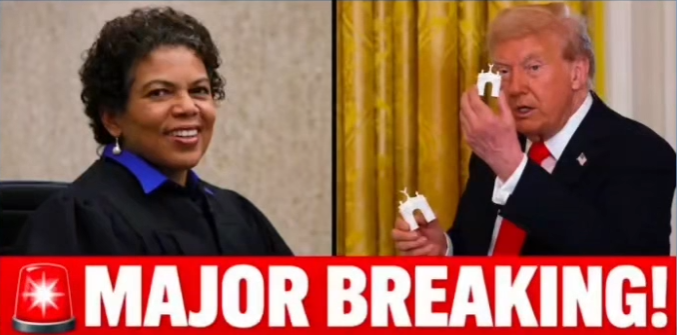
A federal judge has temporarily stopped construction of President Donald Trump’s proposed monumental arch near Arlington National Cemetery, delivering a major setback to the administration’s plans. The 14-day court order came shortly after a key federal commission approved the controversial project in an 8–4 vote.
WASHINGTON, D.C. — November 8, 2026
In a dramatic legal development, a federal judge has temporarily blocked President Donald Trump’s proposed 250-foot triumphal arch in Washington, D.C., just hours after a federal planning commission approved the project.
U.S. District Judge Tanya Chutkan issued the 14-day temporary restraining order on November 5, preventing the Trump administration from beginning construction or site preparation at Memorial Circle.
The decision followed an 8–4 approval vote by the National Capital Planning Commission, which had spent approximately nine and a half hours hearing testimony from supporters and opponents of the controversial monument.
The ruling represents a significant setback for Trump’s plans to place a massive commemorative arch near Arlington National Cemetery.
Why Did Judge Chutkan Stop the Project?
The legal dispute centers on whether the Trump administration has the authority to build the monument without additional congressional authorization.
The District of Columbia and Virginia challenged the project, arguing that the administration had not obtained the necessary legal approval and that construction would create substantial transportation, environmental, and public-safety problems.
Three Vietnam War veterans and other plaintiffs have also pursued a separate legal challenge.
In her November 5 opinion, Chutkan questioned the administration’s reliance on a 1925 law originally connected to the construction of the Arlington Memorial Bridge.
She argued that the century-old legislation did not appear to authorize a completely different project: a 250-foot triumphal arch commemorating America’s independence.
The judge wrote that the government’s interpretation stretched the original law far beyond its apparent purpose.
She also found that Washington and Virginia were likely to succeed on their legal challenge to the government’s approval process.
Importantly, this was a temporary ruling, not a final judgment resolving every question about the project’s legality.
A Monument Planned Near America’s Most Important Memorials
Trump’s proposed arch would stand approximately 250 feet tall near Memorial Circle, across the Potomac River from the Lincoln Memorial and close to the entrance to Arlington National Cemetery.
The proposed structure would be taller than Paris’s famous Arc de Triomphe and would feature a large golden winged figure, decorative sculptures, floodlighting, and an eternal flame.
The administration has described the monument as a tribute to American history, national identity, and military veterans.
However, critics argue that its location could undermine the solemn character of Arlington National Cemetery, disrupt important views, and create serious traffic problems.
Some opponents have also questioned whether the project has received the congressional authorization necessary for construction.
What Happens Next?
The 14-day restraining order means the administration cannot begin construction or related site preparation while the temporary protection remains in effect.
Chutkan also ordered the government to submit a report on November 9 explaining its compliance with the ruling.
The broader lawsuit will continue, and the court must still address the remaining legal questions.
The Trump administration has defended its authority to proceed, relying partly on the interpretation of existing federal laws.
The White House’s vision for a monumental arch is therefore facing an important legal test.
For supporters, the project represents an opportunity to create another landmark honoring America’s history. For opponents, it raises questions about executive authority, congressional approval, historic preservation, and the appropriate use of an important national memorial site.
For now, the construction equipment must stay away.
The proposed arch has received federal planning approval, but a federal judge has made clear that approval alone does not settle the legal battle. The coming court proceedings will determine whether Trump’s ambitious Washington monument can move forward.



