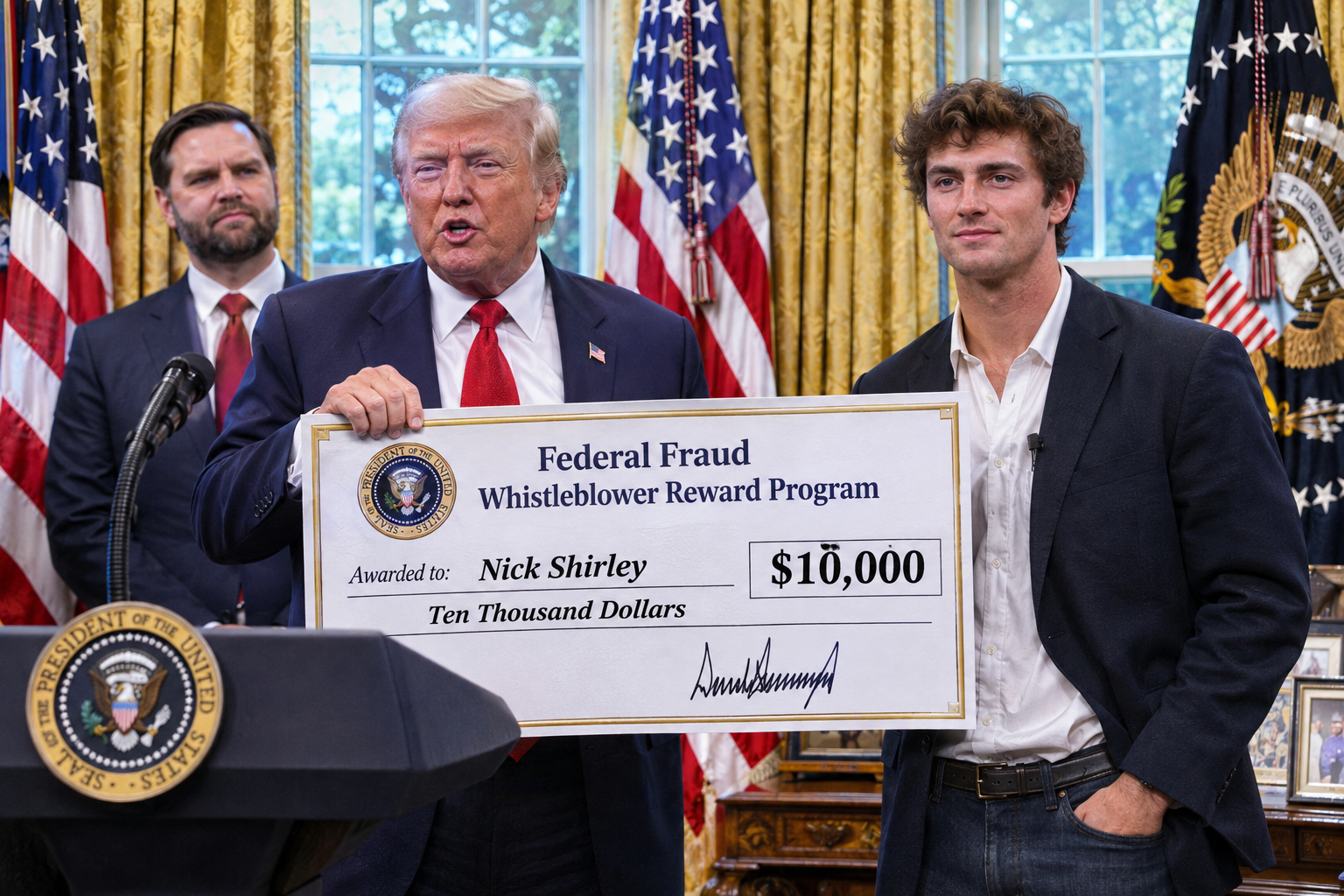
WASHINGTON — President Donald Trump has put a viral Minnesota daycare investigation at the center of a new federal anti-fraud initiative, announcing a $10,000 award for YouTuber Nick Shirley as his administration unveiled a whistleblower program backed by $25 million in Treasury funding.
The October 20 White House announcement, attended by Vice President JD Vance, is intended to encourage Americans to report suspected fraud involving federal programs. But the decision to recognize Shirley has also raised questions about how the new rewards system works—and how much of the viral video’s allegations were actually substantiated.
A New Federal Program Offers Rewards for Fraud Tips
The Justice Department’s Fraud Whistleblower Incentive Program, known as WHIP, offers rewards of $10,000 to $30,000 for qualifying information that leads to criminal charges in covered fraud cases.
The program is administered by the DOJ, with the Treasury Department committing $25 million to support its implementation. Priority areas include hospice care, home health services, daycare and special-services fraud.
There are, however, differences between the administration’s public descriptions. Trump discussed an unlimited 1% commission on recovered funds and said he would arbitrate reward decisions. The DOJ’s published rules instead describe payments of $10,000 to $30,000, determined at the department’s sole discretion.
The White House announced that Shirley would receive $10,000. The Minnesota Star Tribune reported that a check was not handed to him in front of journalists during the October 20 event, and the administration did not publicly explain how he was selected.
What Shirley’s Minnesota Video Actually Found
Shirley posted a roughly 43-minute video in late December 2025, visiting 10 Minnesota daycare centers. He alleged that some facilities were receiving public money without providing childcare services and claimed the businesses had defrauded the state of $111 million. The Star Tribune described that specific figure as unsubstantiated.
State regulators subsequently inspected nine of the centers. They found children present at eight locations; the ninth had not yet opened when inspectors arrived. The tenth center had closed in 2022. CBS News also reviewed licensing and inspection records and found no recorded evidence of fraud in its review of the centers at that time.
One Daycare Owner Later Pleaded Guilty
The story did lead public attention to a facility whose owner later admitted to serious fraud.
In July 2026, Fahima Egeh Mahamud, owner of Future Leaders Early Learning Center, pleaded guilty to wire fraud and conspiracy to defraud the United States. Prosecutors said she obtained approximately $4.6 million through false childcare claims and about $850,000 through fraudulent child-nutrition invoices connected to the Feeding Our Future scheme.
Other Minnesota Medicaid fraud prosecutions involve separate alleged schemes, including a $46.6 million autism-services case. Those cases should not automatically be attributed to Shirley’s video; federal investigations into Minnesota fraud were already underway before it appeared.
A Bigger Debate About Accountability
The new program puts financial incentives behind public fraud reporting, but its credibility will depend on transparent standards, reliable evidence and fair treatment of those accused.
Shirley’s video helped bring national attention to Minnesota’s childcare programs. Yet the inspections, guilty plea and separate prosecutions show why individual cases must be judged on evidence—not viral claims alone.
The central question now is whether the new reward system will produce credible leads and successful prosecutions while protecting the integrity of investigations.



