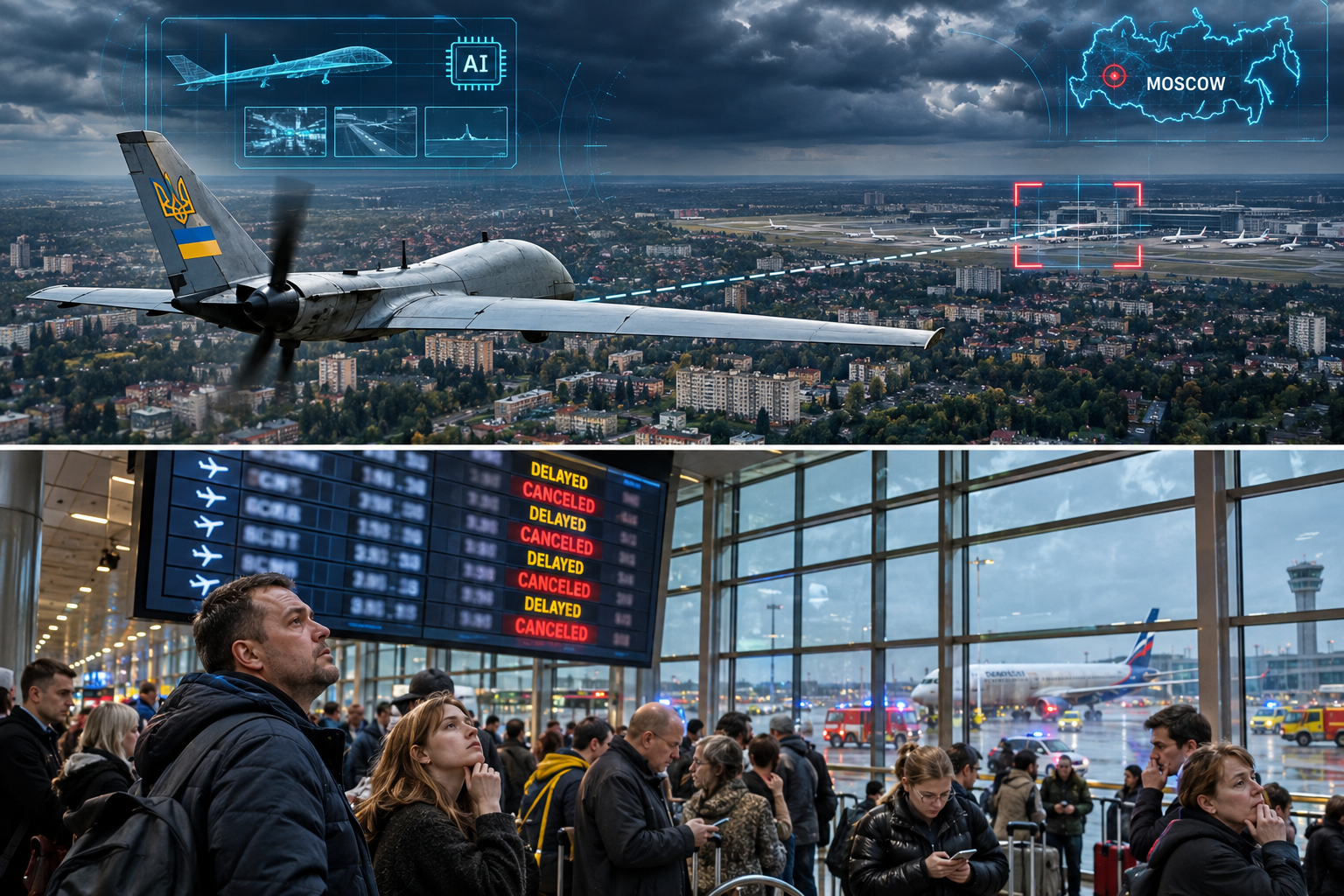
Ukraine is reportedly preparing a major expansion of its long-range drone campaign against Russia, with artificial intelligence-powered weapons potentially capable of targeting airport infrastructure around Moscow. The proposed operation could create unprecedented disruption for Russian aviation, putting pressure on Vladimir Putin’s government while raising serious questions about civilian safety and the future of autonomous warfare.
According to an investigation by The Atlantic journalist Simon Shuster, Ukrainian officials have developed a plan involving large numbers of inexpensive AI-guided drones designed to navigate Russian air defenses and disrupt major airports.
However, there is an important distinction: President Volodymyr Zelenskyy has not authorized the proposed aggressive phase of the operation, according to reporting published October 15.
Operation M&Ms: Ukraine’s Ambitious Drone Strategy
The proposed operation, reportedly code-named M&Ms, was initially presented to Zelenskyy earlier in 2026.
According to two sources familiar with the planning who spoke to The Atlantic, Ukrainian officials wanted to expand the country’s existing long-range campaign beyond oil refineries, military bases and logistics facilities.
The proposal envisioned deploying as many as 1,000 AI-guided drones per night against airport-related targets around Moscow.
Unlike conventional remotely piloted drones, the proposed systems would use onboard artificial intelligence and map-matching technology. They would compare live camera images with stored maps and target photographs to navigate even when Russian electronic warfare interfered with satellite communications.
The concept could reduce dependence on continuous human control and external intelligence support.
But the plan also raised significant legal and humanitarian concerns. An autonomous drone mistakenly identifying a civilian aircraft, passenger terminal or airport worker as a target could produce catastrophic consequences.
Moscow Airports Already Facing Major Disruptions
Even without the proposed AI-powered offensive, Ukrainian drone activity has already created serious problems for Russian aviation.
Between October 3 and October 9, Moscow’s airports reportedly canceled 345 flights and delayed nearly 4,000 more, according to figures cited by Kyiv Post in its coverage of The Atlantic investigation.
On October 10, another 93 flights were canceled and 692 delayed. On October 14, airports reported an additional 124 cancellations and 238 delays.
The disruptions affected Moscow’s four major airports: Sheremetyevo, Domodedovo, Vnukovo and Zhukovsky.
Russian aviation authorities have repeatedly suspended operations when unidentified aerial threats appear. These temporary closures can disrupt thousands of passengers, international connections and cargo movements.
The disruption also affects Russia’s international image. Repeated airport shutdowns could make foreign airlines reconsider the reliability of operating routes into the Russian capital.
Drone Debris Causes Fire at Sochi Airport
The threat has also extended beyond Moscow.
On October 11, debris from an intercepted Ukrainian drone reportedly fell within the grounds of Sochi International Airport, causing a fire in an administrative building.
Russia’s regional emergency authorities said the fire was quickly extinguished and nobody was injured. Debris also reportedly fell on nearby residential properties and hotels.
The incident illustrated how drone interceptions can create secondary risks even when the incoming aircraft is destroyed before reaching its intended destination.
Ukraine’s Attacks Expand Beyond Oil Refineries
Ukraine’s broader campaign is also increasingly targeting Russia’s digital infrastructure.
An Associated Press investigation published in early November documented attacks on five major Russian data-center facilities between October 8 and October 18.
The affected facilities included three operated by technology company Yandex, one associated with Sberbank and another serving VKontakte.
The attacks disrupted cloud services, banking-related operations, online shopping, geolocation and other digital services. Some experts warned that repairs to damaged computing infrastructure could take months or longer.
These attacks suggest that Kyiv is increasingly examining infrastructure that supports Russia’s economy and technological ambitions, not just conventional military installations.
Zelenskyy Faces a Difficult Decision
Despite preparations for a more aggressive airport campaign, Zelenskyy has reportedly remained concerned about the consequences.
According to The Atlantic, he questioned whether such operations could endanger civilian passengers and airport personnel. An official in his office also denied the existence of the proposed AI swarm plan when the original report appeared in August.
The October 15 update stated that Zelenskyy had still not authorized the more aggressive phase.
That distinction matters. The reported proposal should not be confused with an approved operation or evidence that AI-controlled drones are already attacking Moscow’s airport facilities.
The wider conflict also continues to create pressure on Kyiv as Russia launches attacks against Ukrainian residential areas, energy systems and infrastructure.
A New Chapter in Drone Warfare?
Ukraine’s reported plans highlight how artificial intelligence could change the battlefield.
Large numbers of inexpensive autonomous systems could potentially force an opponent to spend substantial resources protecting airports, industrial facilities and transportation networks.
But the same technology raises difficult questions about human control, civilian protection and accountability.
For Putin, the immediate challenge is protecting Russia’s aviation infrastructure from repeated drone-related disruptions. For Zelenskyy, the challenge is deciding how far Ukraine can push its long-range campaign without creating unacceptable risks for civilians.
The technology may already be changing the strategic calculations on both sides, but the most aggressive version of Ukraine’s proposed AI drone campaign remains awaiting presidential approval.



