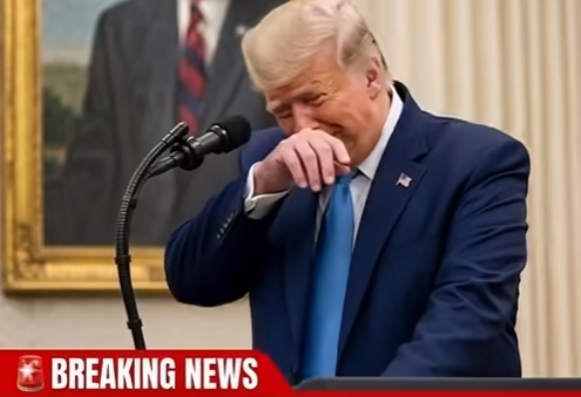
President Donald Trump has intensified his confrontation with American news organizations, calling for NBC journalist Kristen Welker to face possible FCC punishment after criticizing her description of his political endorsement record.
The controversy is now part of a much larger dispute involving ABC, Disney, federal broadcast licenses, and congressional efforts to protect freedom of expression. A proposed bipartisan Senate bill has also advanced, raising questions about whether federal regulators can pressure media companies over journalism and political commentary.
1. Trump’s Threat Against Kristen Welker
The latest controversy began on August 30, 2026, after NBC’s Meet the Press moderator Kristen Welker described Trump’s record of endorsing Republican candidates as having produced “some mixed results.”
Trump strongly rejected that assessment.
In a Truth Social post, he accused Welker of deliberately misrepresenting his political record and announced that she would be reported to the Federal Communications Commission (FCC) for possible “rebuke or punishment.”
He also complained about media polling, writing that the FCC needed to intervene.
The president’s comments attracted immediate attention because the FCC is an independent federal regulatory agency with authority over broadcast licensing and communications rules. It is not, however, a government fact-checking service empowered to punish journalists whenever a president disagrees with their reporting.
NBC News responded by defending its journalist, saying: “Kristen is one of the best in the business and we stand by her.”
2. Why the FCC and the First Amendment Matter
The FCC regulates broadcasting through licenses and requirements established under federal communications law.
However, its authority does not extend to controlling ordinary journalistic judgments simply because officials disagree with a particular story or political opinion.
Section 326 of the Communications Act of 1934 explicitly prohibits the FCC from exercising censorship over radio communications or interfering with free speech through regulatory conditions.
The First Amendment also protects journalists and broadcasters from unconstitutional government retaliation.
The FCC itself has previously stated that replacing broadcasters’ editorial judgment with the commission’s own views would conflict with First Amendment protections.
This does not mean broadcasters are exempt from every regulation. They remain subject to applicable rules covering matters such as political broadcasting, ownership, sponsorship identification, and certain types of prohibited content.
The important distinction is between enforcing legitimate broadcasting requirements and using regulatory authority to punish protected journalism.
3. ABC and Disney Take Their Fight to Federal Court
The dispute has expanded beyond NBC.
ABC and parent company Disney have filed a federal lawsuit challenging the FCC’s unusually early review of broadcast licenses belonging to eight ABC-owned television stations.
The review was ordered in April 2026 by FCC Chairman Brendan Carr, years before the stations’ ordinary license-renewal period scheduled for 2028.
ABC argues that the investigation is retaliation for programming and journalism that angered Trump and administration officials. The company says the prospect of losing licenses creates pressure on broadcasters to change their editorial decisions.
The FCC disputes that interpretation.
The agency says it is investigating potential violations of broadcasting regulations, including allegations involving Disney’s diversity and inclusion practices. Carr has maintained that broadcasters must comply with their public-interest obligations.
On October 6, a federal judge heard arguments from both sides but did not immediately issue a decision.
As of November 5, the lawsuit remained unresolved. Reuters reported on November 3 that no ruling had been issued and that Carr had not decided whether to seek revocation of the stations’ licenses.
4. Congress Advances a Bipartisan Free-Speech Bill
Meanwhile, lawmakers have begun considering legislation intended to protect private companies from government pressure to suppress constitutionally protected expression.
On September 16, 2026, the Senate Commerce Committee approved the JAWBONE Act, introduced by Republican Senator Ted Cruz and Democratic Senator Ron Wyden.
The committee approved the measure 18–10, with three Democratic senators joining Republicans in supporting it.
The proposed legislation would create a legal mechanism allowing individuals to sue federal employees who use government authority to pressure private companies into suppressing protected speech.
Its supporters argue that the federal government should not be allowed to use regulatory threats, official investigations, or other forms of pressure to influence what private platforms and broadcasters permit people to say.
However, the bill has not become law. It still requires approval by the full Senate and House of Representatives before reaching the president.
The legislation reflects concerns shared by lawmakers from both political parties about the possibility of government interference in private communications and media decisions.
5. Another FCC Battle Is Approaching
The controversy is likely to receive additional attention in Washington next week.
The Senate Commerce Committee has scheduled a November 10 confirmation hearing for Trump’s FCC nominee, Danielle Thumann Severs, who previously served as a senior adviser to FCC Chairman Brendan Carr.
Senators are expected to question her about the commission’s treatment of ABC’s broadcast licenses, its regulatory authority, and broader communications policy.
The hearing could become another important forum for examining the relationship between the FCC, the White House, and America’s broadcasting industry.
6. Why This Debate Matters to Americans
The dispute goes beyond one journalist or television network.
Presidents have the right to criticize reporters, challenge inaccurate statements, and publicly defend their political records. News organizations also have a responsibility to correct factual errors and maintain credible reporting standards.
But government regulation introduces a separate constitutional concern.
When broadcasters believe that unfavorable coverage could expose them to investigations, licensing threats, or regulatory penalties, the issue becomes whether government power is influencing editorial independence.
The First Amendment does not protect journalists from criticism. It protects their ability to report and express opinions without unconstitutional government interference.
As the ABC lawsuit continues and Congress considers the JAWBONE Act, the central question facing Washington is whether America’s broadcasting regulations can be enforced without undermining the constitutional freedoms they are supposed to respect.



