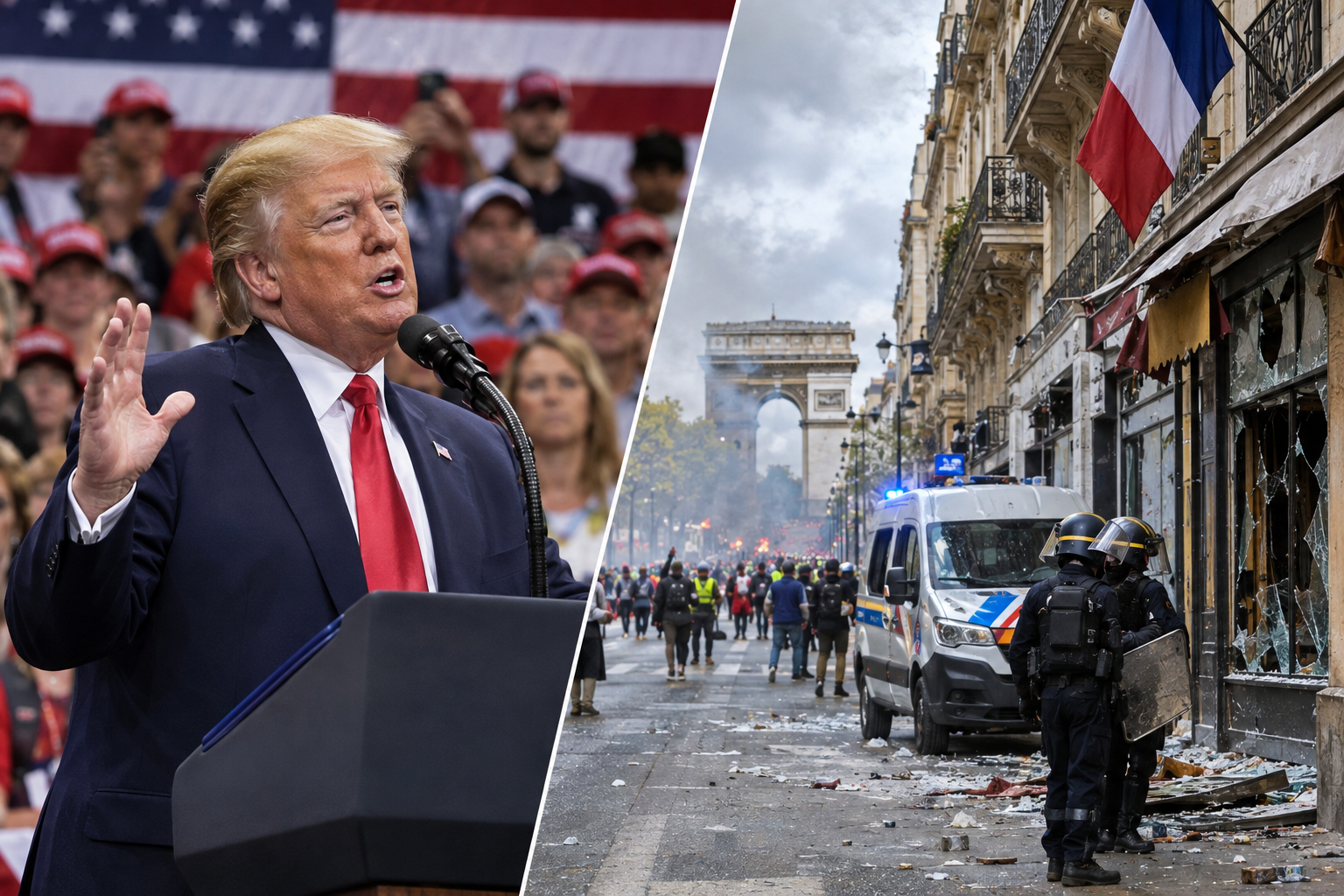
WASHINGTON — President Donald Trump has pointed to France’s violent protests as a warning about immigration, accusing European leaders of allowing policies that he says threaten their countries’ security and cultural identity.
Speaking at a campaign rally in Park City, Kansas, on October 19, Trump argued that France was being damaged by migrants and political extremists. He also said he had warned French President Emmanuel Macron years earlier: “Close your border or you will lose France.”
His comments brought France’s escalating unrest into the American political debate, turning a European crisis into another argument over immigration and border enforcement ahead of the November 3 U.S. midterm elections.
What Trump Said About France
During the rally, Trump described France as a country being “conquered, looted, and burned to the ground by migrants, jihadists and communists who hate Christianity.”
He argued that immigration policies under left-wing European governments had weakened national identity and warned that similar developments could affect the United States.
Trump also urged European countries to close their borders and criticized Macron for failing to take stronger action.
Although some social media posts have attributed the phrase “Paris is becoming a Muslim city” to Trump, that wording does not appear in the October 19 rally transcript reviewed for this article.
France’s Protests Began Over Schools and Living Costs
The unrest in France has a more complicated background than Trump’s description suggests.
According to the Council on Foreign Relations, demonstrations began on September 17, after teachers and students protested staff shortages at a high school near Paris. The movement gradually spread across the country, attracting students, teachers, parents and labor unions.
Protesters raised concerns about overcrowded classrooms, inadequate school facilities, insufficient education funding, rising fuel prices and the increasing cost of living.
Violence escalated dramatically on October 17, when clashes, arson and looting affected Paris, Marseille and Lyon. Reuters reported that approximately 3,000 businesses were ransacked during the unrest surrounding that weekend.
Arrests and Police Response Intensify
French authorities launched a major security operation as the violence spread.
On November 3, Justice Minister Gérald Darmanin said more than 4,900 suspects had been taken into custody since October 17. Of those, approximately 2,290 had been referred for prosecution, while 404 had received prison sentences at that point, Reuters reported.
French officials blamed far-left activists and opportunistic criminals for much of the destruction. However, Reuters reported that police officers and an intelligence official questioned whether far-left groups had played the central role authorities attributed to them.
Most demonstrators were not involved in the violence, and subsequent protests were generally calmer, although clashes continued.
Immigration Debate Reaches Beyond Europe
Trump used the French unrest to reinforce his administration’s arguments for stricter U.S. border enforcement. His remarks came during the final weeks before the November 3 midterms, which have now passed.
But the French demonstrations cannot be explained by immigration alone. Their origins involved education, economic pressure and dissatisfaction with the government, while the violence involved a mixture of groups and circumstances.
The central question is whether France can restore public order while addressing the economic and educational grievances driving the demonstrations—and whether America’s political debate will continue using the crisis as a warning about immigration policy.



