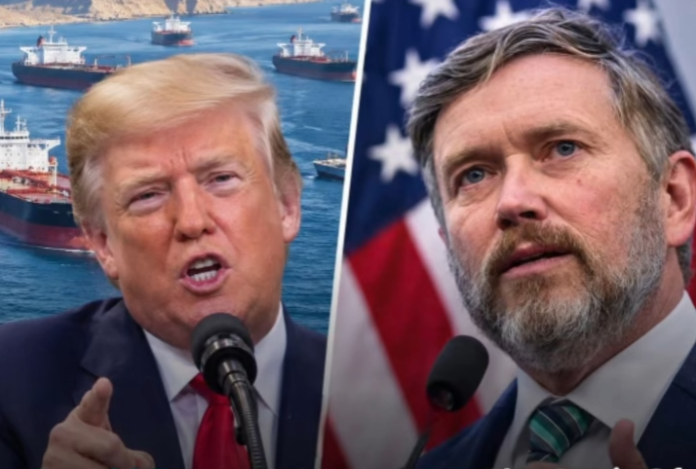
President Donald Trump says the U.S. military restored control of the Strait of Hormuz in approximately two minutes. But shipping through the strategic waterway remains dangerous, commercial vessels continue to face serious threats, and the Pentagon’s latest estimate puts the cost of the Iran war at $47.1 billion through October 16.
Meanwhile, Republican Rep. Thomas Massie has intensified his criticism of the conflict, questioning its strategic value, its financial burden, and Congress’s failure to exercise meaningful oversight.
Massie has also discussed how the war diverted public attention from the Jeffrey Epstein files. Importantly, he said he did not believe the war was deliberately launched to cover up that controversy.
1. Trump’s Two-Minute Claim About the Strait of Hormuz
During a campaign rally in Salina, Kansas, on November 1, Trump told supporters that Iran had previously taken control of the Strait of Hormuz but that American forces had taken it back.
“We took it in about two minutes,” he said, claiming the U.S. Navy now had total control over the strategic waterway.
The statement presented a picture of American military dominance. However, control of the waterway and the restoration of unrestricted commercial shipping are not the same thing.
The Strait of Hormuz remains a major security concern. On November 5, Iran’s Islamic Revolutionary Guard Corps reported that two oil tankers and a tugboat had caught fire in separate incidents involving vessels attempting to navigate routes it considered unauthorized.
The U.S. Maritime Administration continues to warn commercial operators that threats to shipping remain high, including potential attacks involving missiles, drones, and armed vessels.
The Associated Press has also reported that oil shipments have resumed under U.S. Navy escort arrangements. That means the waterway has not simply become completely inaccessible, but safe and unrestricted passage remains an unresolved challenge.
2. Trump’s Threats Against Iranian Bridges and Power Plants
Trump has also made dramatic statements about the speed with which American forces could destroy Iranian infrastructure.
During an April 6 White House news conference, he claimed that the U.S. military could destroy every bridge and power plant in Iran within approximately four hours if he gave the order.
He separately described an operation in which he said he authorized the destruction of Iran’s largest bridge and that the structure was destroyed shortly afterward.
However, the circulating description that Trump specifically promised to destroy key bridges in under an hour and every power plant in less than two hours does not accurately reflect the available transcript.
These statements also raise serious questions about the consequences of attacks on civilian infrastructure, including electricity supplies, transportation networks, hospitals, and essential services.
3. The Iran War’s Cost Has Reached $47.1 Billion
The financial burden is becoming increasingly difficult for Washington to ignore.
According to a Pentagon estimate provided to Congress, the U.S. military had spent approximately $47.1 billion on the Iran conflict through October 16, 2026.
The reported breakdown includes:
- Approximately $29 billion to replace expended ammunition and missiles.
- Around $6.1 billion to replace destroyed or lost military equipment.
- Approximately $11.9 billion in additional operational expenses, including support for deployed forces.
The estimate does not include the full cost of repairing damaged American military bases across the Middle East.
This figure is higher than the approximately $43.6 billion estimate reported in September. It also exceeds the Congressional Budget Office’s earlier estimate of approximately $38 billion in Defense Department costs through August 1, reflecting the different reporting periods and accounting methods.
The CBO warned that continuing the conflict could add another $2 billion to $3 billion per month, depending on the intensity of military operations.
For American taxpayers, the financial implications extend beyond the immediate cost of conducting military operations. Expended missiles and defensive interceptors must also be replaced, potentially affecting military readiness for years.
4. Thomas Massie Challenges the War and Congress
Republican Congressman Thomas Massie of Kentucky has emerged as one of the most outspoken critics of the administration’s Iran policy.
In September, Massie introduced articles of impeachment against Defense Secretary Pete Hegseth, accusing the Pentagon leadership of exceeding its legal authority through military operations.
He also criticized House Speaker Mike Johnson for sending lawmakers home while important questions surrounding the Iran war and the Epstein investigation remained unresolved.
During a House floor speech, Massie said he was trying to obtain justice for Epstein survivors and stop the war.
His criticism focuses on a constitutional question: whether Congress has surrendered too much of its authority over decisions to initiate and continue military conflicts.
Massie argues that lawmakers should not simply approve spending without independently examining the objectives, legal justification, and expected consequences of a war.
5. The Epstein Files: A Distraction, According to Massie
Massie has also connected the Iran conflict with the continuing controversy surrounding the Jeffrey Epstein files.
In a recent interview, he discussed whether the administration could have started the war specifically to distract the public from the Epstein controversy.
Massie rejected that interpretation.
He said he did not believe officials had deliberately planned to launch a war for that purpose. However, he argued that the conflict had the effect of taking public attention away from the Epstein files and the question of accountability.
He also complained that the release of documents had not yet produced the level of accountability he believed was necessary.
His distinction is important: Massie described a possible political consequence of the war, not evidence that the conflict was deliberately created as a cover-up.
6. What Happens Next?
The conflict has now lasted approximately 250 days since February 28, and its future remains uncertain.
Trump has maintained that military action was necessary to prevent Iran from obtaining a nuclear weapon. He has also suggested that additional strikes remain possible if negotiations fail.
Meanwhile, the Strait of Hormuz remains a critical issue for global energy markets, international shipping, and American military strategy.
For Massie and other critics, the central questions concern financial accountability, congressional war powers, and whether the military campaign has achieved its stated objectives.
The contrast is increasingly difficult to ignore: presidential claims of rapid military control, a conflict lasting more than eight months, continued maritime security threats, and an estimated $47.1 billion in military costs.
Americans are now left confronting a fundamental question: how much should the United States spend, and how long should the conflict continue, before the administration can demonstrate a clear and sustainable result?



