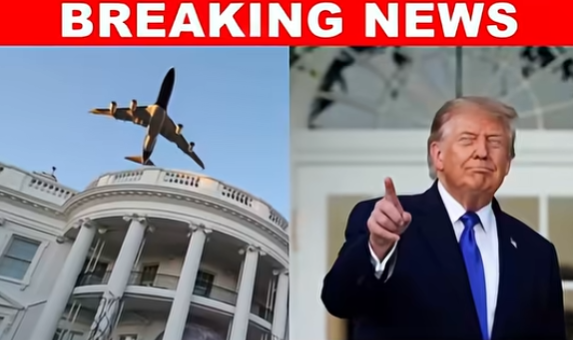
1. A Halloween Surprise Over the White House
The flight took place on Thursday, October 29, 2026, while Trump and First Lady Melania Trump hosted the annual Halloween celebration on the White House South Lawn.
The event welcomed thousands of children and families for trick-or-treating. Trump had discussed the planned aircraft appearance with reporters earlier that day, saying he expected the large presidential aircraft to make a quick flight over the area to entertain the children.
The White House later celebrated the maneuver through its Rapid Response 47 social media account, publishing video of the aircraft flying overhead while Trump and Melania waved from the White House grounds.
The post described it as an “epic Air Force One flyover.”
However, the aircraft was the Qatar-donated Boeing 747-8 intended for interim presidential service. There is also a technical distinction: Air Force One is the radio call sign used by an Air Force aircraft when the president is aboard. In this case, Trump was watching from the ground.
2. Two Passes at Unusually Low Altitudes
The aircraft reportedly made two passes over the White House, at approximately 5:45 p.m. and 5:47 p.m., according to presidential pool reports.
Flight-tracking data reviewed by The Washington Post placed its altitude between approximately 400 and 1,000 feet during the Washington flyover.
The aircraft also passed close to the Washington Monument, which stands approximately 555 feet tall.
These figures attracted attention because Washington has some of the most restricted airspace in the country. Commercial and private aviation movements around the capital are subject to extensive security and air-traffic controls.
The Federal Aviation Administration confirmed that the flyover had been coordinated with the agency. However, the exact altitude authorization and any special approval granted for the operation became central questions after the event.
3. Residents Were Given Little Warning
One of the biggest complaints concerned how little advance notice people received.
The D.C. Council said local residents, the Pentagon, and Ronald Reagan Washington National Airport received only approximately 15 minutes’ notice.
An AlertDC notification was issued at approximately 5:24 p.m., warning that the U.S. military would conduct an aircraft flyover over the National Mall during the following hour.
Airline representatives reportedly received less than an hour’s notice.
For people unfamiliar with the planned event, the sudden appearance of a large four-engine passenger aircraft flying unusually low over the capital was alarming.
Some residents believed an aircraft might be experiencing an emergency. According to The Daily Beast, dispatch recordings captured emergency calls from people concerned about the low-flying jet. A dispatcher subsequently explained that the aircraft was conducting maneuvers.
The Washington Post also reported reactions from residents who described being frightened by the unexpected noise and sight of the aircraft.
4. Reagan National Airport Temporarily Halts Operations
The flyover also affected commercial aviation.
The FAA temporarily stopped traffic at Ronald Reagan Washington National Airport to accommodate the presidential aircraft’s movements.
According to FlightAware figures cited by Reuters, approximately 202 flights were delayed that Thursday. That represented around 26% of departing flights and 17% of arriving flights.
Reuters reported that most of those delays were associated with the airport disruption, although the precise number directly caused by the flyover was not independently established.
For travelers, the incident demonstrated how a relatively brief ceremonial flight in Washington’s restricted airspace could have consequences beyond the White House grounds.
5. White House Defends the Decision
The administration pushed back against criticism, maintaining that the flight was properly coordinated.
A White House spokesperson said the FAA had followed all necessary safety protocols and described the flyover as something that brought excitement to the children attending the Halloween celebration.
The FAA also confirmed coordination with the flight.
However, critics questioned whether a ceremonial appearance justified the disruption, particularly given the limited notice and the sensitivity of Washington’s airspace.
The disagreement is not simply about whether the aircraft was permitted to fly. It concerns the reasons for the low-altitude maneuver, the approvals involved, and whether the public and airport operators received adequate warning.
6. Senator Tammy Duckworth Demands Answers
On November 2, Democratic Senator Tammy Duckworth of Illinois, the ranking member of the Senate Commerce Subcommittee on Aviation, sent letters to the FAA, Pentagon, and White House Office of Management and Budget.
Duckworth described the flyover as a dangerous and unnecessary stunt and requested a complete explanation.
Her questions included who authorized the operation, what its official purpose was, whether it qualified as a military training exercise, and what altitude the FAA approved.
She also requested a detailed accounting of the taxpayer cost, including aviation fuel, aircrew expenses, maintenance, and any additional support.
Duckworth raised another concern: the flyover occurred while the FAA and Pentagon were still working through safety recommendations following the January 29, 2025, collision near Reagan National Airport that killed 67 people.
She argued that aviation safety and coordination should receive sustained attention, especially in the Washington region.
The FAA and Pentagon said they would respond directly to her inquiry. As of November 5, the agencies had not publicly released a complete explanation of the flight’s costs and authorization.
7. The Questions That Remain
The Halloween flyover lasted only a short time, but its consequences have generated a larger debate about presidential privileges, public safety, aviation coordination, and taxpayer spending.
The administration maintains that the flight was properly coordinated and intended to entertain children. Critics want to know why such a low pass was considered necessary and whether the disruption could have been avoided.
The central unanswered questions concern the authorization, approved altitude, public notification, and total cost of the operation.
For Washington residents and travelers, the controversy serves as a reminder that even a ceremonial presidential aircraft movement can affect an entire region when it takes place in one of America’s most sensitive airspaces.



